Vouivria
- Lived
- 159 to 155 million years ago, Late Jurassic
- Diet
- Herbivore
- Group
- Sauropods, Brachiosauridae
- Found in
- France
- Named by
- Mannion et al. 2017
Where its fossils were found
The evidence
Today

155 million years ago
Habitat
Its burial site lay beside a shallow coastal lagoon and tidal flats in what is now France. Woody debris occurs in the surrounding limestone.
Field notes
About Vouivria
What it was like
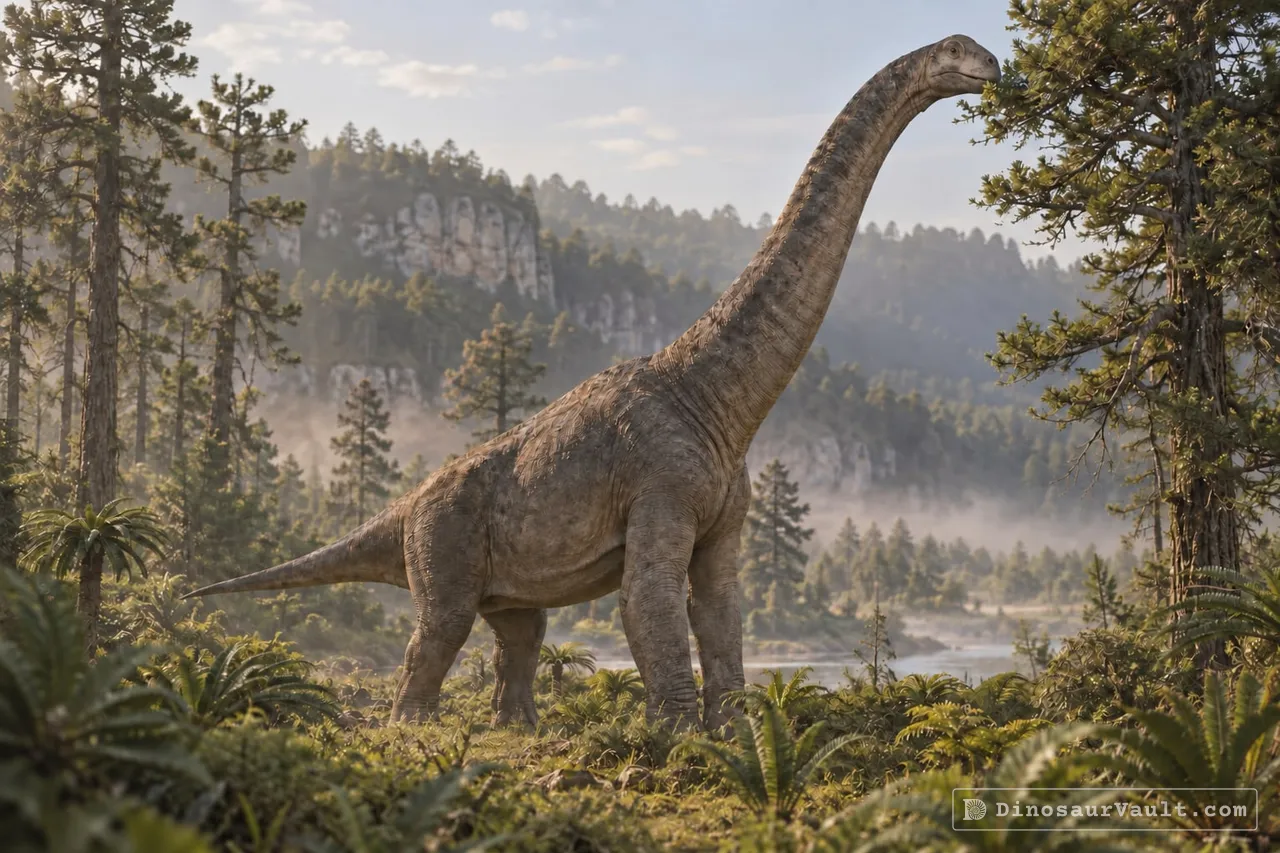
Vouivria was a long-necked sauropod from the brachiosaur family, relatives of Brachiosaurus and Giraffatitan. It is known from a partial skeleton of a young animal.
Its world
It lived about 159 to 155 million years ago, in the Late Jurassic, in what is now France. Europe was then a chain of islands in a warm, shallow sea.
How it was found
The skeleton was found long ago and was long placed in another genus. Mannion and colleagues gave it its own name in 2017. Its name comes from a winged serpent of French legend.
Field gallery
More views of Vouivria
Scenes reconstructed from the available fossil evidence.
The evidence
The science behind Vouivria
Which parts of the picture come from its own bones, and which come from its relatives.
From its own fossils
- The type skeleton preserves teeth, neck and back vertebrae, hip bones and much of the limbs.
- The upper arm bone has an unusually thick ridge where shoulder muscles attached.
- Its hand bones form a partly enclosed column of long palm bones with short finger bones, though the hand is distorted.
Borrowed from relatives
- The missing skull is restored after Europasaurus, and gaps in the backbone after Giraffatitan.
- The missing tips of the foot claws are restored after Camarasaurus.
Still unknown
- The complete shape of its skull.
- Its skin texture, color and changes in body proportions as it grew.
- Whether its lost curved claws belonged to the hands or feet.
Discovery timeline
- 2009Family treeTaylor
- 2013Family treeMannion et al.
- 2017Named itMannion, Allain & Moine
Key papers
The research behind what we know of Vouivria
Family tree
Separated Brachiosaurus and Giraffatitan using differences in their bones and body proportions.
A re-evaluation ofBrachiosaurus altithoraxRiggs 1903 (Dinosauria, Sauropoda) and its generic separation fromGiraffatitan brancai(Janensch 1914). Journal of Vertebrate Paleontology 29: 787-806
Read the paper : A re-evaluation ofBrachiosaurus altithoraxRiggs 1903 (Dinosauria, Sauropoda) and its generic separation fromGiraffatitan brancai(Janensch 1914) (opens in a new tab)Family tree
Described the bones of Lusotitan and tested relationships among the early members of the wider sauropod family that includes Vouivria.
Osteology of the Late Jurassic Portuguese sauropod dinosaurLusotitan atalaiensis(Macronaria) and the evolutionary history of basal titanosauriforms. Zoological Journal of the Linnean Society 168: 98-206
Read the paper : Osteology of the Late Jurassic Portuguese sauropod dinosaurLusotitan atalaiensis(Macronaria) and the evolutionary history of basal titanosauriforms (opens in a new tab)Named it
Redescribed a long-neglected skeleton and identified Vouivria as an early member of the brachiosaur family.
The earliest known titanosauriform sauropod dinosaur and the evolution of Brachiosauridae. PeerJ 5: e3217
Read the paper : The earliest known titanosauriform sauropod dinosaur and the evolution of Brachiosauridae (opens in a new tab)
Close relatives
Other members of Brachiosauridae


Sources: Wikidata