Shixinggia
Type species Shixinggia oblita
- Lived
- 72 to 66 million years ago, Late Cretaceous
- Diet
- Omnivore
- Group
- Theropods, Oviraptoridae
- Found in
- China
- Named by
- Lü and Zhang 2005
Where its fossils were found
The evidence
Today

70 million years ago
Habitat
It lived in a region of rivers and lakes in southern China. Other oviraptorids from the region include Heyuannia, Banji and Corythoraptor.
Field notes
About Shixinggia
What it was like
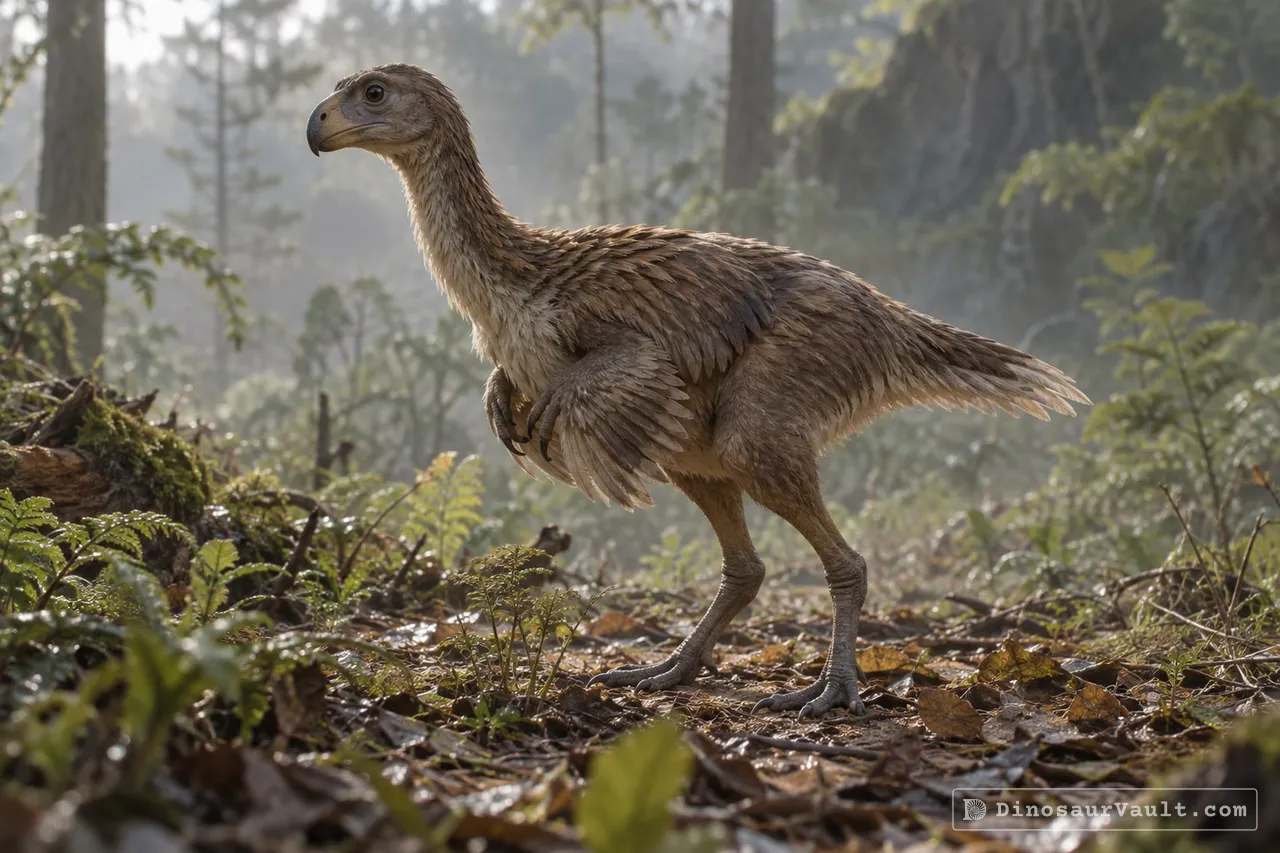
Shixinggia was an oviraptorid known from a partial skeleton that includes hip and leg bones. A toothless beak and feathers are inferred from its relatives.
Its world
It lived about 72 to 66 million years ago, near the end of the Cretaceous, in what is now China. It comes from the Pingling Formation.
How it was found
Lü and Zhang named Shixinggia in 2005. The type species is Shixinggia oblita.
Field gallery
More views of Shixinggia
Scenes reconstructed from the available fossil evidence.
1 of 3
The evidence
The science behind Shixinggia
Which parts of the picture come from its own bones, and which come from its relatives.
From its own fossils
- A partial skeleton includes the hip bones, a thigh bone and a shin bone.
- The hip bone has a short, deep front projection and an arched upper edge. The thigh bone has a large opening near its upper end, and the shin bone a smaller one.
Borrowed from relatives
- Its head, with a short toothless beak, and the build of its neck, body and limbs are restored by comparison with Conchoraptor, a related oviraptorid known from several skeletons.
- A covering of short, soft body feathers is inferred from feathered oviraptorosaurs such as Caudipteryx.
Still unknown
- Its skull, including whether its head carried a crest.
- The foods it ate.
- Its feather color and pattern.
Discovery timeline
- 2005Named itLü & Zhang
- 2013Close relativeLü et al.
- 2017Family treeLü et al.
- 2025Close relativeFoster, Norell & Balanoff
Key papers
The research behind what we know of Shixinggia
Named it
Named Shixinggia from a partial skeleton with distinctive hip bones and openings in the hindlimb bones.
A new oviraptorid (theropod: Oviraptorosauria) from the Upper Cretaceous of the Nanxiong Basin, Guangdong province of southern China. Acta Palaeontologica Sinica 44: 412-422
No link available
Close relative
Named Nankangia and compared the hip bones of southern Chinese oviraptorosaurs, noting the arched upper edge of the Shixinggia hip bone.
A New Oviraptorosaur (Dinosauria: Oviraptorosauria) from the Late Cretaceous of Southern China and Its Paleoecological Implications. PLoS ONE 8: e80557
Read the paper : A New Oviraptorosaur (Dinosauria: Oviraptorosauria) from the Late Cretaceous of Southern China and Its Paleoecological Implications (opens in a new tab)Family tree
Compared Corythoraptor with Shixinggia and other oviraptorids, including differences in their hip and thigh bones.
High diversity of the Ganzhou Oviraptorid Fauna increased by a new “cassowary-like” crested species. Scientific Reports 7
Read the paper : High diversity of the Ganzhou Oviraptorid Fauna increased by a new “cassowary-like” crested species (opens in a new tab)Close relative
Described two new skeletons of Conchoraptor, a small oviraptorid, including its skull, toothless beak, neck, arms, hips and legs.
Two New Specimens of Conchoraptor gracilis (Theropoda: Oviraptorosauria) from the Late Cretaceous of Mongolia. American Museum Novitates 2025: 1-66
Read the paper : Two New Specimens of Conchoraptor gracilis (Theropoda: Oviraptorosauria) from the Late Cretaceous of Mongolia (opens in a new tab)
Close relatives
Other members of Oviraptoridae


Sources: Wikidata