Shingopana
"wide neck"
Type species Shingopana songwensis
- Lived
- 101 to 72 million years ago, Late Cretaceous
- Diet
- Herbivore
- Group
- Sauropods
- Found in
- Tanzania
- Named by
- Gorscak et al. 2017
Where its fossils were found
The evidence
Today

90 million years ago
Habitat
Branching rivers crossed a broad plain in what is now Tanzania. The Galula Formation also contains Rukwatitan and, in older layers, Mnyamawamtuka.
Field notes
About Shingopana
What it was like
Shingopana was a titanosaur, a long-necked, four-legged plant eater, known from part of the neck, ribs, arm and jaw. Its neck bones were broad, which gave it its name in a local African language.
It seems to be more closely related to titanosaurs from South America than to others from Africa.
Its world
It lived in the Late Cretaceous in what is now Tanzania. Its bones come from the Galula Formation, where it shared the land with the titanosaurs Rukwatitan and Mnyamawamtuka.
How it was found
Gorscak and colleagues named Shingopana in 2017, from a single find.
Field gallery
More views of Shingopana
Scenes reconstructed from the available fossil evidence.
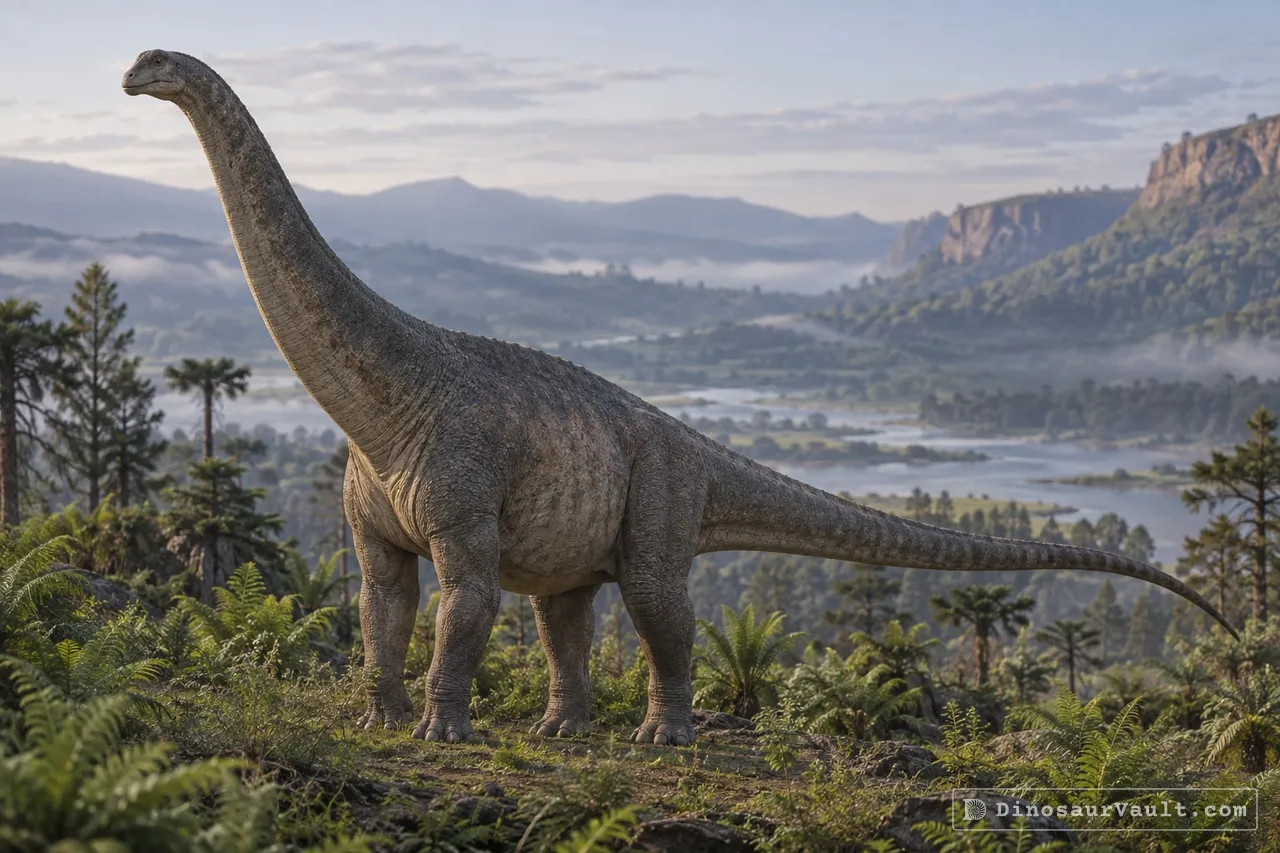
1 of 3
Lived alongside
Found in the same rock formations


A rock formation can hold fossils laid down millions of years apart, so not every animal here met Shingopana.
The evidence
The science behind Shingopana
Which parts of the picture come from its own bones, and which come from its relatives.
From its own fossils
- The partial skeleton includes one bone from the back of the lower jaw, neck vertebrae, neck and back ribs, an upper arm bone and part of the pelvis. Tail vertebrae from the same quarry are not counted as part of it.
- A divided bony strut on its neck vertebrae sets it apart, and one neck vertebra has a swollen spine. Its upper arm bone is flattened, with an oval shaft, and less slender than in Muyelensaurus.
- The back ribs have projecting flanges near their upper ends, a feature also found in Overosaurus.
Borrowed from relatives
- Its missing skull is restored after the titanosaur Tapuiasaurus, and its body, legs, feet and tail after Mnyamawamtuka, an older titanosaur from lower layers of the same formation.
- Its hands follow the compact, column-like hands of sauropods such as Camarasaurus.
Still unknown
- Most of its skull, since only one jaw bone has been found.
- The length of its tail, and its skin covering and color.
- Its exact place among titanosaurs. It has been grouped with aeolosaurs, more broadly with saltasaurs, and in another analysis its position proved unstable.
Discovery timeline
- 2014Same rocksGorscak et al.
- 2017Named itGorscak et al.
- 2019Family treeGorscak & O’Connor
Key papers
The research behind what we know of Shingopana
Same rocks
Described Rukwatitan, another titanosaur from the Galula Formation, with distinctive neck, arm and pelvic bones.
The basal titanosaurianRukwatitan bisepultus(Dinosauria, Sauropoda) from the middle Cretaceous Galula Formation, Rukwa Rift Basin, southwestern Tanzania. Journal of Vertebrate Paleontology 34: 1133-1154
Read the paper : The basal titanosaurianRukwatitan bisepultus(Dinosauria, Sauropoda) from the middle Cretaceous Galula Formation, Rukwa Rift Basin, southwestern Tanzania (opens in a new tab)Named it
Named Shingopana from a partial skeleton and linked its neck and rib anatomy to titanosaurs from South America.
The second titanosaurian (Dinosauria: Sauropoda) from the middle Cretaceous Galula Formation, southwestern Tanzania, with remarks on African titanosaurian diversity. Journal of Vertebrate Paleontology 37: e1343250
Read the paper : The second titanosaurian (Dinosauria: Sauropoda) from the middle Cretaceous Galula Formation, southwestern Tanzania, with remarks on African titanosaurian diversity (opens in a new tab)Family tree
Found that Mnyamawamtuka was a distant relative of Shingopana and Rukwatitan and came from older layers of the Galula Formation.
A new African Titanosaurian Sauropod Dinosaur from the middle Cretaceous Galula Formation (Mtuka Member), Rukwa Rift Basin, Southwestern Tanzania. PLOS ONE 14: e0211412
Read the paper : A new African Titanosaurian Sauropod Dinosaur from the middle Cretaceous Galula Formation (Mtuka Member), Rukwa Rift Basin, Southwestern Tanzania (opens in a new tab)
Close relatives
Other members of Lithostrotia


Sources: Wikidata