Mnyamawamtuka
Type species Mnyamawamtuka moyowamkia
- Lived
- 121 to 94 million years ago, Early Cretaceous to Late Cretaceous
- Diet
- Herbivore
- Group
- Sauropods
- Found in
- Tanzania
- Named by
- Gorscak and O'Connor 2019
Where its fossils were found
The evidence
Today

110 million years ago
Habitat
Rivers split into many channels across a broad sandy plain in Tanzania. The Galula Formation also contains Rukwatitan and Shingopana in younger rocks.
Field notes
About Mnyamawamtuka
What it was like
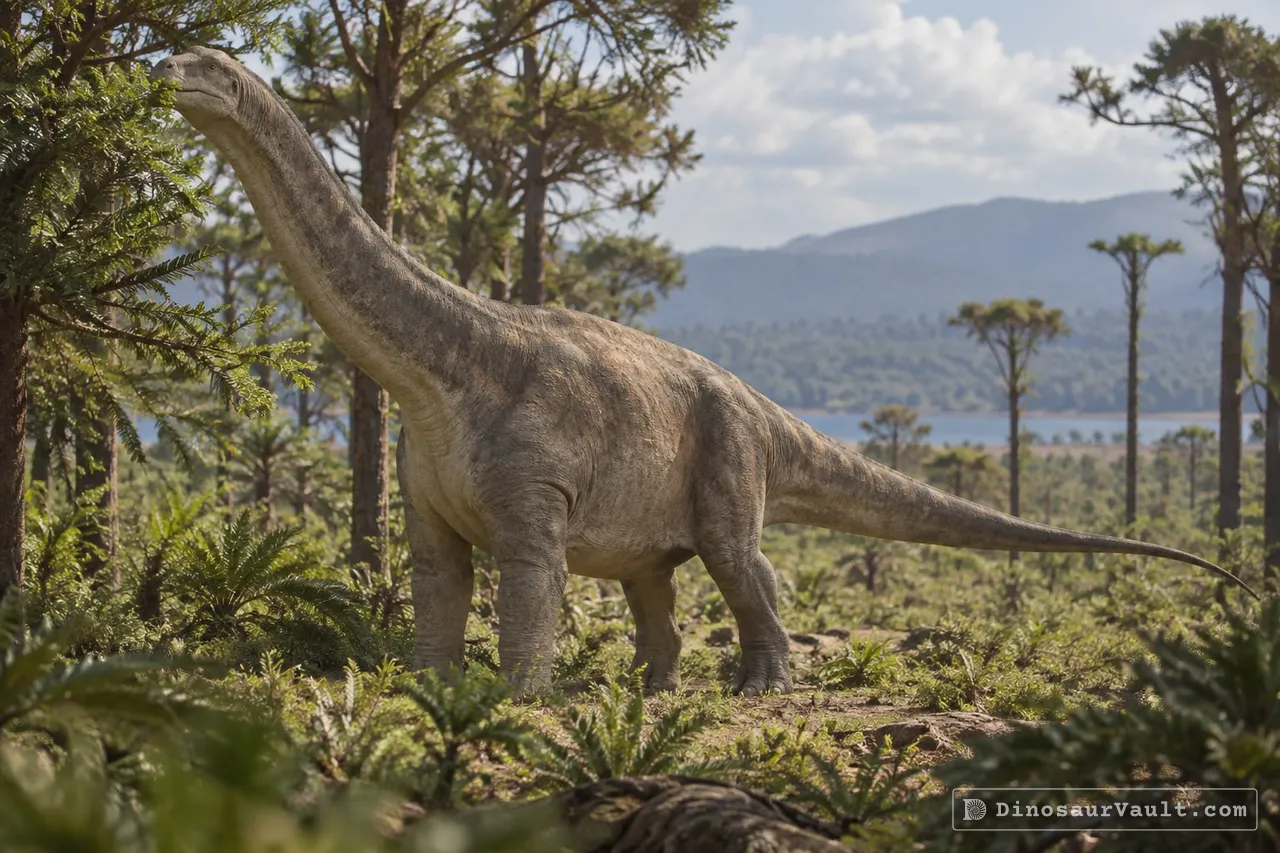
Mnyamawamtuka was a titanosaur, a long-necked plant eater. It is known from a fairly complete skeleton, which is rare for African titanosaurs.
Its world
It lived in the Cretaceous, in what is now Tanzania. It comes from the Galula Formation, where it shared the land with the titanosaurs Rukwatitan and Shingopana.
How it was found
Gorscak and O'Connor named Mnyamawamtuka in 2019. The type species is Mnyamawamtuka moyowamkia. Its name means beast of the river valley where it was found, in a local language.
Field gallery
More views of Mnyamawamtuka
Scenes reconstructed from the available fossil evidence.
Lived alongside
Found in the same rock formations


A rock formation can hold fossils laid down millions of years apart, so not every animal here met Mnyamawamtuka.
The evidence
The science behind Mnyamawamtuka
Which parts of the picture come from its own bones, and which come from its relatives.
From its own fossils
- The skeleton preserves parts of the neck, back, hips and tail, along with shoulder, limb and foot bones.
- Some middle tail vertebrae have heart-shaped rear faces.
- The innermost toe claw is sickle-shaped; another claw is smaller, stouter and less strongly sickle-shaped.
Borrowed from relatives
- Tapuiasaurus provides a comparison for the missing face and skull.
- Apatosaurus provides a comparison for the missing finger bones, and Mendozasaurus for the general build of the body and upright hand.
Still unknown
- The shape of its complete skull and its full finger and toe anatomy.
- Its fully grown size and body proportions, and its closest relatives: a later study places it in different spots on the family tree depending on how traits are weighted.
- Its skin covering and color.
Discovery timeline
- 2010Its worldRoberts et al.
- 2017Same rocksGorscak et al.
- 2019Named itGorscak & O’Connor
Key papers
The research behind what we know of Mnyamawamtuka
Its world
Studied the sedimentary rocks of Tanzania, establishing the river environments that later yielded Mnyamawamtuka.
Sedimentology and depositional environments of the Red Sandstone Group, Rukwa Rift Basin, southwestern Tanzania: New insight into Cretaceous and Paleogene terrestrial ecosystems and tectonics in sub-equatorial Africa. Journal of African Earth Sciences 57: 179-212
Read the paper : Sedimentology and depositional environments of the Red Sandstone Group, Rukwa Rift Basin, southwestern Tanzania: New insight into Cretaceous and Paleogene terrestrial ecosystems and tectonics in sub-equatorial Africa (opens in a new tab)Same rocks
Described Shingopana from the Galula Formation and linked it with South American titanosaurs.
The second titanosaurian (Dinosauria: Sauropoda) from the middle Cretaceous Galula Formation, southwestern Tanzania, with remarks on African titanosaurian diversity. Journal of Vertebrate Paleontology 37: e1343250
Read the paper : The second titanosaurian (Dinosauria: Sauropoda) from the middle Cretaceous Galula Formation, southwestern Tanzania, with remarks on African titanosaurian diversity (opens in a new tab)Named it
Described the skeleton and its heart-shaped tail vertebrae, and linked Mnyamawamtuka with the early branches of the titanosaur family tree.
A new African Titanosaurian Sauropod Dinosaur from the middle Cretaceous Galula Formation (Mtuka Member), Rukwa Rift Basin, Southwestern Tanzania. PLOS ONE 14: e0211412
Read the paper : A new African Titanosaurian Sauropod Dinosaur from the middle Cretaceous Galula Formation (Mtuka Member), Rukwa Rift Basin, Southwestern Tanzania (opens in a new tab)
Close relatives
Other members of Titanosauria


Sources: Wikidata