Schleitheimia
Type species Schleitheimia schutzi
- Lived
- 227 to 206 million years ago, Late Triassic
- Found in
- Switzerland
- Named by
- Rauhut et al. 2020
Where its fossils were found
The evidence
Today

220 million years ago
Habitat
The Klettgau Formation records muddy lowlands in Late Triassic Switzerland. Its dinosaur fauna includes Plateosaurus and the meat eater Notatesseraeraptor.
Field notes
About Schleitheimia
What it was like
Schleitheimia was an early relative of the giant sauropods, a plant eater known from part of a hip and some other bones. It may have been one of the first in its line to walk on four legs.
Its world
It lived in the Late Triassic in what is now Switzerland. Its bones come from the Klettgau Formation, where Plateosaurus and the predator Notatesseraeraptor also lived.
How it was found
Rauhut and colleagues named it in 2020. The type species is Schleitheimia schutzi. It is named after a nearby village.
Field gallery
More views of Schleitheimia
Scenes reconstructed from the available fossil evidence.
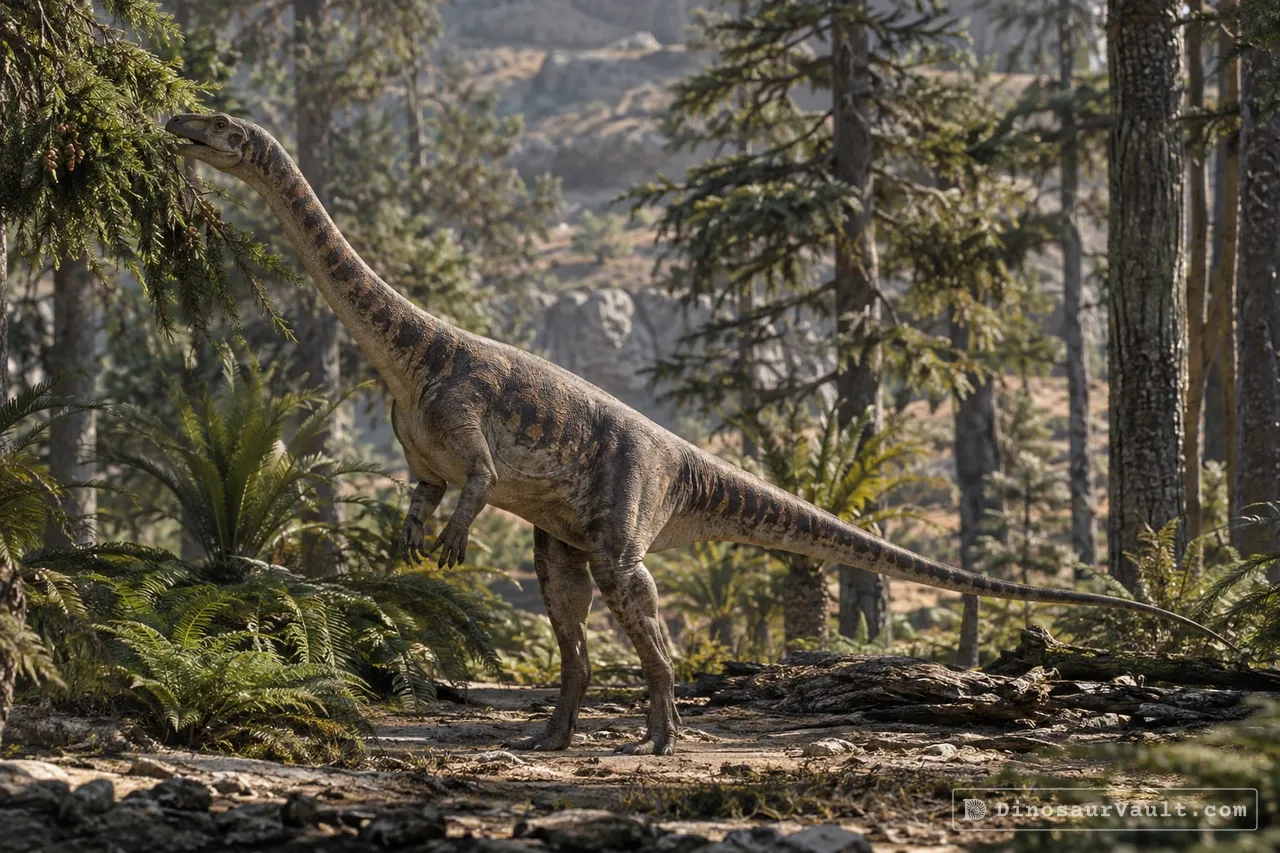
1 of 3
Lived alongside
Found in the same rock formations


A rock formation can hold fossils laid down millions of years apart, so not every animal here met Schleitheimia.
The evidence
The science behind Schleitheimia
Which parts of the picture come from its own bones, and which come from its relatives.
From its own fossils
- The type specimen is part of a right hip bone with an unusual rounded shelf on its inner side and an enlarged ridge toward the back.
- Bones found with it, probably from the same animal, include vertebrae, the lower end of a massive left upper arm bone with a flattened shaft, and pieces of a robust thigh bone with a strong crest for the tail muscles.
- A nearly complete right upper arm bone with a stout shaft, and a flat, only slightly curved claw from the first toe, are assigned to it tentatively.
Borrowed from relatives
- The missing head follows the skulls of Plateosaurus and other early sauropodomorphs.
- The neck, chest, shoulders and upper arms are compared with Antetonitrus, another early relative of the sauropods.
- Its hip and limb bones place it closer to sauropods than Plateosaurus.
Still unknown
- The shape of its skull and teeth.
- Its complete body proportions and walking posture.
- Exactly where it sits among the early relatives of sauropods. The answer changes with how the analysis is weighted and which bones are counted as its own.
Discovery timeline
- 1992Its worldSander
- 2019Same rocksZahner & Brinkmann
- 2020Named itRauhut, Holwerda & Furrer
Key papers
The research behind what we know of Schleitheimia
Its world
Compared Plateosaurus bonebeds and concluded that heavy animals became trapped in floodplain mud.
The Norian Plateosaurus bonebeds of central Europe and their taphonomy. Palaeogeography, Palaeoclimatology, Palaeoecology 93: 255-299
Read the paper : The Norian Plateosaurus bonebeds of central Europe and their taphonomy (opens in a new tab)Same rocks
Named Notatesseraeraptor, a meat-eating dinosaur from the same formation, and examined its place in early theropod evolution.
A Triassic averostran-line theropod from Switzerland and the early evolution of dinosaurs. Nature Ecology & Evolution 3: 1146-1152
Read the paper : A Triassic averostran-line theropod from Switzerland and the early evolution of dinosaurs (opens in a new tab)Named it
Recognized a robust sauropod relative among bones previously assigned to Plateosaurus and named Schleitheimia.
A derived sauropodiform dinosaur and other sauropodomorph material from the Late Triassic of Canton Schaffhausen, Switzerland. Swiss Journal of Geosciences 113
Read the paper : A derived sauropodiform dinosaur and other sauropodomorph material from the Late Triassic of Canton Schaffhausen, Switzerland (opens in a new tab)
Close relatives
Other members of Sauropodiformes


Sources: Wikidata