Gongxianosaurus
Type species Gongxianosaurus shibeiensis
- Lived
- 184 to 175 million years ago, Early Jurassic
- Found in
- China
- Named by
- He et al. 1998
Where its fossils were found
The evidence
Today

180 million years ago
Habitat
Lakes lay within the landscape recorded by the Ziliujing Formation, with ferns, cycads, horsetails and conifers growing around them. Other dinosaurs from the formation include Sanpasaurus and Qianlong.
Field notes
About Gongxianosaurus
What it was like
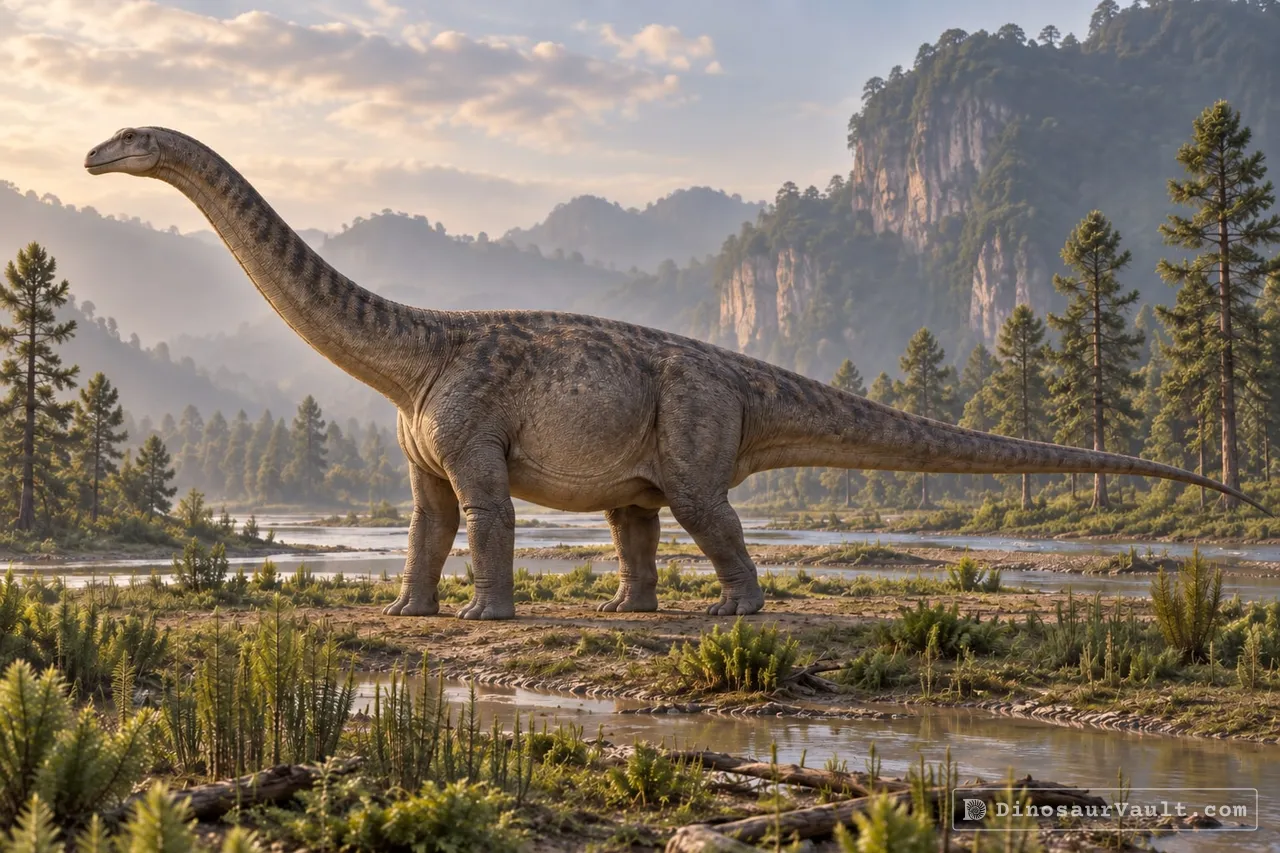
Gongxianosaurus was an early relative of the sauropods, a long-necked plant eater that walked on four legs. Several specimens are known, and some scientists see it as one of the earliest true sauropods.
Its world
It lived in the Early Jurassic, in what is now China. It comes from the Ziliujing Formation.
How it was found
He and colleagues named Gongxianosaurus in 1998. The type species is Gongxianosaurus shibeiensis.
Field gallery
More views of Gongxianosaurus
Scenes reconstructed from the available fossil evidence.
1 of 3
Lived alongside
Found in the same rock formations


A rock formation can hold fossils laid down millions of years apart, so not every animal here met Gongxianosaurus.
The evidence
The science behind Gongxianosaurus
Which parts of the picture come from its own bones, and which come from its relatives.
From its own fossils
- Much of the skeleton is preserved, along with an incomplete skull.
- Its bones combine features of early long-necked plant eaters with those of true sauropods.
Borrowed from relatives
- Much of the body is known from its own bones; missing parts of the skull follow comparisons with early sauropods such as Tazoudasaurus.
Still unknown
- The full shape of its head.
- Its skin color and pattern.
- How it grew from a hatchling into an adult.
Discovery timeline
- 1998Named itHe et al.
- 2000Family treeYaonan & Changsheng
- 2014Family treeMcPhee et al.
Key papers
The research behind what we know of Gongxianosaurus
Named it
Named Gongxianosaurus from fossils of an early long-necked plant eater in China.
[A new species of sauropod from the Early Jurassic of Gongxian Co., Sichuan]. A new species of sauropod from the Early Jurassic of Gongxian Co., Sichuan 18(1):1-6.
No link available
Family tree
Described well-preserved bones and an incomplete skull, showing a mixture of early sauropodomorph and sauropod features.
A New Sauropod, Gongxianosaurus, from the Lower Jurassic of Sichuan, China. Acta Geologica Sinica - English Edition 74: 132-136
Read the paper : A New Sauropod, Gongxianosaurus, from the Lower Jurassic of Sichuan, China (opens in a new tab)Family tree
Placed Gongxianosaurus close to true sauropods while tracing the shift toward limbs built to carry greater weight.
The complete anatomy and phylogenetic relationships ofAntetonitrus ingenipes(Sauropodiformes, Dinosauria): implications for the origins of Sauropoda. Zoological Journal of the Linnean Society 171: 151-205
Read the paper : The complete anatomy and phylogenetic relationships ofAntetonitrus ingenipes(Sauropodiformes, Dinosauria): implications for the origins of Sauropoda (opens in a new tab)
Close relatives
Other members of Sauropodiformes


Sources: Wikidata