Notatesseraeraptor
Type species Notatesseraeraptor frickensis
- Lived
- 227 to 206 million years ago, Late Triassic
- Diet
- Carnivore
- Group
- Theropods
- Found in
- Switzerland
- Named by
- Zahner and Brinkmann 2019
Where its fossils were found
The evidence
Today

220 million years ago
Habitat
It probably lived on a floodplain in what is now Switzerland. The Klettgau Formation also records Plateosaurus, Liliensternus and Schleitheimia.
Field notes
About Notatesseraeraptor
What it was like
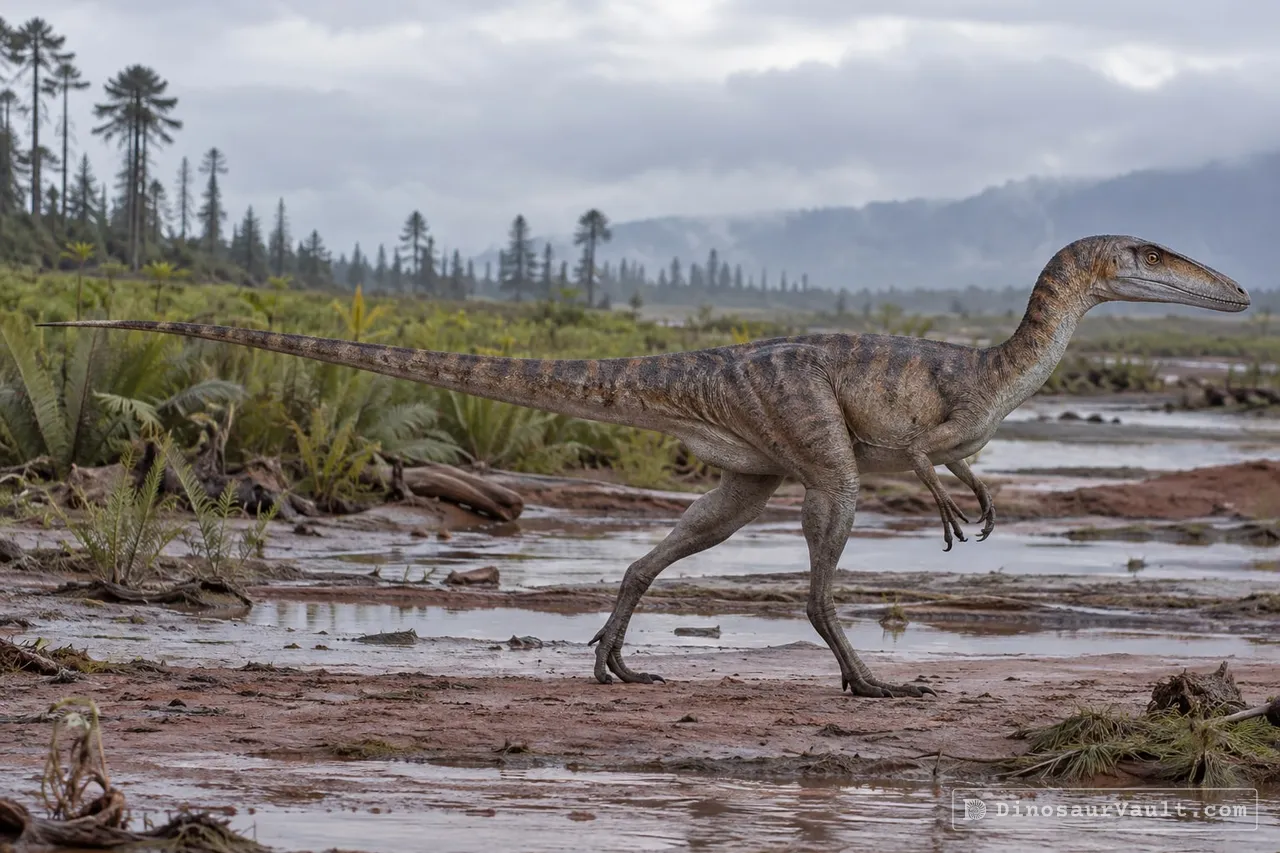
Notatesseraeraptor was a two-legged meat eater. Its skull and skeleton show a mix of features, some like Coelophysis and others like Dilophosaurus, which gave it its name.
Its world
It lived in the Late Triassic, in what is now Switzerland. It comes from the Klettgau Formation, where it lived beside the large plant eater Plateosaurus.
How it was found
Zahner and Brinkmann named Notatesseraeraptor in 2019. The type species is Notatesseraeraptor frickensis.
Field gallery
More views of Notatesseraeraptor
Scenes reconstructed from the available fossil evidence.
1 of 3
Lived alongside
Found in the same rock formations


A rock formation can hold fossils laid down millions of years apart, so not every animal here met Notatesseraeraptor.
The evidence
The science behind Notatesseraeraptor
Which parts of the picture come from its own bones, and which come from its relatives.
From its own fossils
- A nearly complete skull has a long, low snout and slender lower jaws.
- The arms are long, with hands carrying three main fingers and a much smaller outer finger.
- Low ridges border parts of the snout and eye region.
Borrowed from relatives
- The missing neck, hind legs and full tail are restored using early theropods such as Dilophosaurus.
Still unknown
- The appearance of a fully grown adult.
- The exact shape of its feet and the length of its tail.
- Its skin covering and color.
Discovery timeline
- 2019Named itZahner & Brinkmann
- 2020Close relativeMarsh & Rowe
- 2020Same rocksRauhut, Holwerda & Furrer
Key papers
The research behind what we know of Notatesseraeraptor
Named it
Described the skull and partial skeleton, revealing a mix of features found in different branches of early meat-eating dinosaurs.
A Triassic averostran-line theropod from Switzerland and the early evolution of dinosaurs. Nature Ecology & Evolution 3: 1146-1152
Read the paper : A Triassic averostran-line theropod from Switzerland and the early evolution of dinosaurs (opens in a new tab)Close relative
Described Dilophosaurus in detail, providing comparisons for the missing neck, legs and tail of Notatesseraeraptor.
A comprehensive anatomical and phylogenetic evaluation of Dilophosaurus wetherilli (Dinosauria, Theropoda) with descriptions of new specimens from the Kayenta Formation of northern Arizona. Journal of Paleontology 94: 1-103
Read the paper : A comprehensive anatomical and phylogenetic evaluation of Dilophosaurus wetherilli (Dinosauria, Theropoda) with descriptions of new specimens from the Kayenta Formation of northern Arizona (opens in a new tab)Same rocks
Named Schleitheimia and showed that the plant-eating dinosaurs of the Klettgau Formation included more than Plateosaurus.
A derived sauropodiform dinosaur and other sauropodomorph material from the Late Triassic of Canton Schaffhausen, Switzerland. Swiss Journal of Geosciences 113
Read the paper : A derived sauropodiform dinosaur and other sauropodomorph material from the Late Triassic of Canton Schaffhausen, Switzerland (opens in a new tab)
Close relatives
Other members of Neotheropoda


Sources: Wikidata