Leonerasaurus
- Lived
- 193 to 184 million years ago, Early Jurassic
- Found in
- Argentina
- Named by
- Pol et al. 2011
Where its fossils were found
The evidence
Today

190 million years ago
Habitat
Lakes in what is now Argentina, with nearby volcanic eruptions sending ash into the water. Its bones were buried in lake deposits of the Las Leoneras Formation.
Field notes
About Leonerasaurus
What it was like
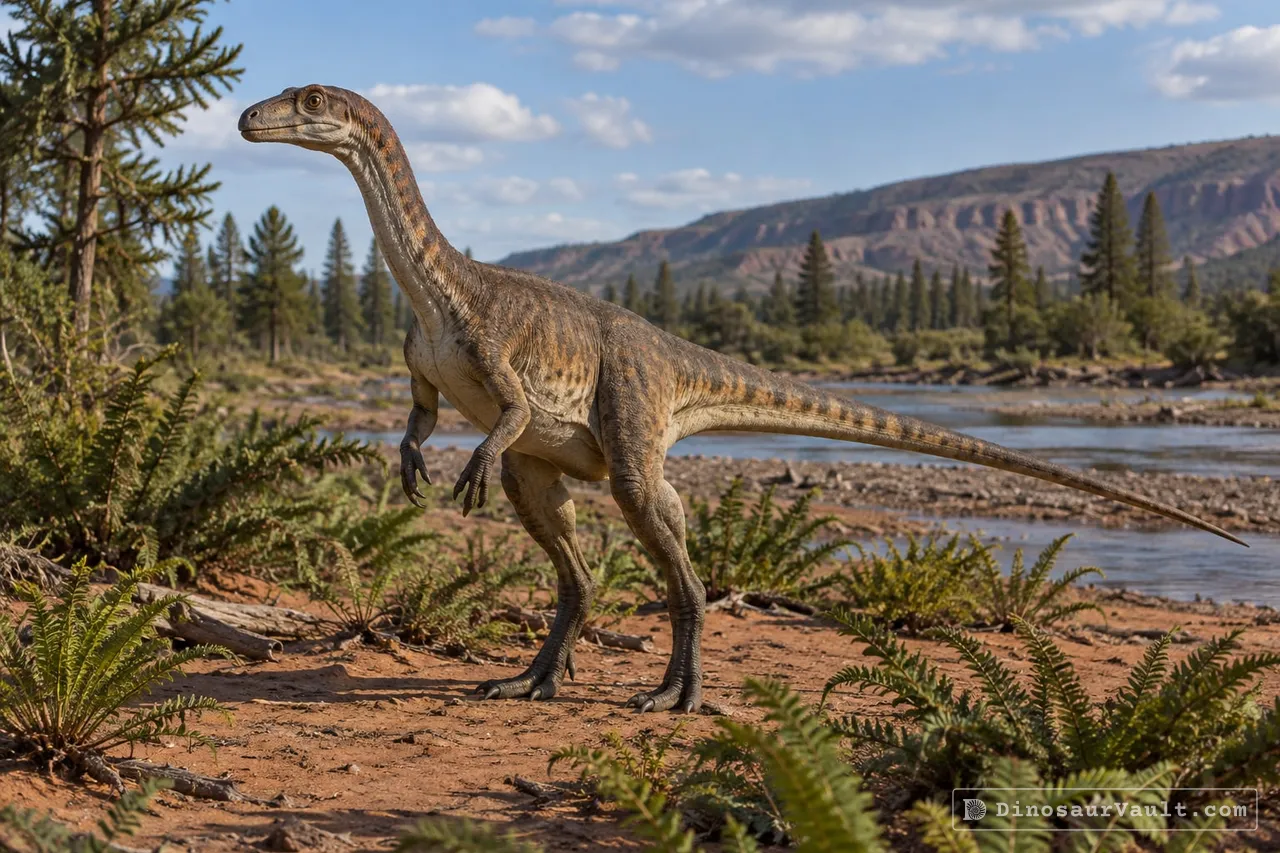
Leonerasaurus was a small, early relative of the sauropods, a plant eater with a long neck. It is known from part of one skeleton of a young animal. Its hips show features of sauropods, while other bones look more primitive.
Its world
It lived in the Early Jurassic, in what is now Argentina. It comes from the Las Leoneras Formation.
How it was found
Pol and colleagues named Leonerasaurus in 2011.
Field gallery
More views of Leonerasaurus
Scenes reconstructed from the available fossil evidence.
1 of 3
The evidence
The science behind Leonerasaurus
Which parts of the picture come from its own bones, and which come from its relatives.
From its own fossils
- Part of a single skeleton preserves the front of the lower jaw, teeth, neck and back vertebrae, hips and parts of the limbs.
- The front teeth have low, spoon-shaped crowns without serrated edges.
- The backbone's attachment to the hips resembles that of early sauropods, despite the animal's small body.
Borrowed from relatives
- Plateosaurus provides a comparison for the missing upper face and grasping hands.
Still unknown
- The shape of its upper skull and the complete arrangement of its fingers and toes.
- How often it walked on its hind legs or on all fours.
- Its skin covering and color.
Discovery timeline
- 2011Named itPol, Garrido & Cerda
- 2021Close relativeLallensack et al.
Key papers
The research behind what we know of Leonerasaurus
Named it
Named a small sauropod relative whose hip vertebrae show that a sauropod-like backbone developed before the group's great increase in body size.
A New Sauropodomorph Dinosaur from the Early Jurassic of Patagonia and the Origin and Evolution of the Sauropod-type Sacrum. PLoS ONE 6: e14572
Read the paper : A New Sauropodomorph Dinosaur from the Early Jurassic of Patagonia and the Origin and Evolution of the Sauropod-type Sacrum (opens in a new tab)Close relative
Documented skull variation in Plateosaurus, a comparison for restoring the missing upper face of Leonerasaurus.
New skulls of the basal sauropodomorph Plateosaurus trossingensis from Frick, Switzerland: is there more than one species? Acta Palaeontologica Polonica 66
Read the paper : New skulls of the basal sauropodomorph Plateosaurus trossingensis from Frick, Switzerland: is there more than one species? (opens in a new tab)
Close relatives
Other members of Sauropodiformes


Sources: Wikidata