Camelotia
"from Camelot"
Type species Camelotia borealis
- Lived
- 206 to 201 million years ago, Late Triassic
- Found in
- United Kingdom
- Named by
- Galton 1985
Where its fossils were found
The evidence
Today

200 million years ago
Habitat
It lived in southwestern England during the latest Triassic, when shallow seas were spreading across the region.
Field notes
About Camelotia
What it was like
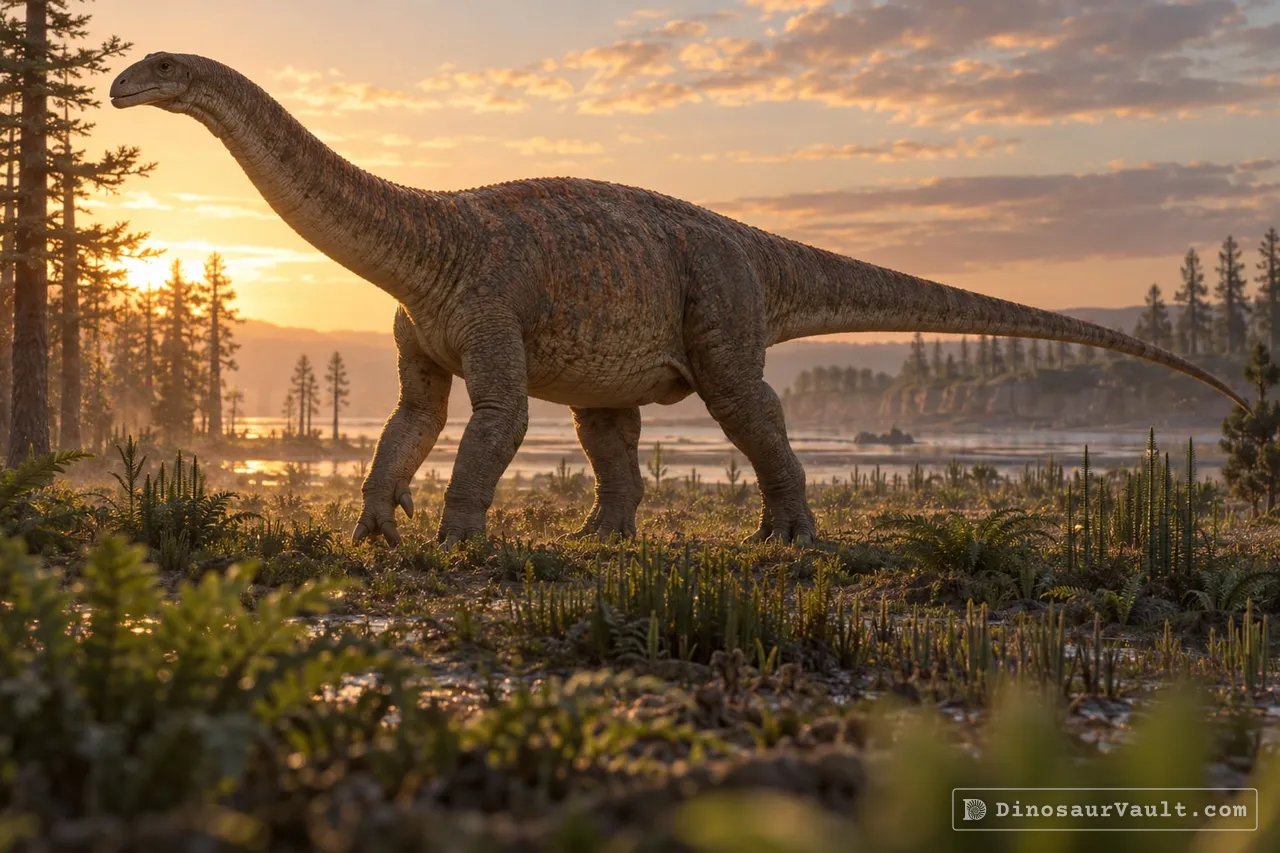
Camelotia was a large plant eater from the long-necked line that later produced the giant sauropods. It is known from part of the backbone, hips and legs, which show a heavy animal that probably walked on all fours.
Its world
It lived in the latest Triassic in what is now southwestern England. Its bones come from the Westbury Formation.
How it was found
Galton named Camelotia in 1985, from bones that had been dug up much earlier. Its name comes from a legendary castle of old British tales, said to lie in the region where it was found.
Field gallery
More views of Camelotia
Scenes reconstructed from the available fossil evidence.
Lived alongside
Found in the same rock formations

A rock formation can hold fossils laid down millions of years apart, so not every animal here met Camelotia.
The evidence
The science behind Camelotia
Which parts of the picture come from its own bones, and which come from its relatives.
From its own fossils
- Parts of the backbone, hips and hind legs show a large, heavily built plant eater.
- The thighbone is broad from side to side, a feature shared with sauropodomorphs close to the origin of sauropods.
Borrowed from relatives
- The missing head, neck and forelimbs are restored by comparison with more complete early sauropodomorphs such as Melanorosaurus.
Still unknown
- The shape of its skull and the full length of its neck.
- Its skin covering and color.
- Its exact place among the earliest relatives of sauropods.
Discovery timeline
- 1985Named itGalton
- 2007Family treeNaish & Martill
- 2020Family treeRauhut, Holwerda & Furrer
Key papers
The research behind what we know of Camelotia
Named it
Named Camelotia from large sauropodomorph bones from England and grouped it with Melanorosaurus.
Notes on the Melanorosauridae, a family of large Prosauropod Dinosaurs (Saurischia: Sauropodomorpha). Geobios 18: 671-676
Read the paper : Notes on the Melanorosauridae, a family of large Prosauropod Dinosaurs (Saurischia: Sauropodomorpha) (opens in a new tab)Family tree
Reviewed British dinosaurs and discussed Camelotia as a large early relative of sauropods.
Dinosaurs of Great Britain and the role of the Geological Society of London in their discovery: basal Dinosauria and Saurischia. Journal of the Geological Society 164: 493-510
Read the paper : Dinosaurs of Great Britain and the role of the Geological Society of London in their discovery: basal Dinosauria and Saurischia (opens in a new tab)Family tree
Compared Camelotia with other large early sauropodomorphs while describing Schleitheimia, another European relative close to sauropods.
A derived sauropodiform dinosaur and other sauropodomorph material from the Late Triassic of Canton Schaffhausen, Switzerland. Swiss Journal of Geosciences 113
Read the paper : A derived sauropodiform dinosaur and other sauropodomorph material from the Late Triassic of Canton Schaffhausen, Switzerland (opens in a new tab)
Close relatives
Other members of Sauropodiformes


Sources: Wikidata