Saltasaurus
SAL-tuh-SORE-us
"lizard from Salta"
- Lived
- 72 to 66 million years ago, Late Cretaceous
- Diet
- Herbivore
- Group
- Sauropods, Saltasauridae
- Found in
- Argentina
- Named by
- Bonaparte and Powell 1980
Where its fossils were found
The evidence
Today

70 million years ago
Habitat
Rivers and lakes shaped its habitat in Argentina. Its wider world included Noasaurus and the related sauropod Neuquensaurus.
Field notes
About Saltasaurus
What it was like
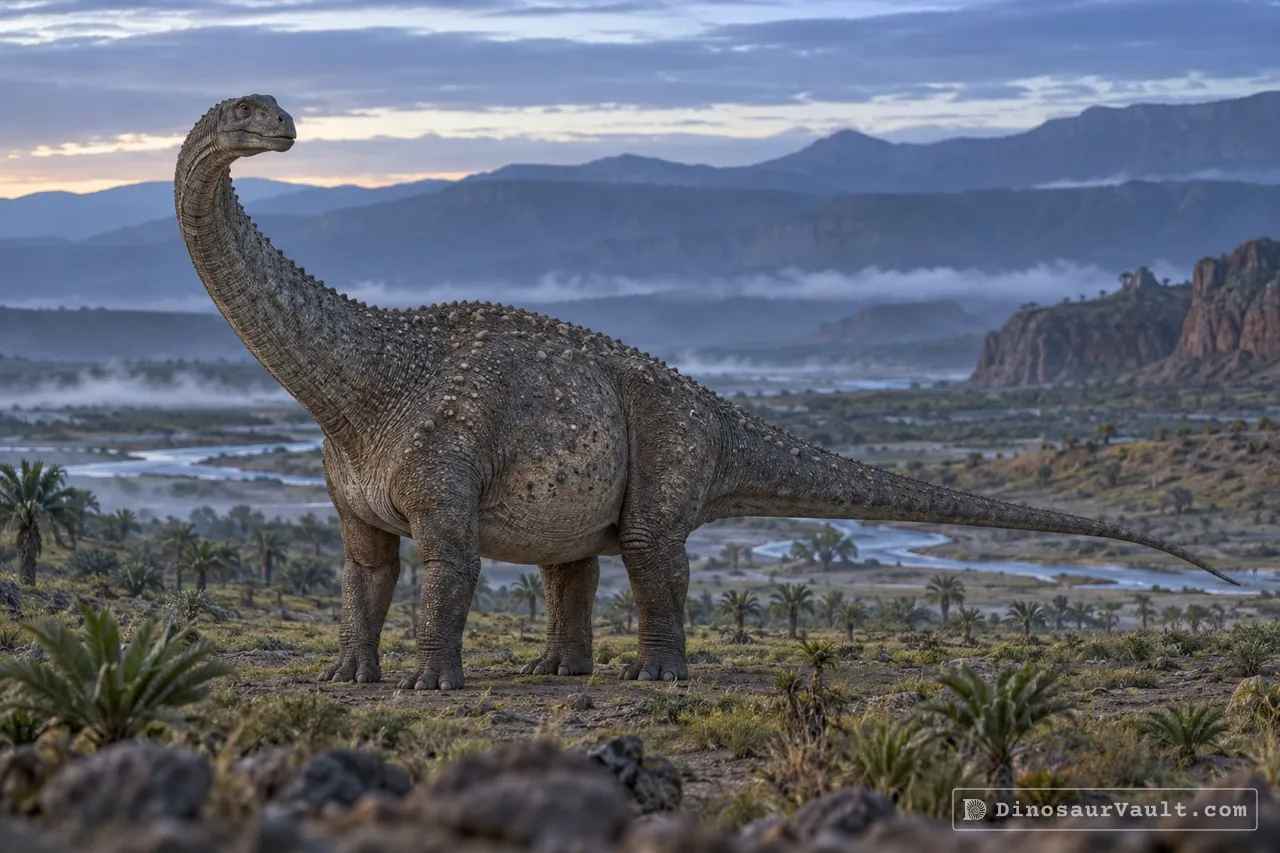
Saltasaurus was a sauropod, but a small one by sauropod standards, with a short neck and robust legs. Its incomplete remains have produced differing body-length estimates. What set it apart was its skin: bony plates called osteoderms, some as big as a fist, were embedded across its back. It was the first sauropod genus found with this kind of armor, and paleontologists have since found similar plates on other titanosaurs.
Like other titanosaurs, it walked on four thick legs and carried a long tail. Its skull was small and its teeth were simple, suited to stripping leaves rather than chewing them, a common feeding style among sauropods.
Its world
Saltasaurus lived from about 72 to 66 million years ago, in the final stretch of the Late Cretaceous, in what is now Argentina. Its bones come from the Lecho Formation.
It shared its habitat with the small predator Noasaurus and the fellow titanosaur Neuquensaurus, and its close relatives include Alamosaurus in North America and Opisthocoelicaudia in Asia.
How it was found
Bonaparte and Powell named Saltasaurus in 1980, from bones found in Argentina. It is known from a single find, but that discovery mattered: bony armor had never before been confirmed on a sauropod. The osteoderms found with Saltasaurus changed how paleontologists pictured titanosaur skin, since armor of this kind has since turned up on several of its relatives.
Field gallery
More views of Saltasaurus
Scenes reconstructed from the available fossil evidence.
1 of 7
Lived alongside
Found in the same rock formations


A rock formation can hold fossils laid down millions of years apart, so not every animal here met Saltasaurus.
The evidence
The science behind Saltasaurus
Which parts of the picture come from its own bones, and which come from its relatives.
From its own fossils
- Its bones show a compact, robust sauropod with a relatively short neck.
- Bony plates and tiny bony nodules formed armor within its skin.
- The larger armor plates contain spongy bone, while the tiny nodules have denser bone.
Borrowed from relatives
- Neuquensaurus and other titanosaurs help fill gaps in the skeleton and guide the shape of the small head.
Still unknown
- The exact arrangement of armor across its body.
- Its color.
- What its hatchlings looked like.
Often drawn wrong
- A continuous shell like an ankylosaur's exaggerates its armor.
- An extremely long, slender neck misses its more compact build.
Discovery timeline
- 1980Named itBonaparte & Powell
- 2010SkinCerda & Powell
- 2016Close relativeChinsamy, Cerda & Powell
Key papers
The research behind what we know of Saltasaurus
Named it
Named Saltasaurus from Argentine fossils and established that a sauropod could carry bony armor.
A continental assemblage of tetrapods from the Upper Cretaceous beds of El Brete, northwestern Argentina (Sauropoda-Coelurosauria-Carnosauria-Aves). Mémoires de la Société Géologique de France, Nouvelle Série 139: 19-28
No link available
Skin
Examined armor under a microscope, finding spongy bone in large plates and dense bone in tiny nodules.
Dermal Armor Histology of Saltasaurus loricatus, an Upper Cretaceous Sauropod Dinosaur from Northwest Argentina. Acta Palaeontologica Polonica 55: 389-398
Read the paper : Dermal Armor Histology of Saltasaurus loricatus, an Upper Cretaceous Sauropod Dinosaur from Northwest Argentina (opens in a new tab)Close relative
Found unusual bone tissue in saltasaurine bones from the same fossil site and examined whether disease or reproduction could explain it.
Vascularised endosteal bone tissue in armoured sauropod dinosaurs. Scientific Reports 6
Read the paper : Vascularised endosteal bone tissue in armoured sauropod dinosaurs (opens in a new tab)
Close relatives
Other members of Saltasauridae


Sources: Wikidata