Qianlong
Type species Qianlong shouhu
- Lived
- 200 to 193 million years ago, Early Jurassic
- Found in
- China
- Named by
- Han et al. 2023
Where its fossils were found
The evidence
Today

195 million years ago
Habitat
It lived on a floodplain where fine mud accumulated and soils formed. Other dinosaurs of the Ziliujing Formation included Gongxianosaurus and Sanpasaurus.
Field notes
About Qianlong
What it was like
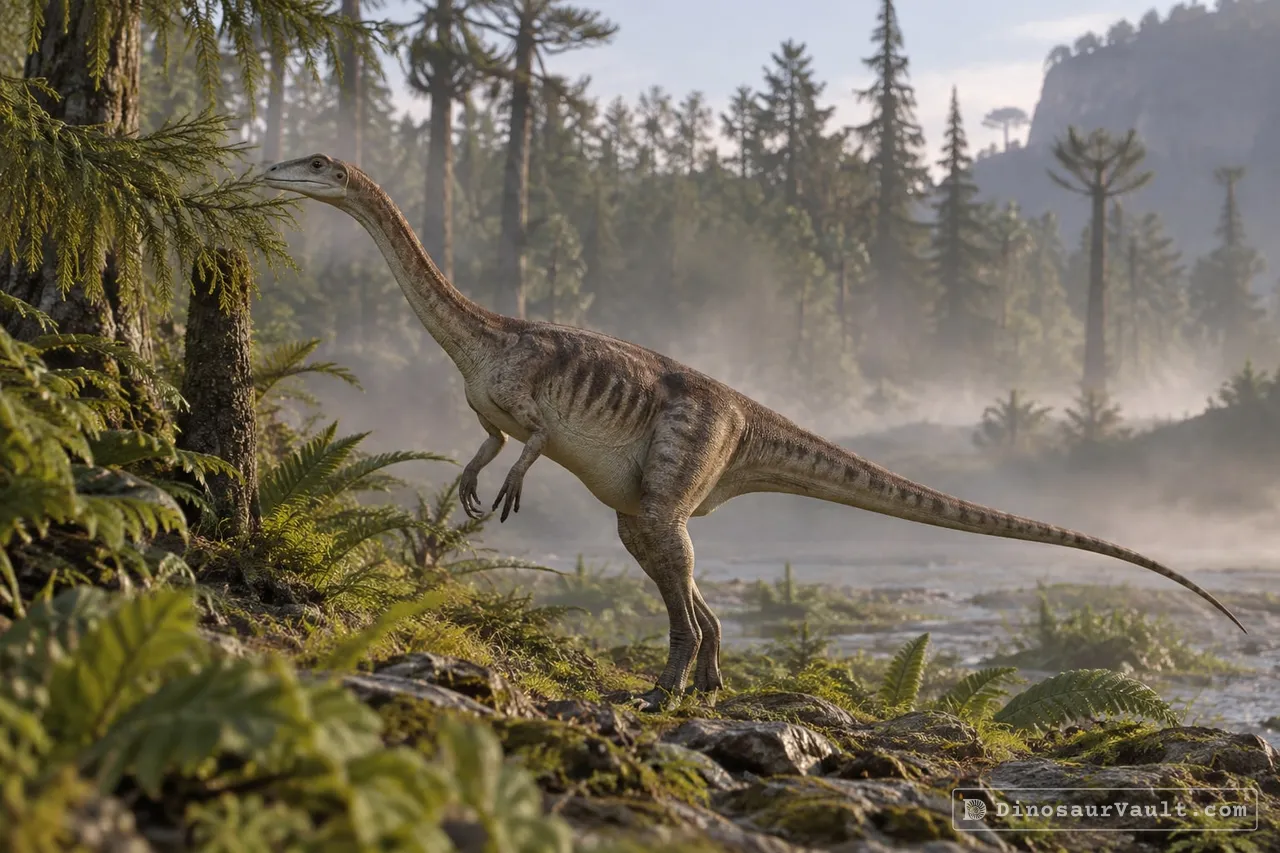
Qianlong was an early sauropodomorph, a long-necked plant eater. Its fossils include adults, eggs and embryos, some of the oldest dinosaur eggs known. The eggs had leathery shells.
Its world
It lived in the Early Jurassic, in what is now China. It comes from the Ziliujing Formation, where the sauropods Gongxianosaurus and Sanpasaurus also lived.
How it was found
Han and colleagues named Qianlong in 2023. The type species is Qianlong shouhu.
Field gallery
More views of Qianlong
Scenes reconstructed from the available fossil evidence.
1 of 3
Lived alongside
Found in the same rock formations

A rock formation can hold fossils laid down millions of years apart, so not every animal here met Qianlong.
The evidence
The science behind Qianlong
Which parts of the picture come from its own bones, and which come from its relatives.
From its own fossils
- Partial adult skeletons show a long neck, a shoulder blade arched outward, a short upper arm, short hands with strong fingers, and a sturdy thigh bone with a double curve, longer than the shin.
- A partial adult skull, found apart from the type skeleton, has a long snout, a deep upper jaw and a lower jaw that curves slightly down at the front.
- Clutches of eggs contain embryos with recognizable skulls and limb bones. The eggshell structure and small shell fragments indicate leathery eggs.
Borrowed from relatives
- Its embryos are compared with embryos of Lufengosaurus, which also grew quickly before hatching.
- The back of the adult skull and the joins of the forearms, wrists and hips are restored by comparison with Massospondylus, an early sauropodomorph whose adult skull and skeleton have been described in detail.
Still unknown
- Its skin color and pattern.
- Whether adults guarded the nests.
- Exactly which plants it ate.
Discovery timeline
- 2013Close relativeReisz et al.
- 2020Close relativeReisz et al.
- 2023Named itHan et al.
Key papers
The research behind what we know of Qianlong
Close relative
Embryonic bones probably belonging to Lufengosaurus show rapid growth before hatching, providing a comparison for the developing Qianlong embryos.
Embryology of Early Jurassic dinosaur from China with evidence of preserved organic remains. Nature 496: 210-214
Read the paper : Embryology of Early Jurassic dinosaur from China with evidence of preserved organic remains (opens in a new tab)Close relative
Showed that Lufengosaurus embryos replaced teeth before hatching, offering a comparison for tooth development in early sauropodomorphs such as Qianlong.
Early Jurassic dinosaur fetal dental development and its significance for the evolution of sauropod dentition. Nature Communications 11
Read the paper : Early Jurassic dinosaur fetal dental development and its significance for the evolution of sauropod dentition (opens in a new tab)Named it
Described adults and embryos, identified leathery eggs and proposed that hatchlings changed their walking posture as they grew.
Exceptional Early Jurassic fossils with leathery eggs shed light on dinosaur reproductive biology. National Science Review 11
Read the paper : Exceptional Early Jurassic fossils with leathery eggs shed light on dinosaur reproductive biology (opens in a new tab)
Close relatives
Other members of Sauropodomorpha


Sources: Wikidata