Ahvaytum
ah-VAY-tum
"long ago"
Type species Ahvaytum bahndooiveche
- Lived
- 237 to 227 million years ago, Late Triassic
- Found in
- United States
- Named by
- Lovelace et al. 2025
Where its fossils were found
The evidence
Today

230 million years ago
Habitat
River deposits in the Popo Agie Formation preserve its ancient landscape in Wyoming. Poposaurus was another reptile from the formation. Parasuchus was a crocodile-like inhabitant of the same region.
Field notes
About Ahvaytum
What it was like
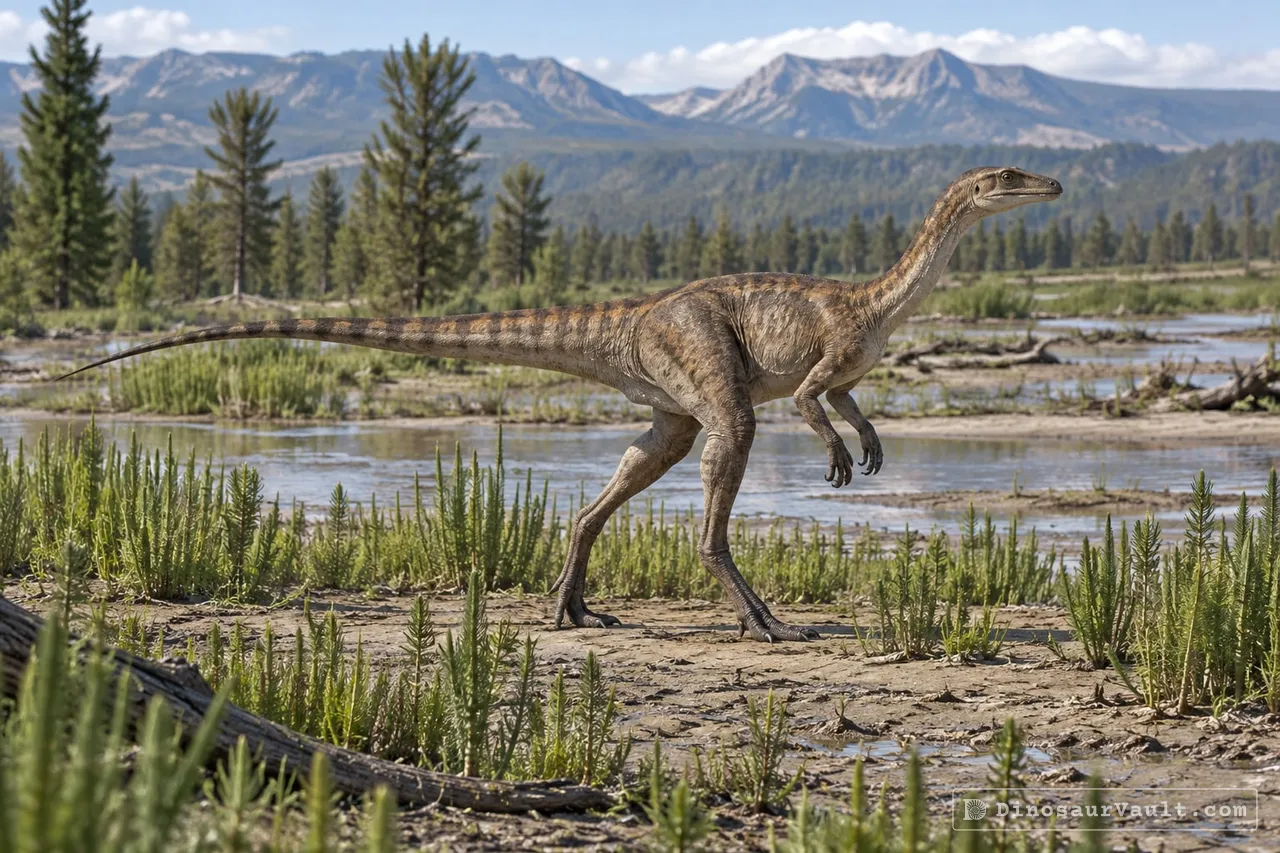
Ahvaytum was a tiny early dinosaur, probably an early relative of the long-necked sauropods. It is known only from leg bones, which show it was about the size of a chicken.
Its world
It lived in the Late Triassic, in what is now Wyoming. It comes from the Popo Agie Formation. It is one of the oldest dinosaurs known from North America.
How it was found
Lovelace and colleagues named Ahvaytum in 2025. The type species is Ahvaytum bahndooiveche. The name comes from the language of the local people, who helped choose it.
Field gallery
More views of Ahvaytum
Scenes reconstructed from the available fossil evidence.
1 of 3
The evidence
The science behind Ahvaytum
Which parts of the picture come from its own bones, and which come from its relatives.
From its own fossils
- An ankle bone has a broad, roller-like joint surface and a distinctive hollow on its inner side.
- A nearby fragment of thighbone has been tentatively assigned to the same genus.
Borrowed from relatives
- Almost the entire body is restored by comparison with Eoraptor, including the head, neck, arms and feet.
- A small body balanced on the hind legs follows Eoraptor as a possible model.
Still unknown
- Whether it was an early sauropodomorph or belonged elsewhere among early saurischians.
- Its diet, skin covering and color.
- Whether the nearby thighbone really belongs to Ahvaytum.
Discovery timeline
- 2012Close relativeSereno, Martínez & Alcober
- 2022Close relativeBallell, Benton & Rayfield
- 2025Named itLovelace et al.
Key papers
The research behind what we know of Ahvaytum
Close relative
Described the skeleton of Eoraptor, a possible relative used to restore the many missing body parts of Ahvaytum.
Osteology ofEoraptor lunensis(Dinosauria, Sauropodomorpha). Journal of Vertebrate Paleontology 32: 83-179
Read the paper : Osteology ofEoraptor lunensis(Dinosauria, Sauropodomorpha) (opens in a new tab)Close relative
Tooth shape and strength supported meat eating in Eoraptor and Buriolestes, showing that early sauropodomorphs included animals with diets unlike later giant plant eaters.
Dental form and function in the early feeding diversification of dinosaurs. Science Advances 8
Read the paper : Dental form and function in the early feeding diversification of dinosaurs (opens in a new tab)Named it
Named Ahvaytum from an ankle bone and argued that dinosaurs reached North America early in their history.
Rethinking dinosaur origins: oldest known equatorial dinosaur-bearing assemblage (mid-late Carnian Popo Agie FM, Wyoming, USA). Zoological Journal of the Linnean Society 203: zlae153
No link available
Close relatives
Other members of Sauropodomorpha


Sources: Wikidata