Archaeocursor
"ancient runner"
Type species Archaeocursor asiaticus
- Lived
- 200 to 184 million years ago, Early Jurassic
- Diet
- Herbivore
- Group
- Early ornithischians
- Found in
- China
- Named by
- Yao et al. 2025
Where its fossils were found
The evidence
Today

190 million years ago
Habitat
A lake basin in Early Jurassic China. Other dinosaurs from the Ziliujing Formation include Gongxianosaurus, Sanpasaurus and Qianlong.
Field notes
About Archaeocursor
What it was like
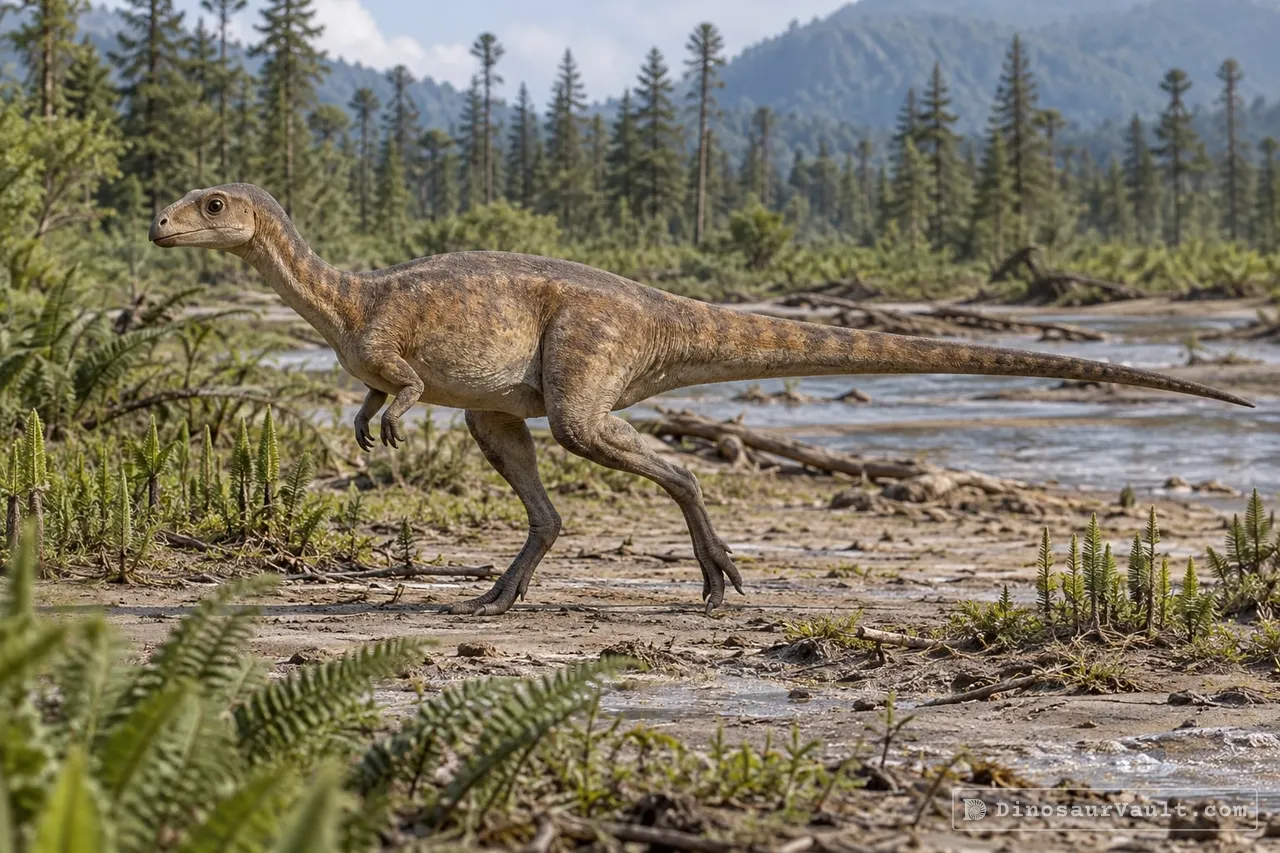
Archaeocursor was a small, two-legged plant eater known only from a thigh bone. It is one of the oldest bird-hipped dinosaurs known from Asia.
Its world
It lived about 200 to 184 million years ago, in the Early Jurassic, in what is now China. Its bone comes from the Ziliujing Formation, where early sauropods such as Gongxianosaurus and Sanpasaurus also lived.
How it was found
Yao and colleagues named it in 2025. The type species is Archaeocursor asiaticus.
Field gallery
More views of Archaeocursor
Scenes reconstructed from the available fossil evidence.
1 of 3
Lived alongside
Found in the same rock formations


A rock formation can hold fossils laid down millions of years apart, so not every animal here met Archaeocursor.
The evidence
The science behind Archaeocursor
Which parts of the picture come from its own bones, and which come from its relatives.
From its own fossils
- A nearly complete left thigh bone is the only described fossil.
- The shape of the thigh bone places it among early bird-hipped dinosaurs.
- A thin section through the bone shows growth marks and a slowing growth rate.
Borrowed from relatives
- A slender body, long tail and grasping hands are restored by comparison with Eocursor and other early bird-hipped dinosaurs.
- Lesothosaurus provides a broader comparison for the missing head and beak.
Still unknown
- The shape of its skull, hands, feet and tail.
- Its skin covering and color.
- Its exact place among the earliest bird-hipped dinosaurs.
Discovery timeline
- 2010Close relativeBUTLER
- 2012Close relativeSereno
- 2025Named itYao et al.
Key papers
The research behind what we know of Archaeocursor
Close relative
Described Eocursor's partial skull and much of its skeleton, including large hands and long lower legs, useful comparisons for Archaeocursor.
The anatomy of the basal ornithischian dinosaur Eocursor parvus from the lower Elliot Formation (Late Triassic) of South Africa. Zoological Journal of the Linnean Society 160: 648-684
Read the paper : The anatomy of the basal ornithischian dinosaur Eocursor parvus from the lower Elliot Formation (Late Triassic) of South Africa (opens in a new tab)Close relative
Documented early bird-hipped dinosaur anatomy, including grasping hands and curved claws that provide broader comparisons for Archaeocursor's missing fingers.
Taxonomy, morphology, masticatory function and phylogeny of heterodontosaurid dinosaurs. ZooKeys 226: 1-225
Read the paper : Taxonomy, morphology, masticatory function and phylogeny of heterodontosaurid dinosaurs (opens in a new tab)Named it
Named Archaeocursor from a thigh bone and used its anatomy and growth marks to study early bird-hipped dinosaurs in Asia.
New evidence for the earliest ornithischian dinosaurs from Asia. iScience 28: 111641
Read the paper : New evidence for the earliest ornithischian dinosaurs from Asia (opens in a new tab)
Close relatives
Other members of Ornithischia


Sources: Wikidata