Mbiresaurus
"Mbire lizard"
Type species Mbiresaurus raathi
- Lived
- 237 to 227 million years ago, Late Triassic
- Found in
- Zimbabwe
- Named by
- Griffin et al. 2022
Where its fossils were found
The evidence
Today

230 million years ago
Habitat
It lived in southern Pangaea, in the climate belt shared by early dinosaur communities in South America and India. Its neighbors included rhynchosaurs, cynodonts and armored aetosaurs.
Field notes
About Mbiresaurus
What it was like
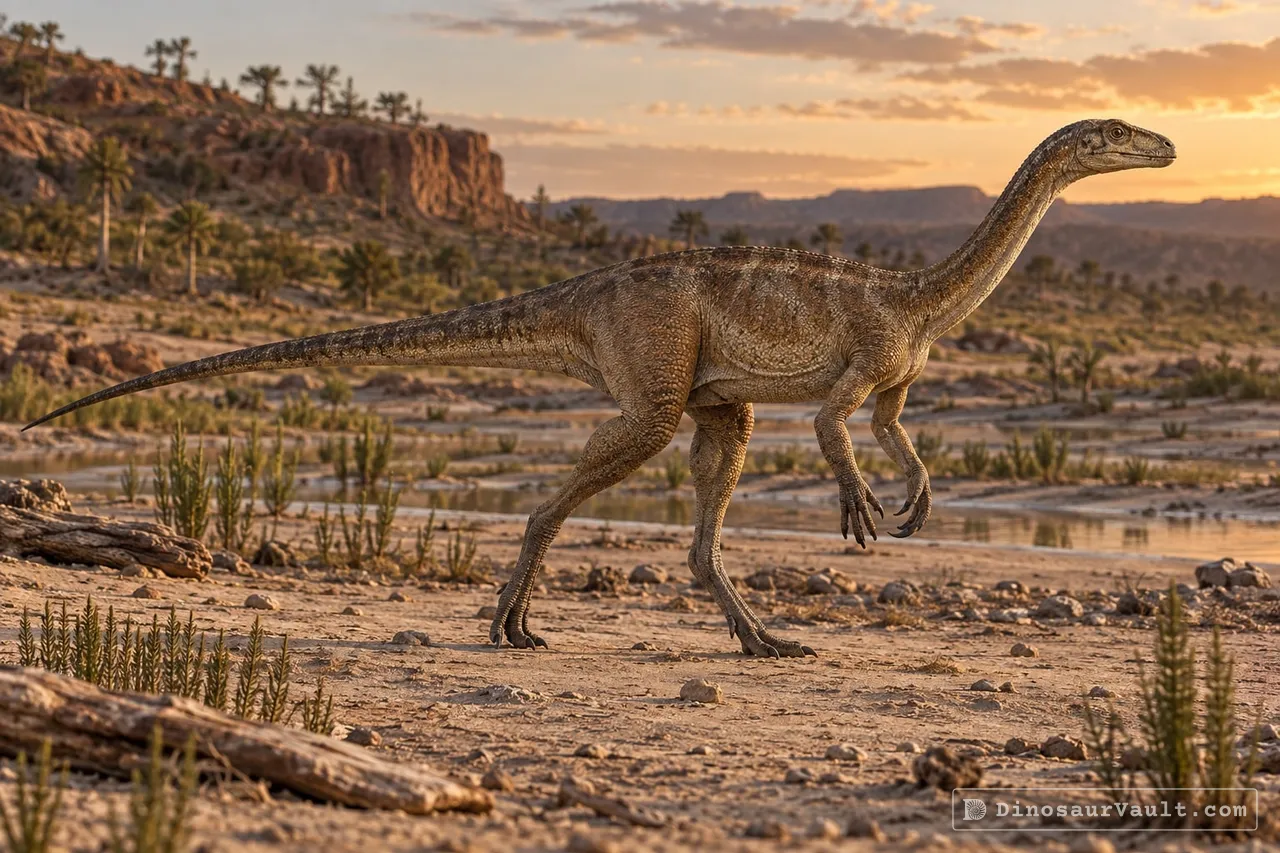
Mbiresaurus was a small, early plant eater, from the long-necked line that later produced the giant sauropods. It walked on two legs and had a small head with serrated, leaf-shaped teeth.
It is known from a nearly complete skeleton.
Its world
It lived in the Late Triassic in what is now Zimbabwe. Its bones come from the Pebbly Arkose Formation.
How it was found
Griffin and colleagues named Mbiresaurus in 2022. It is one of the oldest dinosaurs known from Africa.
Field gallery
More views of Mbiresaurus
Scenes reconstructed from the available fossil evidence.
1 of 3
Lived alongside
Found in the same rock formations

A rock formation can hold fossils laid down millions of years apart, so not every animal here met Mbiresaurus.
The evidence
The science behind Mbiresaurus
Which parts of the picture come from its own bones, and which come from its relatives.
From its own fossils
- A nearly complete skeleton preserves much of the body, including jaw bones, vertebrae, hips and limbs.
- Its jaws carried small, serrated teeth.
- The hind limbs show that it walked on two legs.
Borrowed from relatives
- Most of its body shape comes from its own bones; comparisons with Eoraptor and other early sauropodomorphs help fill the remaining gaps.
Still unknown
- Its skin covering and color.
- Which foods made up most of its diet.
- Whether it lived in groups or cared for its young.
Discovery timeline
- 2022Named itGriffin et al.
- 2024Same rocksBarrett et al.
- 2025Close relativeHechenleitner et al.
Key papers
The research behind what we know of Mbiresaurus
Named it
Described a nearly complete early sauropodomorph and argued that climate belts limited the spread of the first dinosaurs across Pangaea.
Africa’s oldest dinosaurs reveal early suppression of dinosaur distribution. Nature 609: 313-319
Read the paper : Africa’s oldest dinosaurs reveal early suppression of dinosaur distribution (opens in a new tab)Same rocks
Named Musankwa from leg bones in a younger part of the Pebbly Arkose Formation, adding another early sauropodomorph to Zimbabwe's record.
A new sauropodomorph dinosaur from the Late Triassic of the Mid-Zambezi Basin, Zimbabwe. Acta Palaeontologica Polonica 69
Read the paper : A new sauropodomorph dinosaur from the Late Triassic of the Mid-Zambezi Basin, Zimbabwe (opens in a new tab)Close relative
Described Huayracursor, showing that some early sauropodomorphs had already developed longer necks and larger bodies than their small contemporaries.
A long-necked early dinosaur from a newly discovered Upper Triassic basin in the Andes. Nature 648: 634-639
Read the paper : A long-necked early dinosaur from a newly discovered Upper Triassic basin in the Andes (opens in a new tab)
Close relatives
Other members of Sauropodomorpha


Sources: Wikidata