Pantydraco
"dragon from the hollow"
- Lived
- 237 to 227 million years ago, Late Triassic
- Length
- about 3 m (10 ft)
- Found in
- United Kingdom
- Named by
- Galton et al. 2007
Size comparison
To scale

Scale in metersOutline: typical early sauropodomorph shape
Where its fossils were found
The evidence
Today

230 million years ago
Habitat
A limestone island with cracks and caves that collected sediment and bones. The small hunter Pendraig lived there, along with small crocodile relatives and reptiles related to modern tuataras.
Field notes
About Pantydraco
What it was like
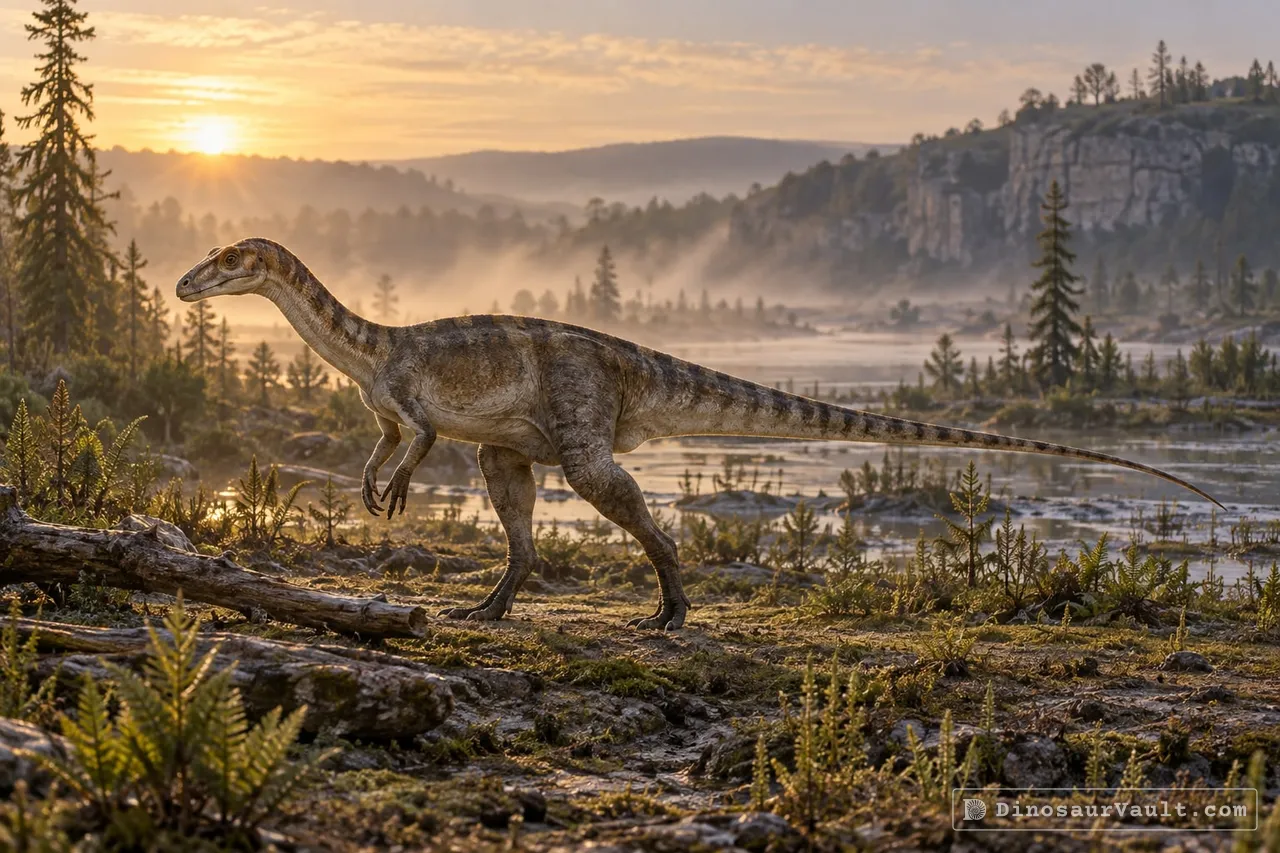
Pantydraco was a small, early plant eater, about 3 meters (10 feet) long if fully grown, from the long-necked line that later produced the giant sauropods. It walked on its hind legs and had a small head with leaf-shaped teeth.
The only known skeleton is from a young animal.
Its world
It lived in the Late Triassic in what is now Wales. Its bones come from a quarry, where cracks in older limestone filled with sediment and bones.
How it was found
Galton and colleagues named Pantydraco in 2007. The skeleton had once been thought to belong to Thecodontosaurus.
Field gallery
More views of Pantydraco
Scenes reconstructed from the available fossil evidence.
The evidence
The science behind Pantydraco
Which parts of the picture come from its own bones, and which come from its relatives.
From its own fossils
- Partial skeletons preserve much of the skull and parts of the neck, shoulders and limbs.
- Some neck vertebrae have distinctive hollows where their main bodies meet the arches above them.
Borrowed from relatives
- Missing parts of the body are restored using Thecodontosaurus and other early sauropodomorphs.
Still unknown
- The size and proportions of a fully grown adult.
- Its color and skin covering.
- Whether it ate small animals as well as plants.
Discovery timeline
- 2003Full descriptionYates
- 2007Named itGalton, Yates & Kermack
- 2018Its worldKeeble, Whiteside & Benton
Key papers
The research behind what we know of Pantydraco
Full description
Described the juvenile skeletons under their earlier name, Thecodontosaurus caducus, and compared them with other early dinosaurs.
A new species of the primitive dinosaurThecodontosaurus(Saurischia: Sauropodomorpha) and its implications for the systematics of early dinosaurs. Journal of Systematic Palaeontology 1: 1-42
Read the paper : A new species of the primitive dinosaurThecodontosaurus(Saurischia: Sauropodomorpha) and its implications for the systematics of early dinosaurs (opens in a new tab)Named it
Separated the young sauropodomorph fossils from Thecodontosaurus and gave them the genus name Pantydraco.
Pantydraco n. gen. for Thecodontosaurus caducus Yates, 2003, a basal sauropodomorph dinosaur from the Upper Triassic or Lower Jurassic of South Wales, UK. Neues Jahrbuch für Geologie und Paläontologie - Abhandlungen 243: 119-125
Read the paper : Pantydraco n. gen. for Thecodontosaurus caducus Yates, 2003, a basal sauropodomorph dinosaur from the Upper Triassic or Lower Jurassic of South Wales, UK (opens in a new tab)Its world
Reconstructed the island fauna around Pantydraco, including small crocodile relatives and abundant relatives of modern tuataras.
The terrestrial fauna of the Late Triassic Pant-y-ffynnon Quarry fissures, South Wales, UK and a new species of Clevosaurus (Lepidosauria: Rhynchocephalia). Proceedings of the Geologists' Association 129: 99-119
Read the paper : The terrestrial fauna of the Late Triassic Pant-y-ffynnon Quarry fissures, South Wales, UK and a new species of Clevosaurus (Lepidosauria: Rhynchocephalia) (opens in a new tab)
Close relatives
Other members of Sauropodomorpha


Sources: Wikidata