Huayracursor
"wind runner"
Type species Huayracursor jaguensis
- Lived
- 237 to 227 million years ago, Late Triassic
- Found in
- Argentina
- Named by
- Hechenleitner et al. 2025
Where its fossils were found
The evidence
Today

230 million years ago
Habitat
Rivers, floodplains and shallow lakes occupied the basin in what is now Argentina. Its neighbors included beaked rhynchosaurs, mammal relatives called cynodonts and armored aetosaurs.
Field notes
About Huayracursor
What it was like
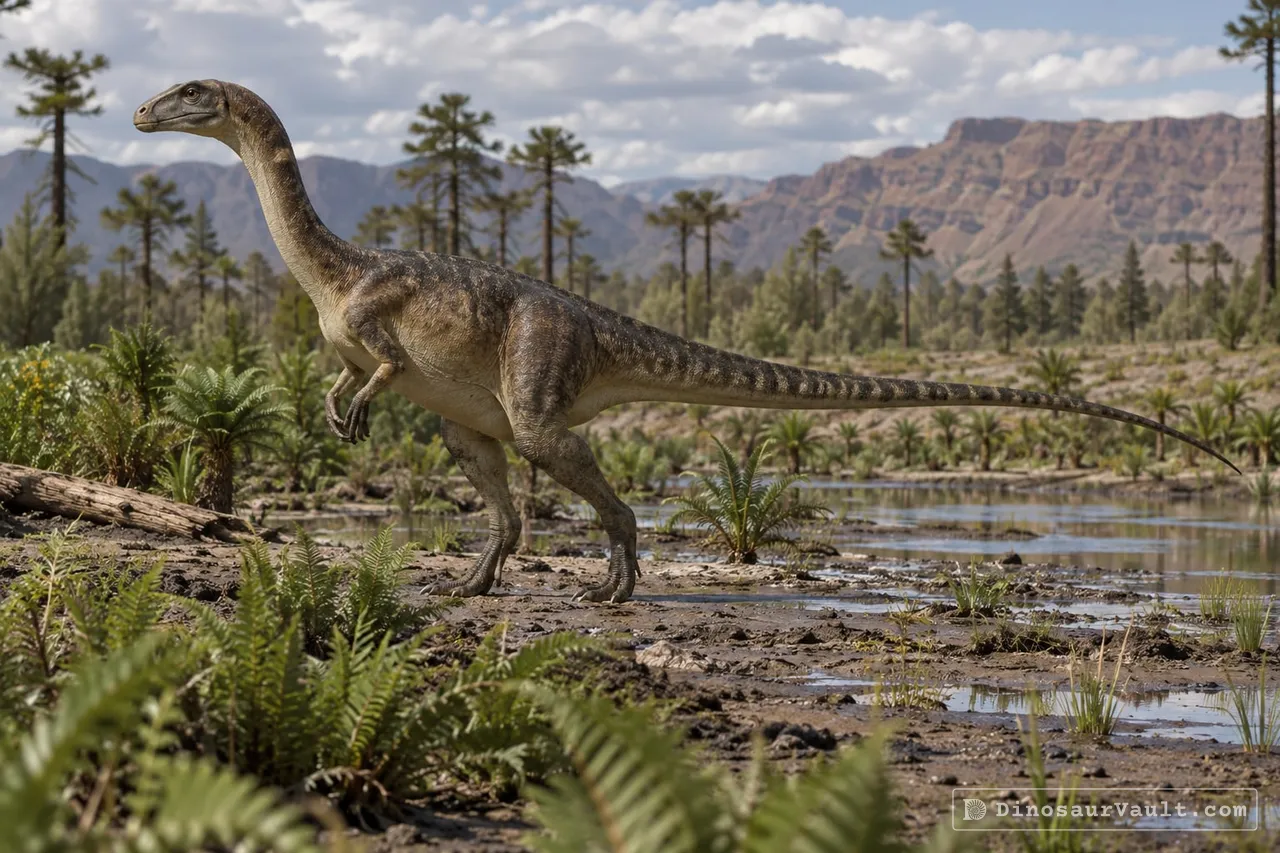
Huayracursor was a small, early sauropodomorph, an early relative of the giant long-necked dinosaurs. Its partial skeleton shows it already had a longer neck than other dinosaurs of its time, a first step toward the giants that came later.
Its world
It lived in the Late Triassic, in what is now Argentina. It comes from the Santo Domingo Formation.
How it was found
Hechenleitner and colleagues named Huayracursor in 2025. The type species is Huayracursor jaguensis.
Field gallery
More views of Huayracursor
Scenes reconstructed from the available fossil evidence.
1 of 3
The evidence
The science behind Huayracursor
Which parts of the picture come from its own bones, and which come from its relatives.
From its own fossils
- One largely articulated skeleton includes part of the skull, the first neck vertebrae and more of the neck, the shoulder, arm and hand, the hips, and the thigh, shin, ankle and foot.
- Its neck vertebrae are longer than those of many other early sauropodomorphs, marking an early step toward the long necks of later giants.
Borrowed from relatives
- Most of the body comes from its own skeleton. The front of the skull and the lower jaw are compared with Bagualosaurus.
- Eoraptor guides the skull roof, cheeks, arms and hands, and Buriolestes the base of the neck, the ribs and the hips.
- The tip of the tail is compared with Panphagia, whose tail bones from near the end are preserved still joined together.
Still unknown
- Its skin covering and color.
- Which foods it ate.
- Whether it lived in groups.
Discovery timeline
- 2012Close relativeSereno, Martínez & Alcober
- 2018Close relativeMüller et al.
- 2018Close relativeMüller, Langer & Dias-da-Silva
- 2025Named itHechenleitner et al.
Key papers
The research behind what we know of Huayracursor
Close relative
A bone-by-bone account of Eoraptor, an early relative whose skull, arms, hands and hips offer close comparisons.
Osteology ofEoraptor lunensis(Dinosauria, Sauropodomorpha). Journal of Vertebrate Paleontology 32: 83-179
Read the paper : Osteology ofEoraptor lunensis(Dinosauria, Sauropodomorpha) (opens in a new tab)Close relative
A nearly complete Buriolestes skeleton provides a detailed comparison with the smaller, earlier members of the sauropodomorph family.
Early evolution of sauropodomorphs: anatomy and phylogenetic relationships of a remarkably well-preserved dinosaur from the Upper Triassic of southern Brazil. Zoological Journal of the Linnean Society 184: 1187-1248
Read the paper : Early evolution of sauropodomorphs: anatomy and phylogenetic relationships of a remarkably well-preserved dinosaur from the Upper Triassic of southern Brazil (opens in a new tab)Close relative
Skeletons of Macrocollum show how early sauropodomorphs developed longer necks, larger bodies and teeth better suited to eating plants.
An exceptionally preserved association of complete dinosaur skeletons reveals the oldest long-necked sauropodomorphs. Biology Letters 14: 20180633
Read the paper : An exceptionally preserved association of complete dinosaur skeletons reveals the oldest long-necked sauropodomorphs (opens in a new tab)Named it
Described an early sauropodomorph whose elongated neck bones show that neck lengthening began before the rise of the larger, later forms.
A long-necked early dinosaur from a newly discovered Upper Triassic basin in the Andes. Nature 648: 634-639
Read the paper : A long-necked early dinosaur from a newly discovered Upper Triassic basin in the Andes (opens in a new tab)
Close relatives
Other members of Sauropodomorpha


Sources: Wikidata