Paranthodon
pa-RAN-tho-don
"near Anthodon"
Type species Paranthodon africanus
- Lived
- 143 to 133 million years ago, Early Cretaceous
- Diet
- Herbivore
- Group
- Stegosaurs, Stegosauridae
- Found in
- South Africa
- Named by
- Nopcsa 1929
Where its fossils were found
The evidence
Today

140 million years ago
Habitat
Winding rivers crossed floodplains with conifers, cycads and ferns in what is now South Africa. Nqwebasaurus and Iyuku lived in the region.
Field notes
About Paranthodon
What it was like
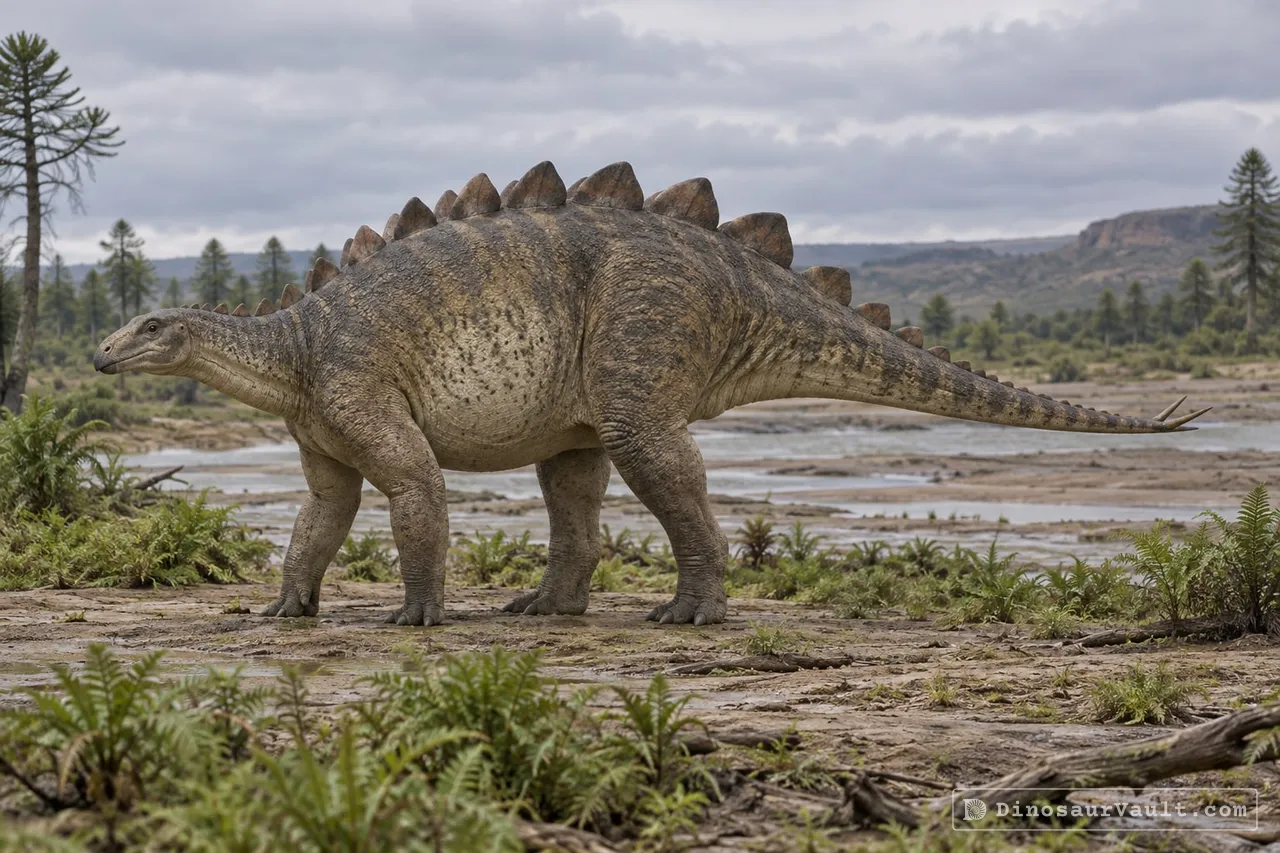
Paranthodon was a stegosaur, a plated plant eater. It is known only from part of a snout with teeth, so its full appearance is uncertain. Its closest relatives may include Kentrosaurus and Dacentrurus.
Its world
It lived in the Early Cretaceous in what is now South Africa. Its bones come from the Kirkwood Formation, where the small theropod Nqwebasaurus also lived.
How it was found
Its bones were found very early in the history of paleontology and were first thought to belong to a very different reptile. Nopcsa gave it its own genus in 1929. It was one of the first stegosaur fossils ever found.
Field gallery
More views of Paranthodon
Scenes reconstructed from the available fossil evidence.
1 of 3
Lived alongside
Found in the same rock formations


A rock formation can hold fossils laid down millions of years apart, so not every animal here met Paranthodon.
The evidence
The science behind Paranthodon
Which parts of the picture come from its own bones, and which come from its relatives.
From its own fossils
- Part of the upper snout preserves teeth, the toothless front of the jaw and a nasal bone.
- The front of the upper jaw curves downward, and the nasal bone has a gently rounded upper surface.
- A partial back vertebra is also included among its known remains.
Borrowed from relatives
- Stegosaurus guides the missing lower jaw, rear of the head, limbs and tail.
- Back plates and tail spikes are inferred from stegosaurs such as Stegosaurus.
- The compact forefeet and blunt hind claws follow Stegosaurus and other stegosaurs.
Still unknown
- The shape, number and arrangement of its plates and spikes.
- Its full body size and proportions.
- Its precise place among stegosaurs.
Often drawn wrong
- Teeth running to the very tip of the upper snout overlook its toothless front.
- An exact copy of Stegosaurus's plates presents a borrowed design as Paranthodon's own.
Discovery timeline
- 1929Named it
- 2010PostureSenter
- 2015Close relativeMaidment, Brassey & Barrett
- 2018Full descriptionRaven & Maidment
Key papers
The research behind what we know of Paranthodon
Posture
Showed that stegosaur hand bones formed a compact upright arc rather than a spreading fan.
Evidence for a Sauropod-Like Metacarpal Configuration in Stegosaurian Dinosaurs. Acta Palaeontologica Polonica 55: 427-432
Read the paper : Evidence for a Sauropod-Like Metacarpal Configuration in Stegosaurian Dinosaurs (opens in a new tab)Close relative
Described a remarkably complete Stegosaurus skeleton, providing comparisons for the missing body, limbs and armor of Paranthodon.
The Postcranial Skeleton of an Exceptionally Complete Individual of the Plated Dinosaur Stegosaurus stenops (Dinosauria: Thyreophora) from the Upper Jurassic Morrison Formation of Wyoming, U.S.A. PLOS ONE 10: e0138352
Read the paper : The Postcranial Skeleton of an Exceptionally Complete Individual of the Plated Dinosaur Stegosaurus stenops (Dinosauria: Thyreophora) from the Upper Jurassic Morrison Formation of Wyoming, U.S.A. (opens in a new tab)Full description
Restudied the snout and teeth, retained Paranthodon as a stegosaur, and showed how its family-tree position changes with the comparisons used.
The systematic position of the enigmatic thyreophoran dinosaur Paranthodon africanus , and the use of basal exemplifiers in phylogenetic analysis. PeerJ 6: e4529
Read the paper : The systematic position of the enigmatic thyreophoran dinosaur Paranthodon africanus , and the use of basal exemplifiers in phylogenetic analysis (opens in a new tab)
Close relatives
Other members of Stegosauridae


Sources: Wikidata