Iyuku
eye-YOO-koo
"hatchling"
- Lived
- 137 to 133 million years ago, Early Cretaceous
- Diet
- Herbivore
- Group
- Ornithopods
- Found in
- South Africa
- Named by
- Forster et al. 2022
Where its fossils were found
The evidence
Today

135 million years ago
Habitat
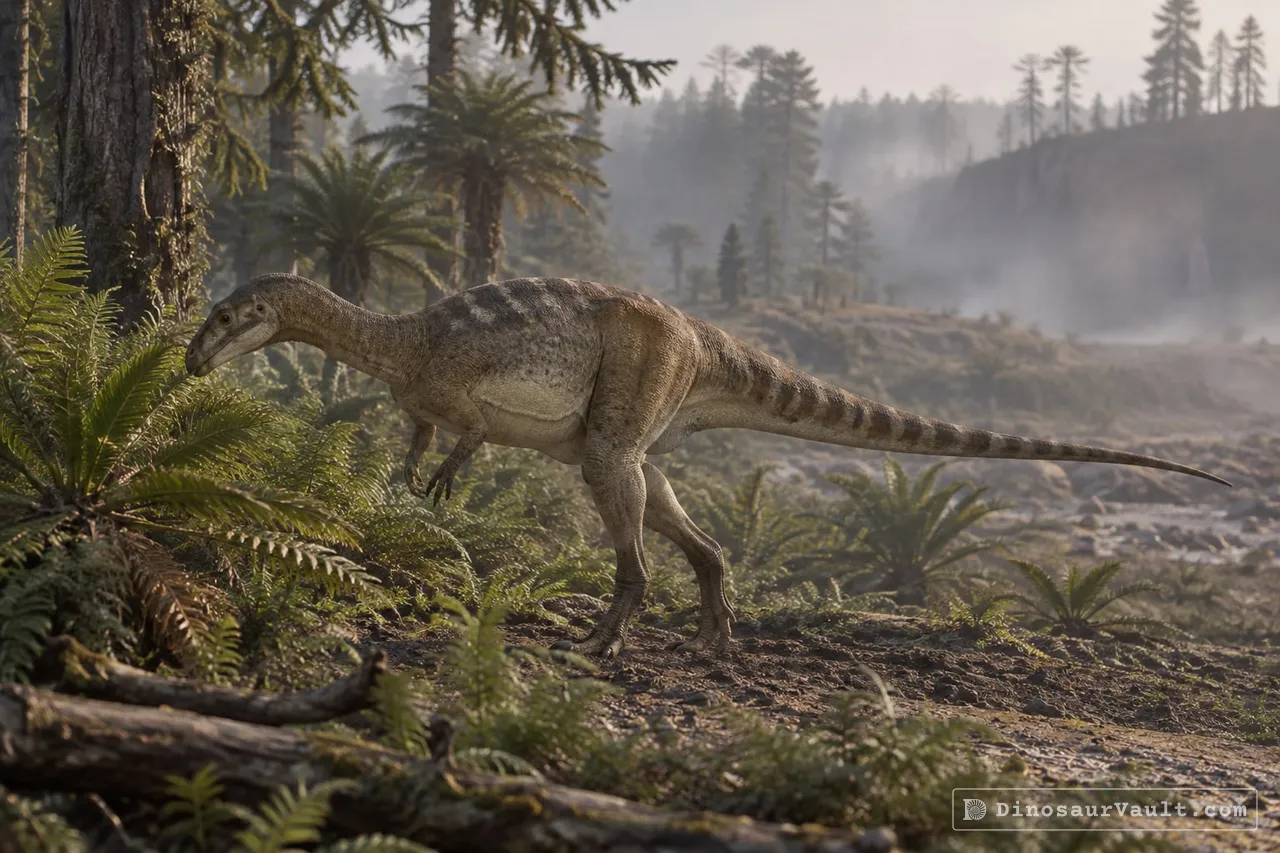
Rivers crossed a landscape with conifers, cycads and ferns. Paranthodon and Nqwebasaurus also lived in the region recorded by the Kirkwood Formation.
Field notes
About Iyuku
What it was like
Iyuku was a small plant eater related to Iguanodon. It is known from bones of many young animals and one older one, found together.
Its world
It lived in the Early Cretaceous, in what is now South Africa. It comes from the Kirkwood Formation, where it shared the land with the plant eater Paranthodon and the small theropod Nqwebasaurus.
How it was found
Forster and colleagues named Iyuku in 2022. Its name comes from a local language.
Field gallery
More views of Iyuku
Scenes reconstructed from the available fossil evidence.
1 of 3
Lived alongside
Found in the same rock formations


A rock formation can hold fossils laid down millions of years apart, so not every animal here met Iyuku.
The evidence
The science behind Iyuku
Which parts of the picture come from its own bones, and which come from its relatives.
From its own fossils
- The type specimen is a partial skeleton found partly jointed, and loose bones from many more young animals add parts of the skull, spine and limbs.
- The front of its upper jaw had no teeth, and its upper arm bones are very slender with only a low crest.
- Thin sections show fast growth interrupted by pauses, and some of the smallest limb bones belonged to hatchlings.
Borrowed from relatives
- Dysalotosaurus is its closest relative in the published family-tree analysis and provides a comparison for adult body proportions.
- Skulls of Dryosaurus, including one from a young animal, are the guide for the missing bones of its snout.
Still unknown
- Its fully grown size and proportions.
- Its nose bones, the bone in front of the eye and the beak bone at the tip of the lower jaw are unknown, and no hand bones have been identified.
- Whether adults cared for the young.
Discovery timeline
- 2016Same rocksMcPhee et al.
- 2022Named itForster et al.
- 2022Family treePoole
- 2026Close relativeRocchi et al.
Key papers
The research behind what we know of Iyuku
Same rocks
Described diverse sauropod remains from the Kirkwood Formation and reviewed the plants and other animals of its landscape.
High diversity in the sauropod dinosaur fauna of the Lower Cretaceous Kirkwood Formation of South Africa: Implications for the Jurassic–Cretaceous transition. Cretaceous Research 59: 228-248
Read the paper : High diversity in the sauropod dinosaur fauna of the Lower Cretaceous Kirkwood Formation of South Africa: Implications for the Jurassic–Cretaceous transition (opens in a new tab)Named it
Described Iyuku from an assemblage dominated by young animals and used bone structure to identify hatchlings and juveniles.
Iyuku raathi, a new iguanodontian dinosaur from the Early Cretaceous Kirkwood Formation, South Africa. The Anatomical Record 306: 1762-1803
Read the paper : Iyuku raathi, a new iguanodontian dinosaur from the Early Cretaceous Kirkwood Formation, South Africa (opens in a new tab)Family tree
Accounted for features that change during growth and consistently recovered Iyuku beside Dysalotosaurus.
Placing juvenile specimens in phylogenies: An ontogenetically sensitive phylogenetic assessment of a new genus of iguanodontian dinosaur from the Early Cretaceous Kirkwood Formation, South Africa. The Anatomical Record 306: 1939-1950
Read the paper : Placing juvenile specimens in phylogenies: An ontogenetically sensitive phylogenetic assessment of a new genus of iguanodontian dinosaur from the Early Cretaceous Kirkwood Formation, South Africa (opens in a new tab)Close relative
Described a very well preserved young iguanodontian from Tanzania and kept Iyuku among the close relatives it was compared with.
An exquisitely preserved young iguanodontian from the Upper Jurassic of Tanzania sheds light on skeletal fusion patterns within Archosauria. Papers in Palaeontology 12
Read the paper : An exquisitely preserved young iguanodontian from the Upper Jurassic of Tanzania sheds light on skeletal fusion patterns within Archosauria (opens in a new tab)
Close relatives
Other members of Euiguanodontia

Sources: Wikidata