Alcovasaurus
- Diet
- Herbivore
- Group
- Stegosaurs, Stegosauridae
- Named by
- Galton and Carpenter 2016
Where its fossils were found
The evidence
No finds with map coordinates are recorded yet.
Habitat
It lived in the Late Jurassic of the western United States, on a landscape of rivers and wetlands with dry seasons. Stegosaurus and Allosaurus also occur in the same broad rock sequence.
Field notes
About Alcovasaurus
What it was like
Alcovasaurus was a stegosaur with plates along its back and very long spikes on its tail, among the longest of any stegosaur. It is known from a partial skeleton.
Its bones were first described as a species of Stegosaurus. Later studies placed it closer to Dacentrurus and its European relatives, though its exact place is still debated.
Its world
It lived in the Late Jurassic in what is now the western United States, in the same rocks that hold Stegosaurus.
How it was found
Galton and Carpenter gave it its own genus in 2016. The original skeleton was later lost, so scientists now rely on old descriptions.
Field gallery
More views of Alcovasaurus
Scenes reconstructed from the available fossil evidence.
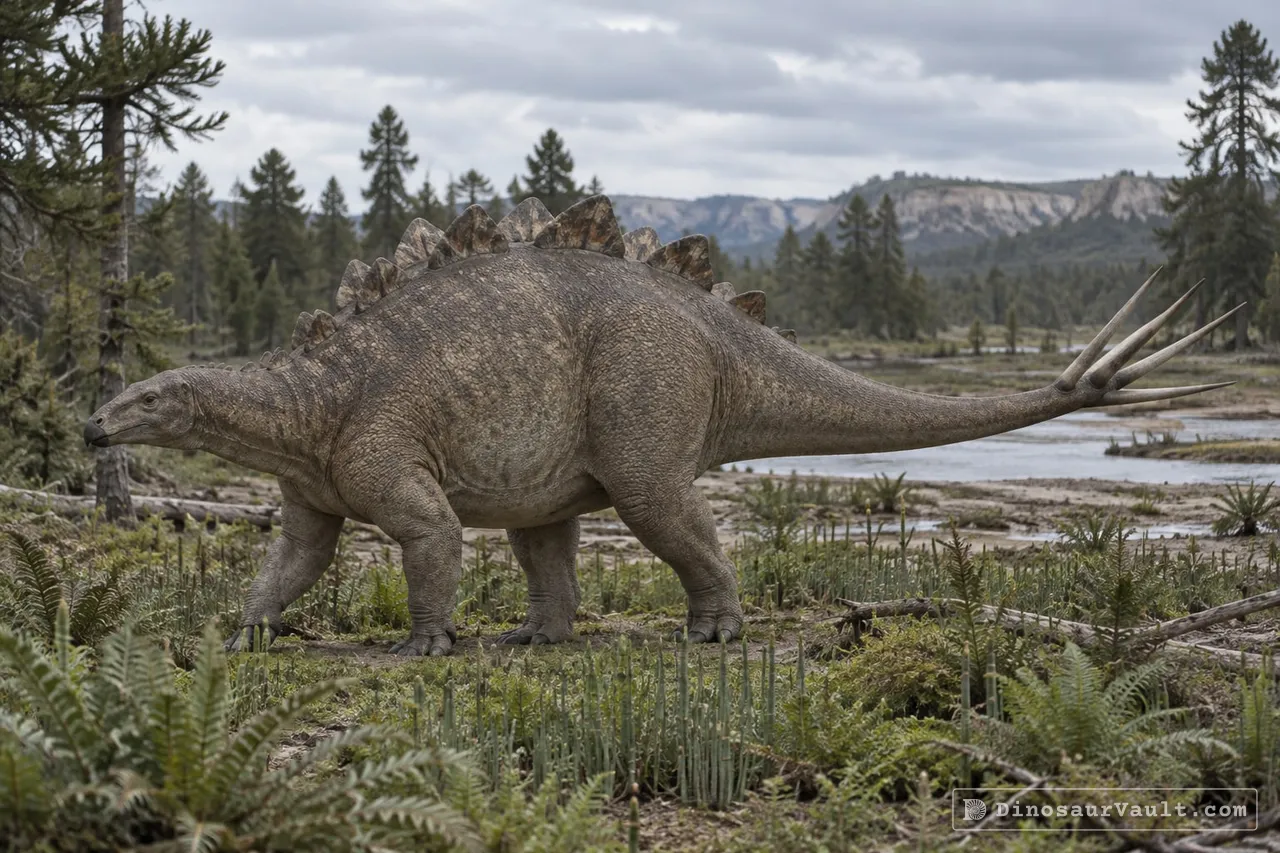
The evidence
The science behind Alcovasaurus
Which parts of the picture come from its own bones, and which come from its relatives.
From its own fossils
- The original partial skeleton included hip bones, a thigh bone, vertebrae and unusually long, slender tail spikes.
- Side projections continued far along the tail, whose rear vertebrae were short from front to back.
Borrowed from relatives
- The missing head, neck and much of the body must be restored by comparison with stegosaurs such as Stegosaurus and Dacentrurus.
Still unknown
- The shape and arrangement of its back plates.
- The length of its neck.
- Whether it belongs in its own genus or shares a genus with a long-necked European relative.
Discovery timeline
- 2004Its worldTurner & Peterson
- 2016Named itGalton & Carpenter
- 2017Family treeRaven & Maidment
- 2019Close relativeCosta & Mateus
Key papers
The research behind what we know of Alcovasaurus
Its world
Reconstructed a generally dry dinosaur landscape in which rivers, lakes and wetlands supplied water.
Reconstruction of the Upper Jurassic Morrison Formation extinct ecosystem—a synthesis. Sedimentary Geology 167: 309-355
Read the paper : Reconstruction of the Upper Jurassic Morrison Formation extinct ecosystem—a synthesis (opens in a new tab)Named it
Restudied surviving material and old photographs, giving the long-spiked species formerly assigned to Stegosaurus its own genus.
The plated dinosaur Stegosaurus longispinus Gilmore, 1914 (Dinosauria: Ornithischia; Upper Jurassic, western USA), type species of Alcovasaurus n. gen. Neues Jahrbuch für Geologie und Paläontologie - Abhandlungen 279: 185-208
Read the paper : The plated dinosaur Stegosaurus longispinus Gilmore, 1914 (Dinosauria: Ornithischia; Upper Jurassic, western USA), type species of Alcovasaurus n. gen. (opens in a new tab)Family tree
Found an unusual family-tree position for Alcovasaurus, but showed that missing anatomical information made this result weakly supported.
A new phylogeny of Stegosauria (Dinosauria, Ornithischia). Palaeontology 60: 401-408
Read the paper : A new phylogeny of Stegosauria (Dinosauria, Ornithischia) (opens in a new tab)Close relative
Compared a more complete Miragaia skeleton with Alcovasaurus and proposed placing the long-spiked species in Miragaia.
Dacentrurine stegosaurs (Dinosauria): A new specimen of Miragaia longicollum from the Late Jurassic of Portugal resolves taxonomical validity and shows the occurrence of the clade in North America. PLOS ONE 14: e0224263
Read the paper : Dacentrurine stegosaurs (Dinosauria): A new specimen of Miragaia longicollum from the Late Jurassic of Portugal resolves taxonomical validity and shows the occurrence of the clade in North America (opens in a new tab)
Close relatives
Other members of Stegosauridae


Sources: Wikidata