Olorotitan
OH-loh-roh-TIE-tan
"giant swan"
- Lived
- 72 to 66 million years ago, Late Cretaceous
- Diet
- Herbivore
- Group
- Ornithopods, Hadrosauridae
- Found in
- Russia
- Named by
- Godefroit et al. 2003
Where its fossils were found
The evidence
Today

70 million years ago
Habitat
It lived on a river plain in far eastern Russia, where mud flows buried dinosaur skeletons. Other duck-bills in the region included Amurosaurus and Kerberosaurus.
Field notes
About Olorotitan
What it was like
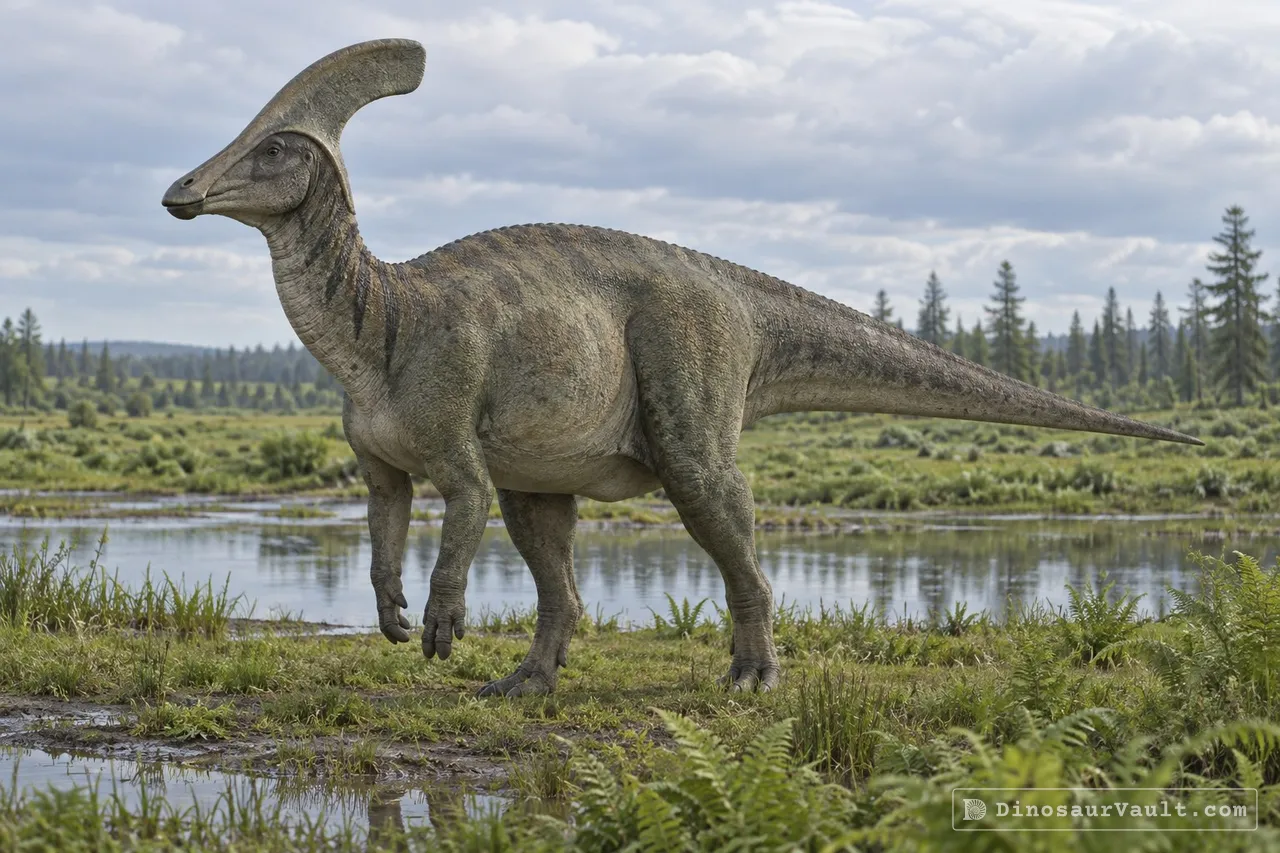
Olorotitan was a large duck-billed dinosaur with a long neck and a tall, hollow crest shaped like a fan or a hatchet. The crest probably helped it make loud calls and signal to others.
Its skeleton is one of the most complete duck-bills known from outside North America.
Its world
It lived about 72 to 66 million years ago, at the very end of the Cretaceous, in what is now far eastern Russia. Its bones come from the Udurchukan Formation, where it lived beside other duck-bills, Amurosaurus and Kerberosaurus.
How it was found
Godefroit and colleagues named Olorotitan in 2003. Only one find is known.
Field gallery
More views of Olorotitan
Scenes reconstructed from the available fossil evidence.
1 of 3
Lived alongside
Found in the same rock formations


A rock formation can hold fossils laid down millions of years apart, so not every animal here met Olorotitan.
The evidence
The science behind Olorotitan
Which parts of the picture come from its own bones, and which come from its relatives.
From its own fossils
- A nearly complete skeleton preserves the skull, long neck, backbone and much of the limbs.
- Its tall, hollow crest rises above the skull and extends far behind the head.
- Its jaws carried tightly packed rows of teeth for processing plants.
Borrowed from relatives
- Most of its body is known from its own bones; missing hands and feet follow other duck-bills such as Corythosaurus.
Still unknown
- Its skin color.
- The sound of its calls.
- How its crest changed as it grew.
Discovery timeline
- 2003Named itGodefroit, Bolotsky & Alifanov
- 2005Its worldVAN ITTERBEECK et al.
- 2012Full descriptionGodefroit, Bolotsky & Bolotsky
Key papers
The research behind what we know of Olorotitan
Named it
Named a duck-billed dinosaur from Russia with an unusually long neck and a large hollow crest.
A remarkable hollow-crested hadrosaur from Russia: an Asian origin for lambeosaurines. Comptes Rendus Palevol 2: 143-151
Read the paper : A remarkable hollow-crested hadrosaur from Russia: an Asian origin for lambeosaurines (opens in a new tab)Its world
Reconstructed a river plain where flows of mud and sediment rapidly buried dinosaur skeletons.
Stratigraphy, sedimentology and palaeoecology of the dinosaur-bearing Kundur section (Zeya-Bureya Basin, Amur Region, Far Eastern Russia). Geological Magazine 142: 735-750
Read the paper : Stratigraphy, sedimentology and palaeoecology of the dinosaur-bearing Kundur section (Zeya-Bureya Basin, Amur Region, Far Eastern Russia) (opens in a new tab)Full description
Described the skull and skeleton in detail and compared Olorotitan with other hollow-crested duck-bills.
Osteology and Relationships ofOlorotitan arharensis, A Hollow-Crested Hadrosaurid Dinosaur from the Latest Cretaceous of Far Eastern Russia. Acta Palaeontologica Polonica 57: 527-560
Read the paper : Osteology and Relationships ofOlorotitan arharensis, A Hollow-Crested Hadrosaurid Dinosaur from the Latest Cretaceous of Far Eastern Russia (opens in a new tab)
Close relatives
Other members of Hadrosauridae


Sources: Wikidata