Oblitosaurus
"forgotten lizard"
- Lived
- 152 to 143 million years ago, Late Jurassic
- Diet
- Herbivore
- Group
- Ornithopods
- Found in
- Spain
- Named by
- Sánchez-Fenollosa et al. 2023
Where its fossils were found
The evidence
Today

150 million years ago
Habitat
Coastal lowlands in what is now Spain. Turiasaurus and Dacentrurus were other plant eaters in this landscape.
Field notes
About Oblitosaurus
What it was like
Oblitosaurus was a large plant eater, an early relative of Iguanodon, known from part of a skeleton.
Its world
It lived in the Late Jurassic in what is now eastern Spain. Its bones come from the Villar del Arzobispo Formation, where it shared the land with the stegosaur Dacentrurus and the giant long-necked Turiasaurus.
How it was found
Sánchez-Fenollosa and colleagues named Oblitosaurus in 2023. Its bones had been kept in a museum for decades, forgotten, which gave it its name.
Field gallery
More views of Oblitosaurus
Scenes reconstructed from the available fossil evidence.
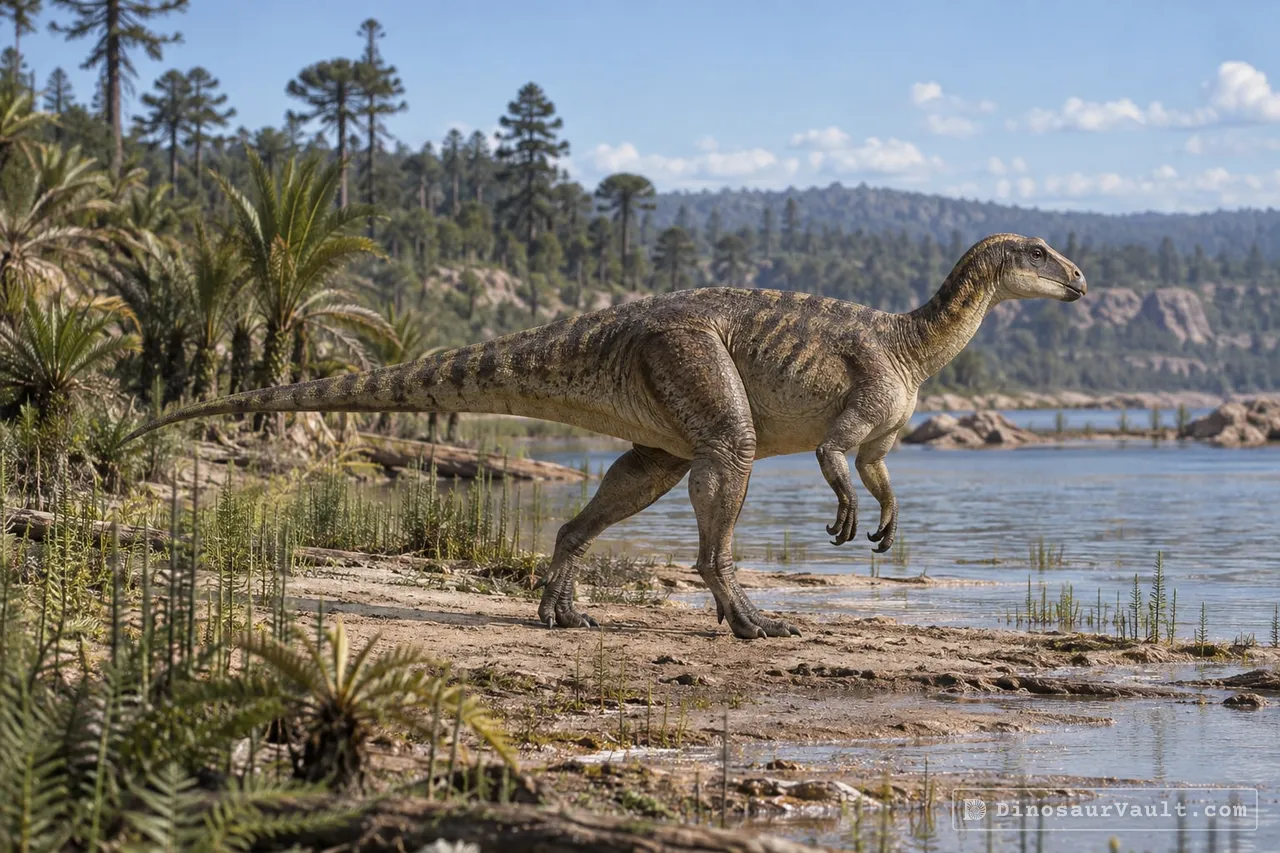
1 of 3
Lived alongside
Found in the same rock formations


A rock formation can hold fossils laid down millions of years apart, so not every animal here met Oblitosaurus.
The evidence
The science behind Oblitosaurus
Which parts of the picture come from its own bones, and which come from its relatives.
From its own fossils
- A tooth and a thumb claw were found a short distance from an almost complete, partly joined hind leg, and are thought to come from the same animal.
- The thumb claw is short, thick and cone-shaped. On the foot, the second claw is long and slightly curved, while the fourth is shorter, slimmer, more curved and pointed.
- The thigh bone is robust, the shin bone relatively short and the fourth long bone of the foot slender.
Borrowed from relatives
- The missing head, neck, body, arms and tail are restored by comparison with Camptosaurus.
Still unknown
- The shape of its skull, which is known only from a single tooth.
- Its closest relatives. Its describers placed it near Draconyx, while a later study placed it in a more advanced group of iguanodontians.
- Whether it made the large ornithopod footprints found in the same region.
Discovery timeline
- 2012Family treeMcDonald
- 2022Family treeRotatori, Moreno-Azanza & Mateus
- 2023Named itSánchez-Fenollosa, Verdú & Cobos
- 2026Family treeRotatori et al.
Key papers
The research behind what we know of Oblitosaurus
Family tree
Compared early iguanodontians and supported splitting some species formerly grouped under Camptosaurus and Iguanodon into separate genera.
Phylogeny of Basal Iguanodonts (Dinosauria: Ornithischia): An Update. PLoS ONE 7: e36745
Read the paper : Phylogeny of Basal Iguanodonts (Dinosauria: Ornithischia): An Update (opens in a new tab)Family tree
Restudied Draconyx, including newly recognized hand bones, and identified it as a small dinosaur that walked on its hind legs.
Reappraisal and new material of the holotype of Draconyx loureiroi (Ornithischia: Iguanodontia) provide insights on the tempo and modo of evolution of thumb-spiked dinosaurs. Zoological Journal of the Linnean Society 195: 125-156
Read the paper : Reappraisal and new material of the holotype of Draconyx loureiroi (Ornithischia: Iguanodontia) provide insights on the tempo and modo of evolution of thumb-spiked dinosaurs (opens in a new tab)Named it
Described a large ornithopod from a tooth, thumb claw and hind leg, and placed it close to Draconyx.
The largest ornithopod (Dinosauria: Ornithischia) from the Upper Jurassic of Europe sheds light on the evolutionary history of basal ankylopollexians. Zoological Journal of the Linnean Society 199: 1013-1033
Read the paper : The largest ornithopod (Dinosauria: Ornithischia) from the Upper Jurassic of Europe sheds light on the evolutionary history of basal ankylopollexians (opens in a new tab)Family tree
A new family-tree analysis of iguanodontians placed Oblitosaurus in a more advanced position than its first description did.
The early origin of Iguanodontia: new insights into the macroevolution, diversity and biogeography of the clade. Palaeontology 69
Read the paper : The early origin of Iguanodontia: new insights into the macroevolution, diversity and biogeography of the clade (opens in a new tab)
Close relatives
Other members of Dryomorpha


Sources: Wikidata