Owenodon
"Owen's tooth"
Type species Owenodon hoggii
- Lived
- 149 to 137 million years ago, Late Jurassic to Early Cretaceous
- Diet
- Herbivore
- Group
- Ornithopods
- Found in
- United Kingdom and Romania
- Named by
- Galton 2009
Where its fossils were found
The evidence
Today

145 million years ago
Habitat
Its English home included shallow lakes, muddy shores and patches of conifers and cycad-like plants. Echinodon and Nuthetes lived in the Lulworth Formation.
Field notes
About Owenodon
What it was like
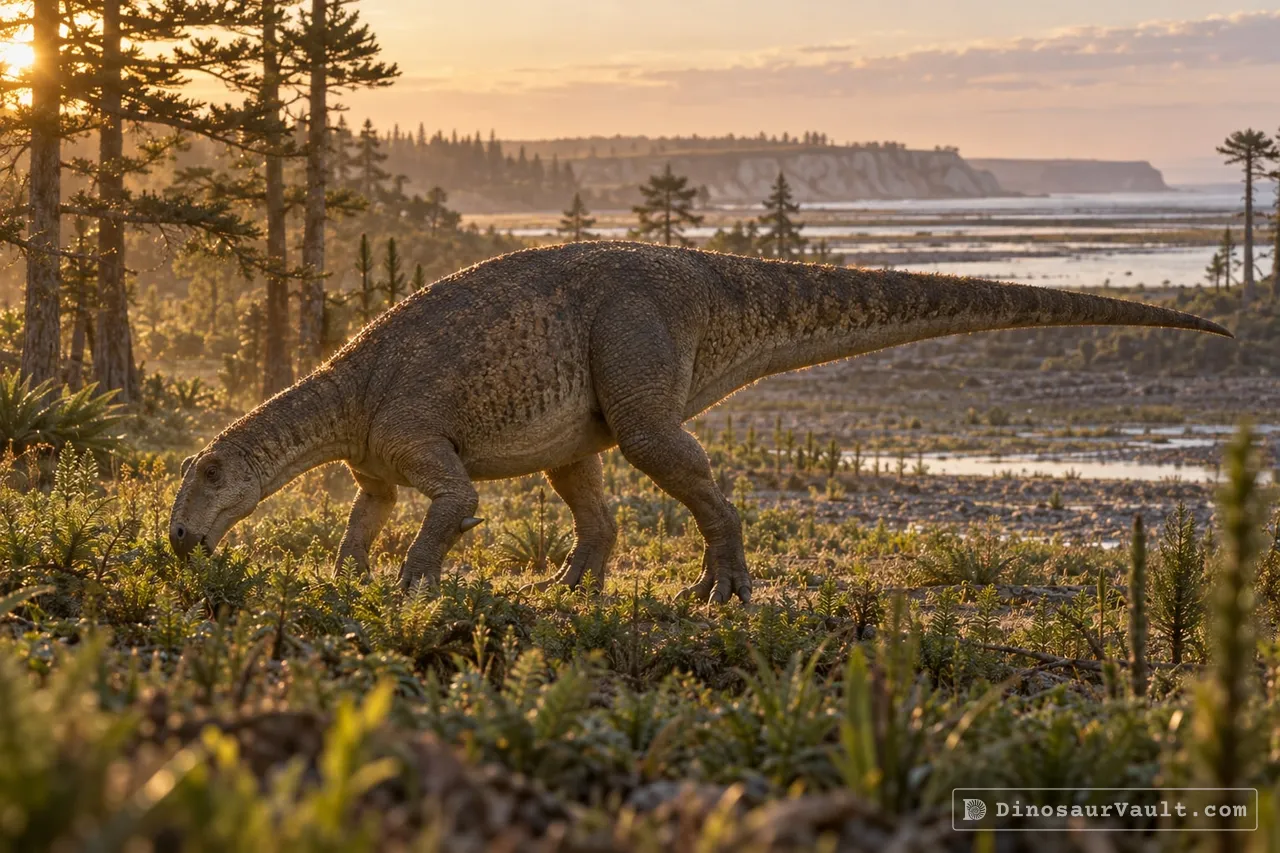
Owenodon was a plant eater related to Iguanodon, known from part of a lower jaw with teeth.
Its world
It lived in the Early Cretaceous in what is now England. Its fossil comes from the Lulworth Formation, where the small plant eater Echinodon also lived.
How it was found
Galton named it in 2009. The type species is Owenodon hoggii. The jaw had once been placed in other genera.
Field gallery
More views of Owenodon
Scenes reconstructed from the available fossil evidence.
Lived alongside
Found in the same rock formations


A rock formation can hold fossils laid down millions of years apart, so not every animal here met Owenodon.
The evidence
The science behind Owenodon
Which parts of the picture come from its own bones, and which come from its relatives.
From its own fossils
- The type specimen is a nearly complete right lower jaw bone with teeth.
- Its tooth row arches upward, and the front of the jaw tapers; the jaw is deeper than in Camptosaurus.
Borrowed from relatives
- Its missing upper skull, hands, feet and tail are compared with Iguanodon, a larger relative.
Still unknown
- Its full body size and proportions.
- Its exact place among the relatives of Iguanodon.
- Whether teeth attributed to it outside England belong to the same animal.
Discovery timeline
- 2008Family treeCarpenter & Wilson
- 2009Named itGalton
- 2012Family treeMcDonald
Key papers
The research behind what we know of Owenodon
Family tree
Compared the Owenodon jaw with Camptosaurus in a study of a Camptosaurus species from Utah.
A New Species of Camptosaurus (Ornithopoda: Dinosauria) from the Morrison Formation (Upper Jurassic) of Dinosaur National Monument, Utah, and a Biomechanical Analysis of Its Forelimb. Annals of Carnegie Museum 76: 227-263
Read the paper : A New Species of Camptosaurus (Ornithopoda: Dinosauria) from the Morrison Formation (Upper Jurassic) of Dinosaur National Monument, Utah, and a Biomechanical Analysis of Its Forelimb (opens in a new tab)Named it
Separated the old jaw from Camptosaurus and gave it the genus name Owenodon.
Notes on Neocomian (Lower Cretaceous) ornithopod dinosaurs from England - Hypsilophodon, Valdosaurus, "Camptosaurus", "Iguanodon" - and referred specimens from Romania and elsewhere. Revue de Paléobiologie, Genève 28: 211-273
No link available
Family tree
Included Owenodon in a broad family-tree analysis and showed how incomplete skeletons complicate the relationships of early iguanodonts.
Phylogeny of Basal Iguanodonts (Dinosauria: Ornithischia): An Update. PLoS ONE 7: e36745
Read the paper : Phylogeny of Basal Iguanodonts (Dinosauria: Ornithischia): An Update (opens in a new tab)
Close relatives
Other members of Dryomorpha


Sources: Wikidata