Nuthetes
"monitor"
Type species Nuthetes destructor
- Lived
- 143 to 137 million years ago, Early Cretaceous
- Diet
- Carnivore
- Group
- Theropods, Dromaeosauridae
- Found in
- United Kingdom and France
- Named by
- Owen 1854
Where its fossils were found
The evidence
Today

140 million years ago
Habitat
Shallow lakes and lagoons covered parts of its world in what is now England. Echinodon and Owenodon are other dinosaurs from the Lulworth Formation.
Field notes
About Nuthetes
What it was like
Nuthetes is known from small, blade-like teeth and a piece of jaw. The teeth belonged to a small theropod, perhaps a dromaeosaur or an early tyrannosaur relative.
Its world
It lived in the Early Cretaceous, in what is now England. It comes from the Lulworth Formation, where it lived beside the small plant eaters Echinodon and Owenodon.
How it was found
Owen named Nuthetes in 1854. The type species is Nuthetes destructor. Owen first thought the jaw belonged to a lizard. If it is a dromaeosaur, it was one of the first ever named.
Field gallery
More views of Nuthetes
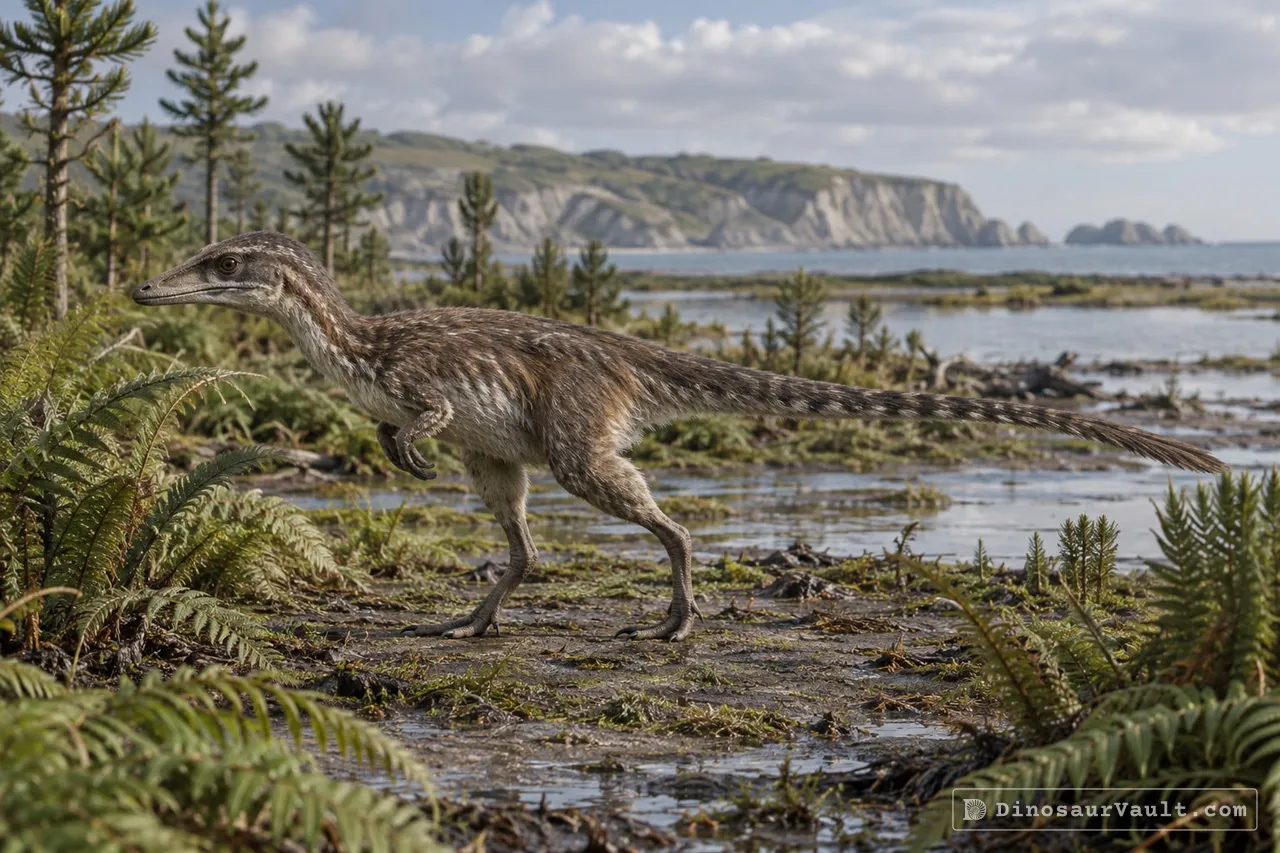
Scenes reconstructed from the available fossil evidence.
Lived alongside
Found in the same rock formations


A rock formation can hold fossils laid down millions of years apart, so not every animal here met Nuthetes.
The evidence
The science behind Nuthetes
Which parts of the picture come from its own bones, and which come from its relatives.
From its own fossils
- A fragment of lower jaw and isolated teeth are the main remains of Nuthetes.
- Its narrow teeth have cutting edges lined with small serrations.
Borrowed from relatives
- A body modeled on Velociraptor borrows its arms, legs and tail from that better-known dinosaur.
- A feathered covering follows feathered relatives if Nuthetes belongs among the dromaeosaurs.
Still unknown
- Whether it was a dromaeosaur or an early relative of tyrannosaurs.
- Its adult size and body proportions.
- Its color and feather covering.
Discovery timeline
- 1854Named it
- 2002Same rocksBarrett et al.
- 2010Family treeRAUHUT, MILNER & MOORE-FAY
Key papers
The research behind what we know of Nuthetes
Same rocks
Showed that small bony plates once assigned to Nuthetes were actually turtle limb armor.
Morphology, histology and identification of the ‘granicones’ from the Purbeck Limestone Formation (Lower Cretaceous: Berriasian) of Dorset, southern England. Cretaceous Research 23: 279-295
Read the paper : Morphology, histology and identification of the ‘granicones’ from the Purbeck Limestone Formation (Lower Cretaceous: Berriasian) of Dorset, southern England (opens in a new tab)Family tree
Described an early tyrannosaur relative with uneven tooth serrations, a feature also used to identify dromaeosaurs such as Nuthetes.
Cranial osteology and phylogenetic position of the theropod dinosaurProceratosaurus bradleyi(Woodward, 1910) from the Middle Jurassic of England. Zoological Journal of the Linnean Society 158: 155-195
Read the paper : Cranial osteology and phylogenetic position of the theropod dinosaurProceratosaurus bradleyi(Woodward, 1910) from the Middle Jurassic of England (opens in a new tab)
Close relatives
Other members of Dromaeosauridae


Sources: Wikidata