Echinodon
eh-KY-noh-don
"spiny tooth"
- Lived
- 143 to 137 million years ago, Early Cretaceous
- Diet
- Herbivore
- Group
- Early ornithischians, Heterodontosauridae
- Found in
- United Kingdom and France
- Named by
- Owen 1861
Where its fossils were found
The evidence
Today

140 million years ago
Habitat
Lagoons and dry scrub in England, with Nuthetes and Owenodon in the surrounding region.
Field notes
About Echinodon
What it was like
Echinodon was a tiny plant eater from the heterodontosaurid family. It is known from jaws and teeth. Like its relatives, it had teeth of different shapes, including small fangs near the front of its jaws.
Its world
It lived in the Early Cretaceous in what is now England, and it may also have lived in France. Its fossils come from the Lulworth Formation, a land of lagoons and dry scrub.
How it was found
Owen named Echinodon in 1861. It was one of the first small bird-hipped dinosaurs to be named.
Field gallery
More views of Echinodon
Scenes reconstructed from the available fossil evidence.
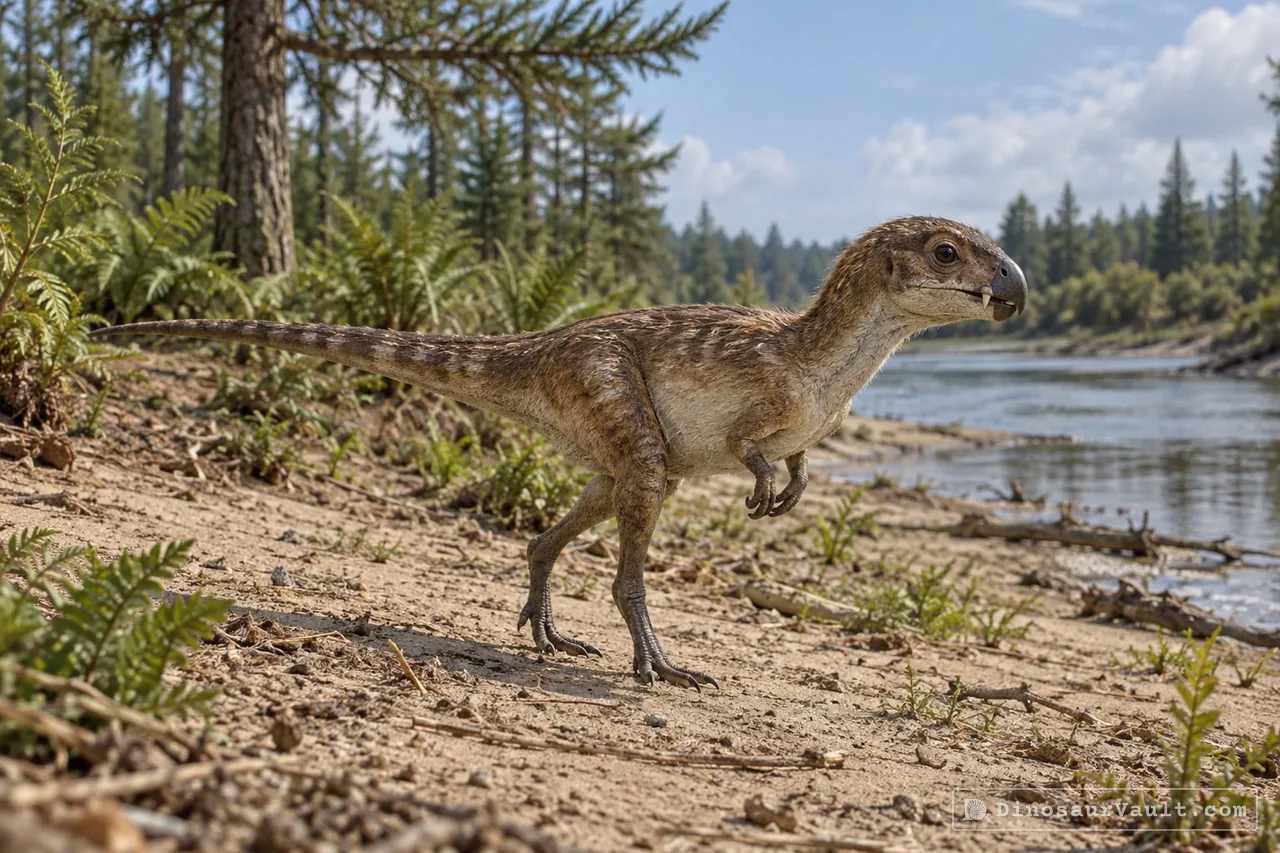
1 of 3
Lived alongside
Found in the same rock formations


A rock formation can hold fossils laid down millions of years apart, so not every animal here met Echinodon.
The evidence
The science behind Echinodon
Which parts of the picture come from its own bones, and which come from its relatives.
From its own fossils
- Fragments of upper and lower jaws with teeth, rather than a complete skull or skeleton.
- Small triangular cheek teeth with serrations near their tips and an enlarged fang-like tooth in the upper jaw.
- Stout lower jaws with toothless margins at the front.
Borrowed from relatives
- Tianyulong and Heterodontosaurus help restore the missing back of the skull, limbs and tail.
- The beak is restored from relatives, guided by the toothless front of its own lower jaws.
Still unknown
- The proportions of its limbs and tail.
- Whether it had a covering of bristles like Tianyulong.
- The age of the animals represented by the jaws.
Discovery timeline
- 1861Named itOwen
- 2012RedescriptionSereno
- 2012How it fedButler et al.
Key papers
The research behind what we know of Echinodon
Named it
Named Echinodon from small jaws and teeth found in England, initially treating it as a lizard.
Monograph on the fossil Reptilia of the Wealden and Purbeck formations. Part V. Lacertilia (Nuthetes, etc.). [Purbeck]. The Palaeontological Society, London 1858: 31-39
No link available
Redescription
Restudied the jaws and teeth of Echinodon, revised its diagnosis and compared it with other heterodontosaurids.
Taxonomy, morphology, masticatory function and phylogeny of heterodontosaurid dinosaurs. ZooKeys 226: 1-225
Read the paper : Taxonomy, morphology, masticatory function and phylogeny of heterodontosaurid dinosaurs (opens in a new tab)How it fed
Compared small heterodontosaurids and suggested that Echinodon and its relatives processed food with simple biting and crushing rather than heavy chewing.
Anatomy and Cranial Functional Morphology of the Small-Bodied Dinosaur Fruitadens haagarorum from the Upper Jurassic of the USA. PLoS ONE 7: e31556
Read the paper : Anatomy and Cranial Functional Morphology of the Small-Bodied Dinosaur Fruitadens haagarorum from the Upper Jurassic of the USA (opens in a new tab)
Close relatives
Other members of Heterodontosauridae


Sources: Wikidata