Stegopelta
"roofed shield"
Type species Stegopelta landerensis
- Lived
- 101 to 94 million years ago, Late Cretaceous
- Diet
- Herbivore
- Group
- Ankylosaurs, Nodosauridae
- Found in
- United States
- Named by
- Williston 1905
Where its fossils were found
The evidence
Today

95 million years ago
Habitat
It lived on land near the Western Interior Seaway in what is now Wyoming, and its remains were buried in marine sediments of the Frontier Formation. Nodosaurus lived in the same region.
Field notes
About Stegopelta
What it was like
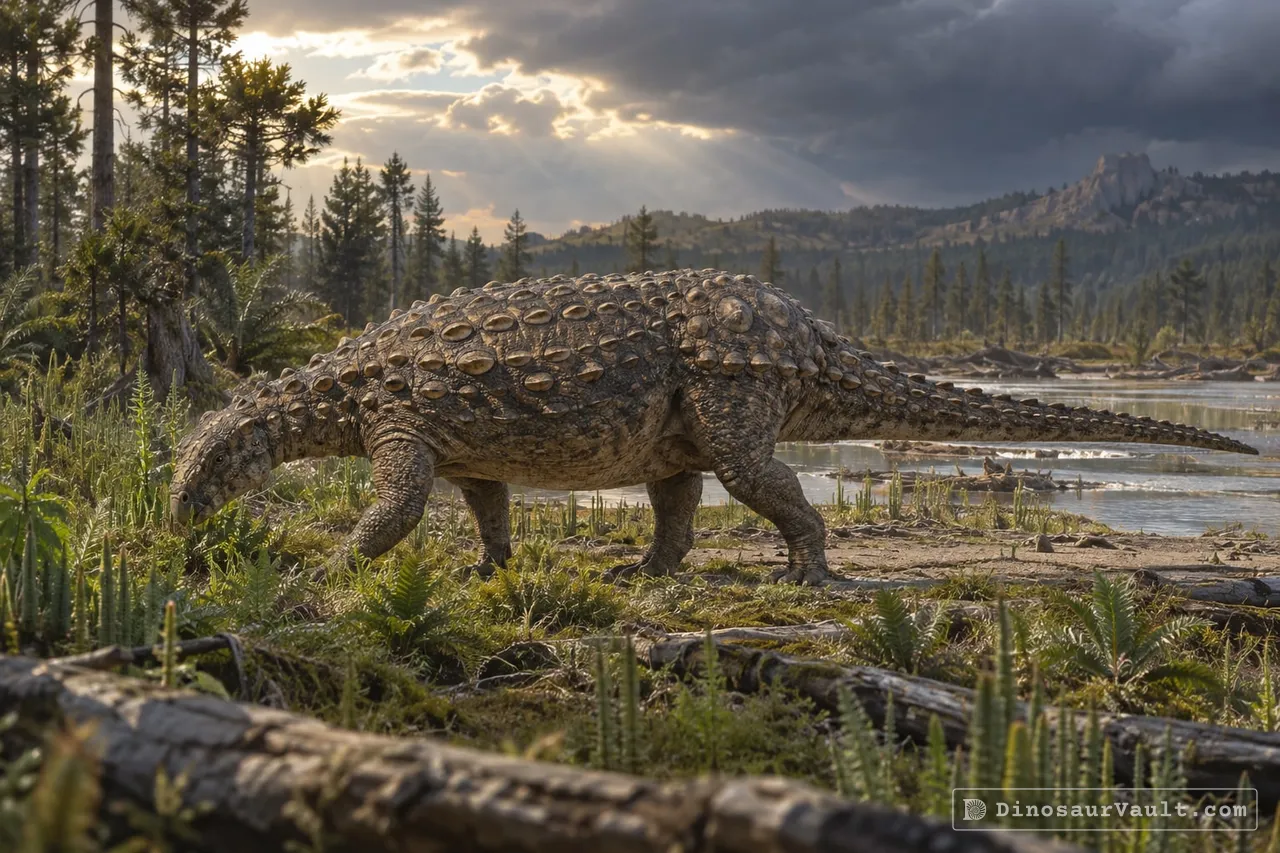
Stegopelta was a nodosaur, an armored plant eater without a tail club. It is known from a partial skeleton with pieces of its armor, including a shield of plates over the hips.
Its world
It lived in the Late Cretaceous in what is now Wyoming. Its bones come from the Frontier Formation. The armored Nodosaurus lived in the same region at around the same time.
How it was found
Williston named Stegopelta in 1905. The type species is Stegopelta landerensis.
Field gallery
More views of Stegopelta
Scenes reconstructed from the available fossil evidence.
1 of 3
Lived alongside
Found in the same rock formations

A rock formation can hold fossils laid down millions of years apart, so not every animal here met Stegopelta.
The evidence
The science behind Stegopelta
Which parts of the picture come from its own bones, and which come from its relatives.
From its own fossils
- A partial skeleton preserves jaw fragments, teeth, vertebrae, limb bones and bony armor.
- Polygon-shaped armor plates are fused into a shield over the hips, with gently raised centers.
- Armor from the neck, shoulders and trunk has pits and raised rough patches.
Borrowed from relatives
- Its missing trunk, limbs and feet are compared with Sauropelta, and its missing skull with Gargoyleosaurus, an earlier armored dinosaur.
Still unknown
- The shape of its complete skull.
- The arrangement of armor across the whole body.
- Its skin color.
Discovery timeline
- 1905Named itWilliston
- 2011SkinArbour, Burns & Currie
- 2018SkinMcDonald & Wolfe
- 2023Family treeRaven et al.
Key papers
The research behind what we know of Stegopelta
Named it
Named Stegopelta from a partial armored skeleton found in Wyoming.
A New Armored Dinosaur from the Upper Cretaceous of Wyoming. Science 22: 503-504
Read the paper : A New Armored Dinosaur from the Upper Cretaceous of Wyoming (opens in a new tab)Skin
Compared hip shields across armored dinosaurs, distinguishing arrangements of interlocking plates and fused plates, including the shield of Stegopelta.
A review of pelvic shield morphology in ankylosaurs (Dinosauria: Ornithischia). Journal of Paleontology 85: 298-302
Read the paper : A review of pelvic shield morphology in ankylosaurs (Dinosauria: Ornithischia) (opens in a new tab)Skin
Compared Stegopelta armor with another armored dinosaur, describing its pitted, rough surfaces and fused polygonal hip plates.
A new nodosaurid ankylosaur (Dinosauria: Thyreophora) from the Upper Cretaceous Menefee Formation of New Mexico. PeerJ 6: e5435
Read the paper : A new nodosaurid ankylosaur (Dinosauria: Thyreophora) from the Upper Cretaceous Menefee Formation of New Mexico (opens in a new tab)Family tree
Tested armored dinosaur relationships in a large analysis that includes Stegopelta, known only from fragmentary remains.
The phylogenetic relationships and evolutionary history of the armoured dinosaurs (Ornithischia: Thyreophora). Journal of Systematic Palaeontology 21
Read the paper : The phylogenetic relationships and evolutionary history of the armoured dinosaurs (Ornithischia: Thyreophora) (opens in a new tab)
Close relatives
Other members of Nodosauridae


Sources: Wikidata