Nanningosaurus
"Nanning lizard"
Type species Nanningosaurus dashiensis
- Lived
- 101 to 66 million years ago, Late Cretaceous
- Diet
- Herbivore
- Group
- Ornithopods
- Found in
- China
- Named by
- Mo et al. 2007
Where its fossils were found
The evidence
Today

80 million years ago
Habitat
It lived in an inland basin in southern China during the Late Cretaceous. The sauropod Qingxiusaurus also comes from the region's red beds.
Field notes
About Nanningosaurus
What it was like
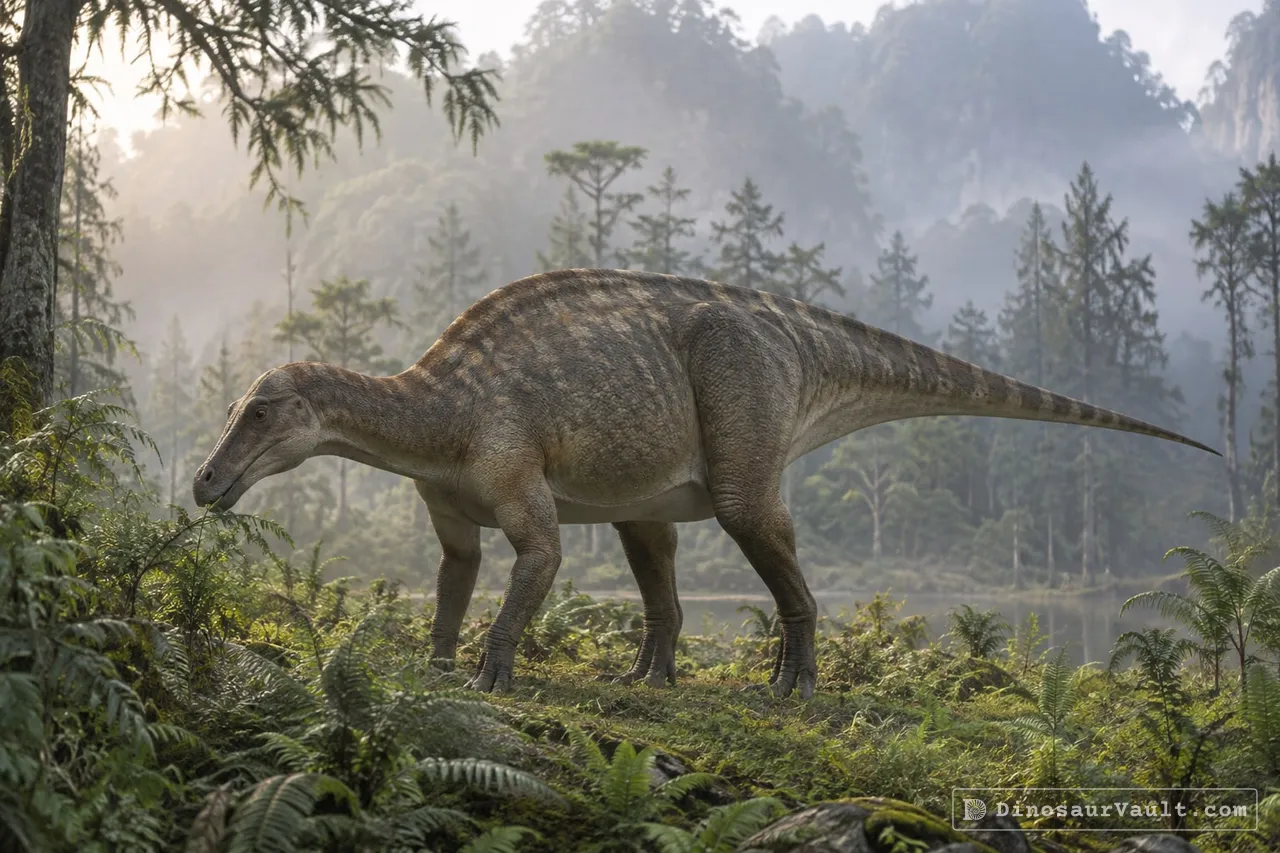
Nanningosaurus was a plant eater related to the duck-billed dinosaurs. Its known bones include parts of the skull and lower jaw, an upper arm bone and a hip bone.
Its world
It lived in the Late Cretaceous in what is now southern China.
How it was found
Mo and colleagues named Nanningosaurus in 2007, from a single find. Its name comes from a nearby city.
Field gallery
More views of Nanningosaurus
Scenes reconstructed from the available fossil evidence.
1 of 2
The evidence
The science behind Nanningosaurus
Which parts of the picture come from its own bones, and which come from its relatives.
From its own fossils
- Parts of the skull and lower jaw, an upper arm bone and a hip bone of a plant-eating dinosaur related to the duck-billed dinosaurs. The type specimen includes a left lower jaw and a loose tooth from the lower jaw.
- Its upper jaw has a tall, sharply peaked projection, and its lower-jaw teeth carry a winding main ridge and a smaller side ridge. The tall prong at the back of the lower jaw, where jaw muscles attached, tilts slightly forward and has a rounded top.
- The upper arm bone was slender with a low, rounded crest, and a long bone in the hip was curved near its lower end.
Borrowed from relatives
- The missing front of the head, the neck and the shoulders are restored by comparison with Gobihadros, a well-preserved early relative of the duck-billed dinosaurs.
Still unknown
- Whether its head carried a crest, and what shape it had.
- Its skin covering and color.
- Its place in the family tree. The first study grouped it with the crested duck-billed dinosaurs, while later studies placed it outside the duck-billed dinosaur family, and a recent one found it to be that family's closest relative.
Discovery timeline
- 2007Named itJinyou et al.
- 2014Family treeXing et al.
- 2019Close relativeTsogtbaatar et al.
Key papers
The research behind what we know of Nanningosaurus
Named it
Described bones of the jaws, upper arm and hip and proposed a relationship with the crested duck-billed dinosaurs.
The First Hadrosaurid Dinosaur from Southern China. Acta Geologica Sinica - English Edition 81: 550-554
Read the paper : The First Hadrosaurid Dinosaur from Southern China (opens in a new tab)Family tree
Placed Nanningosaurus outside the main duck-billed dinosaur family in a broad comparison of hadrosauroid relationships.
A New Basal Hadrosauroid Dinosaur (Dinosauria: Ornithopoda) with Transitional Features from the Late Cretaceous of Henan Province, China. PLoS ONE 9: e98821
Read the paper : A New Basal Hadrosauroid Dinosaur (Dinosauria: Ornithopoda) with Transitional Features from the Late Cretaceous of Henan Province, China (opens in a new tab)Close relative
Named Gobihadros from the Gobi Desert, an early duck-bill relative known from an uncrushed skull and a jointed skeleton.
A new hadrosauroid (Dinosauria: Ornithopoda) from the Late Cretaceous Baynshire Formation of the Gobi Desert (Mongolia). PLOS ONE 14: e0208480
Read the paper : A new hadrosauroid (Dinosauria: Ornithopoda) from the Late Cretaceous Baynshire Formation of the Gobi Desert (Mongolia) (opens in a new tab)
Close relatives
Other members of Hadrosauroidea


Sources: Wikidata