Nambalia
- Lived
- 227 to 206 million years ago, Late Triassic
- Found in
- India
- Named by
- Novas et al. 2011
Where its fossils were found
The evidence
Today

220 million years ago
Habitat
It lived in a river landscape in what is now India, recorded in the Maleri Formation. Jaklapallisaurus and other early dinosaur relatives also lived there.
Field notes
About Nambalia
What it was like
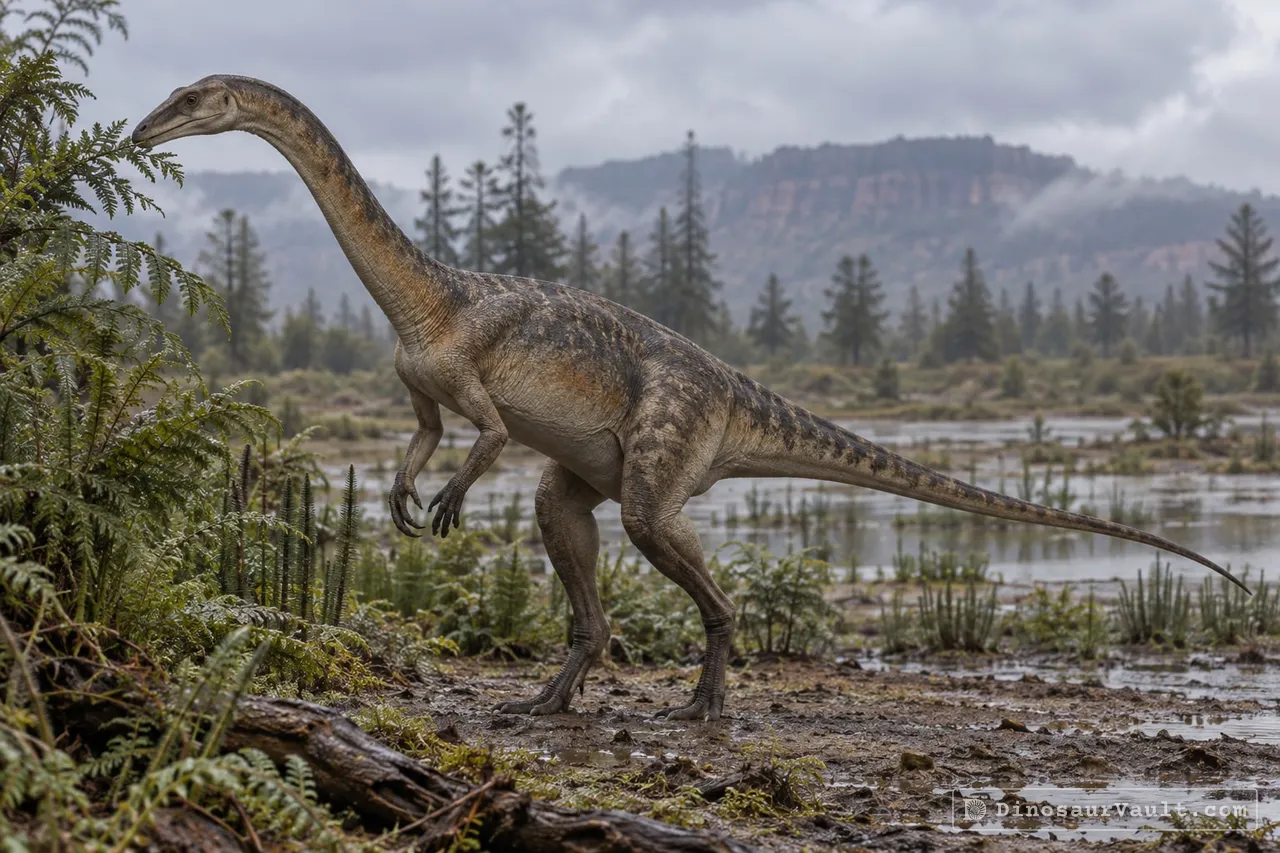
Nambalia was a small, early sauropodomorph, a plant eater that walked on two legs. It is known from part of the skeleton.
Its world
It lived in the Late Triassic, in what is now India. It comes from the Maleri Formation, where it shared the land with the early sauropodomorph Jaklapallisaurus.
How it was found
Novas and colleagues named Nambalia in 2011. Its name comes from the village near where it was found.
Field gallery
More views of Nambalia
Scenes reconstructed from the available fossil evidence.
1 of 3
Lived alongside
Found in the same rock formations


A rock formation can hold fossils laid down millions of years apart, so not every animal here met Nambalia.
The evidence
The science behind Nambalia
Which parts of the picture come from its own bones, and which come from its relatives.
From its own fossils
- The type specimen, found almost in its natural position, is a right hip bone, a left thigh bone and the lower ends of the left shin and calf bones with its ankle bones.
- Its thigh bone barely widens at the knee end and has a shallow groove at the front there. Together with the shape of its ankle bone, this sets it apart from other early sauropodomorphs.
- Matching ankle bones show at least three individuals of different sizes. Tail vertebrae, hip bones and slender hand and foot bones were assigned to them because they lay nearby and match in size, and the foot bones are proportionally longer than those of Jaklapallisaurus.
Borrowed from relatives
- Its missing head, neck, shoulders, arms and chest are restored by comparison with Plateosaurus, a better-known early sauropodomorph.
Still unknown
- Its skull, teeth and neck. None are among its described bones, and teeth found with it have not been securely assigned to it.
- Its closest relatives. Its describers placed it among the early sauropodomorphs, but its exact branch depends on the analysis.
- Its skin covering and color, and how its body proportions changed as it grew.
Discovery timeline
- 2011Named itNovas et al.
- 2021Family treeApaldetti et al.
- 2023Same rocksEzcurra et al.
Key papers
The research behind what we know of Nambalia
Named it
Named Nambalia and Jaklapallisaurus among new dinosaur finds that expanded the known variety of early dinosaurs in India.
New dinosaur species from the Upper Triassic Upper Maleri and Lower Dharmaram formations of Central India. Earth and Environmental Science Transactions of the Royal Society of Edinburgh 101: 333-349
No link available
Family tree
Compared sauropodomorph body plans and found that slender forms such as Nambalia retained similarities to earlier members of the group.
Sauropodomorph evolution across the Triassic–Jurassic boundary: body size, locomotion, and their influence on morphological disparity. Scientific Reports 11
Read the paper : Sauropodomorph evolution across the Triassic–Jurassic boundary: body size, locomotion, and their influence on morphological disparity (opens in a new tab)Same rocks
Described Jaklapallisaurus in detail and compared its thigh, ankle and foot bones with Nambalia from the same formation.
Osteology of the sauropodomorph dinosaur Jaklapallisaurus asymmetricus from the Late Triassic of central India. The Anatomical Record 307: 1093-1112
Read the paper : Osteology of the sauropodomorph dinosaur Jaklapallisaurus asymmetricus from the Late Triassic of central India (opens in a new tab)
Close relatives
Other members of Sauropodomorpha


Sources: Wikidata