Kaijutitan
"kaiju titan"
Type species Kaijutitan maui
- Lived
- 90 to 86 million years ago, Late Cretaceous
- Diet
- Herbivore
- Group
- Sauropods
- Found in
- Argentina
- Named by
- Filippi et al. 2019
Where its fossils were found
The evidence
Today

90 million years ago
Habitat
It lived on a floodplain in what is now Argentina. Murusraptor comes from the same formation, while Macrogryphosaurus lived in the wider region.
Field notes
About Kaijutitan
What it was like
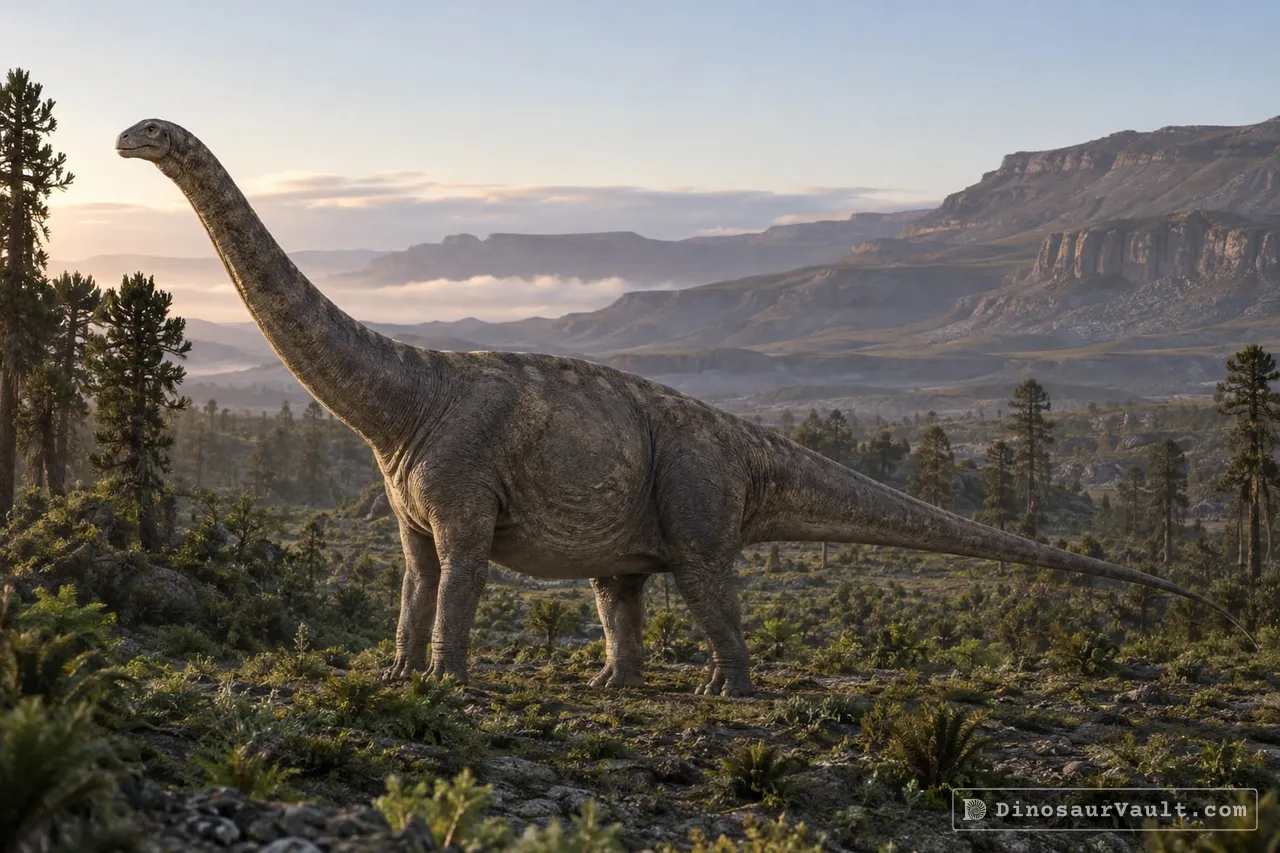
Kaijutitan was a large titanosaur, a long-necked, four-legged plant eater, known from part of the skull, neck, back and legs.
Its world
It lived in the Late Cretaceous in what is now Argentina. Its bones come from the Sierra Barrosa Formation, where it shared the land with the megaraptor Murusraptor.
How it was found
Filippi and colleagues named Kaijutitan in 2019, from a single find. Its name comes from the giant monsters of Japanese films.
Field gallery
More views of Kaijutitan
Scenes reconstructed from the available fossil evidence.
1 of 3
Lived alongside
Found in the same rock formations


A rock formation can hold fossils laid down millions of years apart, so not every animal here met Kaijutitan.
The evidence
The science behind Kaijutitan
Which parts of the picture come from its own bones, and which come from its relatives.
From its own fossils
- The associated type skeleton preserves an incomplete braincase, backbone and limb bones of a very large animal. The forearm has a moderately robust ulna and a narrow radius with an expanded lower end.
- The bony projections on top of the front neck vertebrae split into paired branches.
- Cracks and worn surfaces show that the bones weathered before their final burial.
Borrowed from relatives
- Tapuiasaurus, an early titanosaur, is a comparison for the missing face and jaws, and Mnyamawamtuka for parts of the neck and trunk. Preserved Kaijutitan limb bones guide those parts of its restoration.
Still unknown
- Its full length and weight, and whether it had finished growing.
- The shape of its complete skull and snout.
- Its skin color and pattern.
Discovery timeline
- 2016Same rocksCoria & Currie
- 2016SkullWilson et al.
- 2019Named itFilippi, Salgado & Garrido
- 2024Fossil sitesFilippi, Previtera & Garrido
Key papers
The research behind what we know of Kaijutitan
Same rocks
Described Murusraptor, a large meat eater from the same formation as Kaijutitan.
A New Megaraptoran Dinosaur (Dinosauria, Theropoda, Megaraptoridae) from the Late Cretaceous of Patagonia. PLOS ONE 11: e0157973
Read the paper : A New Megaraptoran Dinosaur (Dinosauria, Theropoda, Megaraptoridae) from the Late Cretaceous of Patagonia (opens in a new tab)Skull
Described the skull of Tapuiasaurus, an early titanosaur, a comparison for the missing face of Kaijutitan.
The skull of the titanosaurTapuiasaurus macedoi(Dinosauria: Sauropoda), a basal titanosaur from the Lower Cretaceous of Brazil. Zoological Journal of the Linnean Society 178: 611-662
Read the paper : The skull of the titanosaurTapuiasaurus macedoi(Dinosauria: Sauropoda), a basal titanosaur from the Lower Cretaceous of Brazil (opens in a new tab)Named it
Described a giant titanosaur with forked projections on its front neck vertebrae and a mix of early and specialized features.
A new giant basal titanosaur sauropod in the Upper Cretaceous (Coniacian) of the Neuquén Basin, Argentina. Cretaceous Research 100: 61-81
Read the paper : A new giant basal titanosaur sauropod in the Upper Cretaceous (Coniacian) of the Neuquén Basin, Argentina (opens in a new tab)Fossil sites
Studied the adult's bone tissue and burial history, finding that its remains weathered before burial in floodplain mud.
KAIJUTITAN MAUI, UN SAURÓPODO TITANOSAURIO DEL CRETÁCICO SUPERIOR (FORMACIÓN SIERRA BARROSA, CUENCA NEUQUINA) DEL NORTE DE PATAGONIA ARGENTINA: CONSIDERACIONES TAFONÓMICAS Y ANÁLISIS HISTOLÓGICO. Publicación Electrónica de la Asociación Paleontológica Argentina
Read the paper : KAIJUTITAN MAUI, UN SAURÓPODO TITANOSAURIO DEL CRETÁCICO SUPERIOR (FORMACIÓN SIERRA BARROSA, CUENCA NEUQUINA) DEL NORTE DE PATAGONIA ARGENTINA: CONSIDERACIONES TAFONÓMICAS Y ANÁLISIS HISTOLÓGICO (opens in a new tab)
Close relatives
Other members of Lithostrotia


Sources: Wikidata