Minotaurasaurus
Type species Minotaurasaurus ramachandrani
- Lived
- Cretaceous
- Diet
- Herbivore
- Group
- Ankylosaurs, Ankylosauridae
- Named by
- Miles and Miles 2009
Where its fossils were found
The evidence
Fossil record
Gobi Desert (inferred), Mongolia or China (uncertain)
Cretaceous; exact age unresolved
The skull passed through dealers without a recorded excavation site. Its surrounding rock suggests the Gobi Desert, but the original description could not establish which country or geological horizon it came from.
No finds with map coordinates are recorded yet.
Habitat
It probably inhabited a dry landscape with sand dunes in Mongolia. Protoceratops and Velociraptor lived in its likely home region.
Field notes
About Minotaurasaurus
What it was like
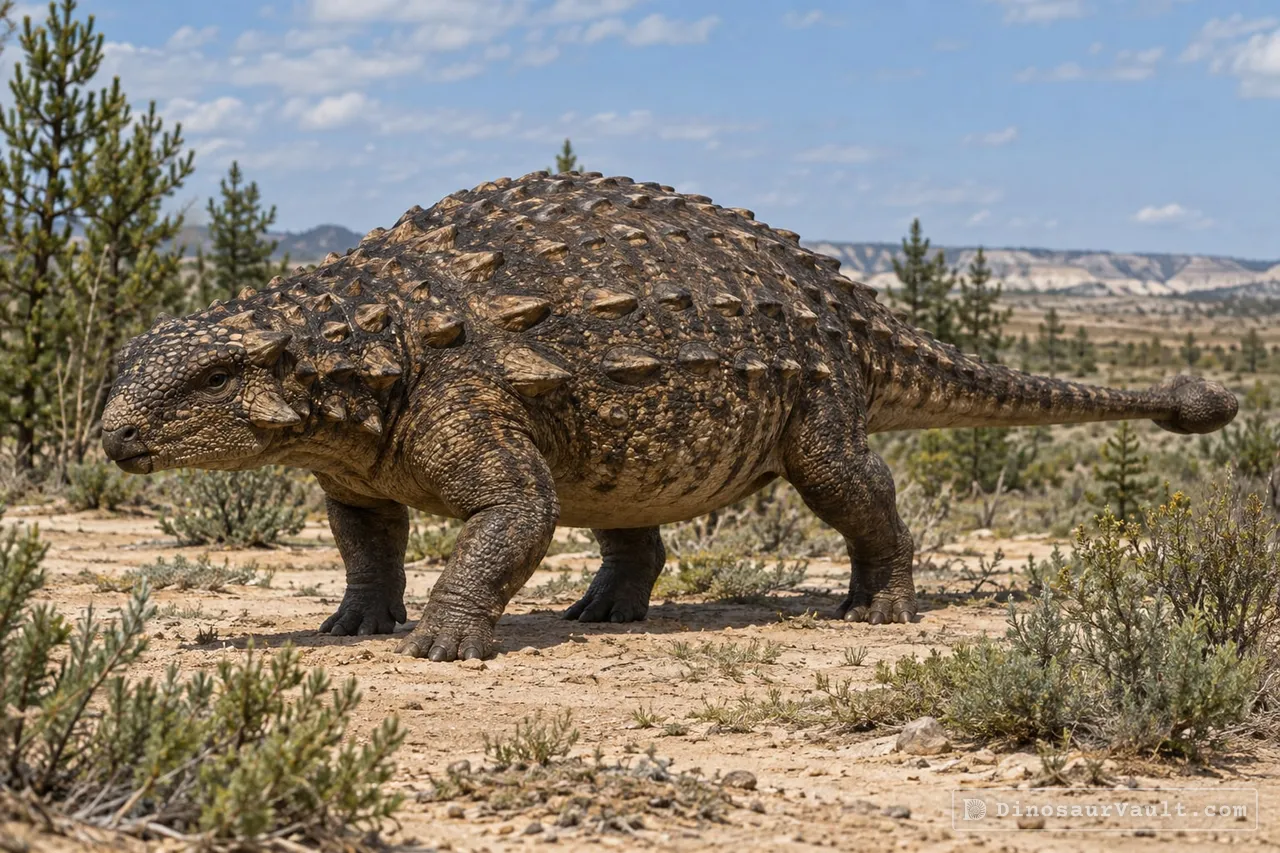
Minotaurasaurus was an ankylosaur, a low, armored plant eater. It is known from a skull with horns curving out at the back, which gave it its bull-like name.
How it was found
Miles and Miles named Minotaurasaurus in 2009. The type species is Minotaurasaurus ramachandrani. The skull was bought from a private collection, so where it was found is not well recorded. Some scientists think it is the same animal as Tarchia.
Field gallery
More views of Minotaurasaurus
Scenes reconstructed from the available fossil evidence.
1 of 3
The evidence
The science behind Minotaurasaurus
Which parts of the picture come from its own bones, and which come from its relatives.
From its own fossils
- A nearly complete skull and lower jaws preserve a broad beak and small, leaf-shaped teeth.
- Flared nostril rims and slender, pointed horns give the head its bull-like outline.
- Scans show that many pyramid-shaped bumps on the skull are sculpted skull bone.
Borrowed from relatives
- The broad body, stout limbs and clubbed tail are restored from relatives such as Saichania and Pinacosaurus.
Still unknown
- The precise place and rock layer where the original skull was found.
- The arrangement of armor across its body.
- Its color.
Discovery timeline
- 2009Named itMiles & Miles
- 2014Family treeArbour, Currie & Badamgarav
- 2017SkullPenkalski & Tumanova
Key papers
The research behind what we know of Minotaurasaurus
Named it
Described the skull, jaws and teeth, including flared nostrils and pointed horns, and used scans to examine the skull's bony ornament.
Skull of Minotaurasaurus ramachandrani, a new Cretaceous ankylosaur from the Gobi Desert. Current Science 96: 65-70
No link available
Family tree
Compared armored dinosaur skulls and proposed that Minotaurasaurus belonged to Tarchia, based on shared ornament behind the eye.
The ankylosaurid dinosaurs of the Upper Cretaceous Baruungoyot and Nemegt formations of Mongolia. Zoological Journal of the Linnean Society 172: 631-652
Read the paper : The ankylosaurid dinosaurs of the Upper Cretaceous Baruungoyot and Nemegt formations of Mongolia (opens in a new tab)Skull
Reexamined Tarchia skulls and found differences supporting Minotaurasaurus as a separate genus.
The cranial morphology and taxonomic status of Tarchia (Dinosauria: Ankylosauridae) from the Upper Cretaceous of Mongolia. Cretaceous Research 70: 117-127
Read the paper : The cranial morphology and taxonomic status of Tarchia (Dinosauria: Ankylosauridae) from the Upper Cretaceous of Mongolia (opens in a new tab)
Close relatives
Other members of Ankylosauridae


Sources: Wikidata