Musankwa
Type species Musankwa sanyatiensis
- Lived
- 237 to 206 million years ago, Late Triassic
- Found in
- Zimbabwe
- Named by
- Barrett et al. 2024
Where its fossils were found
The evidence
Today

220 million years ago
Habitat
A river floodplain in Zimbabwe that repeatedly flooded and dried out. The ground developed cracks and soils between floods.
Field notes
About Musankwa
What it was like
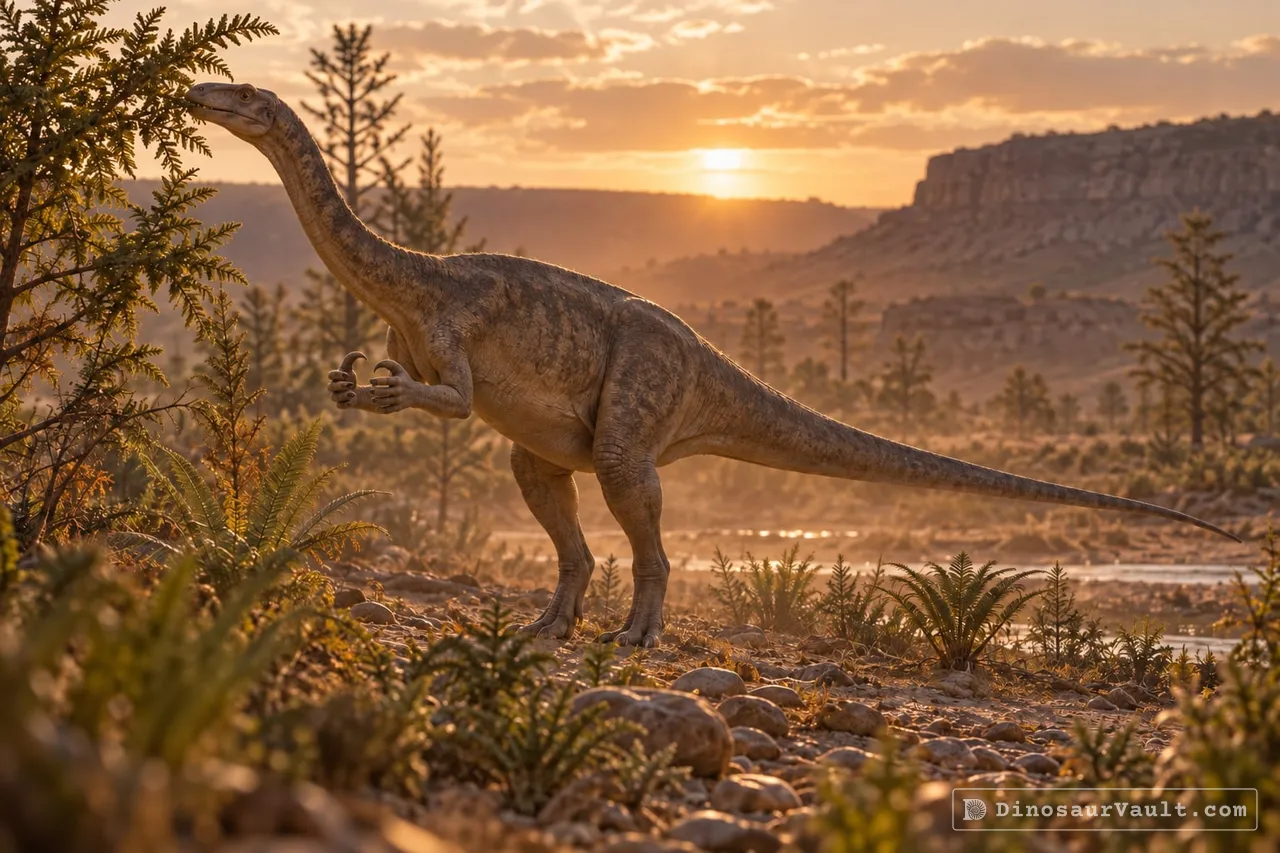
Musankwa was an early relative of the giant sauropods, a plant eater known from part of a hind leg.
Its world
It lived in the Late Triassic in what is now Zimbabwe. Its bones come from the Pebbly Arkose Formation, which formed along a river.
How it was found
Barrett and colleagues named it in 2024. The type species is Musankwa sanyatiensis. It was the fourth dinosaur named from Zimbabwe.
Field gallery
More views of Musankwa
Scenes reconstructed from the available fossil evidence.
Lived alongside
Found in the same rock formations

A rock formation can hold fossils laid down millions of years apart, so not every animal here met Musankwa.
The evidence
The science behind Musankwa
Which parts of the picture come from its own bones, and which come from its relatives.
From its own fossils
- The type specimen preserves part of a right hind leg: the thigh bone, shin bone and an ankle bone found together.
- The shapes of the leg joints and muscle attachments distinguish Musankwa from other early sauropodomorphs.
- The thigh bone curves in opposite directions along its length, and the shin bone is shorter than the thigh bone.
Borrowed from relatives
- Plateosaurus provides comparisons for the missing face, neck, tail, hands and feet.
Still unknown
- The shape of its skull and teeth, and its skin covering and color.
- Its closest relatives; its place among early sauropodomorphs has low support.
- Whether it sometimes walked on all fours.
Discovery timeline
- 2022Its worldGriffin et al.
- 2024Named itBarrett et al.
- 2025Family treeWang et al.
Key papers
The research behind what we know of Musankwa
Its world
Described the earlier Zimbabwe dinosaur Mbiresaurus and linked the spread of early dinosaurs to climate.
Africa’s oldest dinosaurs reveal early suppression of dinosaur distribution. Nature 609: 313-319
Read the paper : Africa’s oldest dinosaurs reveal early suppression of dinosaur distribution (opens in a new tab)Named it
Described associated hind-leg bones and identified Musankwa as an early branch of the sauropodomorph family tree.
A new sauropodomorph dinosaur from the Late Triassic of the Mid-Zambezi Basin, Zimbabwe. Acta Palaeontologica Polonica 69
Read the paper : A new sauropodomorph dinosaur from the Late Triassic of the Mid-Zambezi Basin, Zimbabwe (opens in a new tab)Family tree
Added Wudingloong to the early sauropodomorph family tree and included Musankwa in the comparison.
A new Early Jurassic dinosaur represents the earliest-diverging and oldest sauropodomorph of East Asia. Scientific Reports 15
Read the paper : A new Early Jurassic dinosaur represents the earliest-diverging and oldest sauropodomorph of East Asia (opens in a new tab)
Close relatives
Other members of Massopoda


Sources: Wikidata