Liubangosaurus
- Lived
- 121 to 113 million years ago, Early Cretaceous
- Diet
- Herbivore
- Group
- Sauropods
- Found in
- China
- Named by
- Mo et al. 2010
Where its fossils were found
The evidence
Today

115 million years ago
Habitat
It lived in a warm, dry region of southern China crossed by rivers. Other dinosaurs from the Xinlong Formation include Fusuisaurus, Datanglong and Napaisaurus.
Field notes
About Liubangosaurus
What it was like
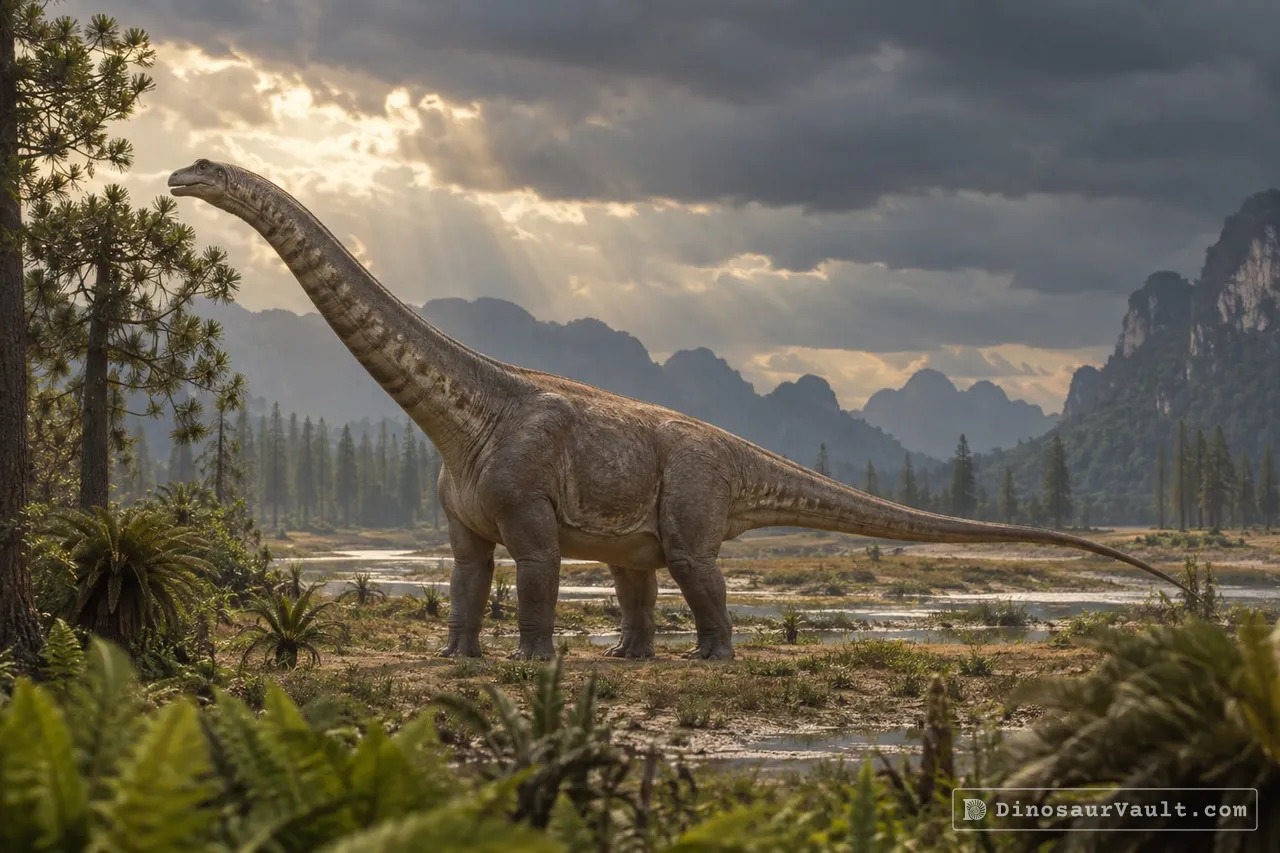
Liubangosaurus was a sauropod, a long-necked plant eater. It is known from a connected series of back vertebrae.
Its world
It lived in the Early Cretaceous, in what is now China. It comes from the Xinlong Formation, where it shared the land with the predator Datanglong and the sauropod Fusuisaurus.
How it was found
Mo and colleagues named Liubangosaurus in 2010. Its name comes from the village where it was found.
Field gallery
More views of Liubangosaurus
Scenes reconstructed from the available fossil evidence.
1 of 3
Lived alongside
Found in the same rock formations


A rock formation can hold fossils laid down millions of years apart, so not every animal here met Liubangosaurus.
The evidence
The science behind Liubangosaurus
Which parts of the picture come from its own bones, and which come from its relatives.
From its own fossils
- The named specimen is a connected series of five vertebrae from the middle and rear of the back, found in the same quarry as a separate skeleton of Fusuisaurus.
- The vertebrae have low spines that are widened from side to side.
- Pits and branching ridges on the vertebrae help distinguish Liubangosaurus from other sauropods.
Borrowed from relatives
- The missing head is restored by comparison with Euhelopus, a related sauropod with a known skull.
- The neck, limbs and tail are restored by comparison with more complete titanosauriforms such as Mnyamawamtuka and Lusotitan.
Still unknown
- Its total size and neck length.
- Its exact position among titanosauriform sauropods, though it is probably a somphospondylan.
- Its skin texture and color.
Discovery timeline
- 2010Named itMo, Xu & Buffetaut
- 2013Family treeMannion et al.
- 2015Its worldMO et al.
- 2026Family treeSethapanichsakul et al.
Key papers
The research behind what we know of Liubangosaurus
Named it
Named Liubangosaurus from five connected back vertebrae with low, widened spines and a distinctive pattern of pits and ridges.
A new eusauropod dinosaur from the Lower Cretaceous of Guangxi Province, southern China. Acta Geologica Sinica 84: 1328-1335
No link available
Family tree
Reexamined sauropod relationships and placed Liubangosaurus among titanosauriforms, changing its position from the original description.
Osteology of the Late Jurassic Portuguese sauropod dinosaurLusotitan atalaiensis(Macronaria) and the evolutionary history of basal titanosauriforms. Zoological Journal of the Linnean Society 168: 98-206
Read the paper : Osteology of the Late Jurassic Portuguese sauropod dinosaurLusotitan atalaiensis(Macronaria) and the evolutionary history of basal titanosauriforms (opens in a new tab)Its world
Reviewed Liubangosaurus and its neighbors, describing river deposits and a warm, dry climate in southern China.
Early Cretaceous vertebrates from the Xinlong Formation of Guangxi (southern China): a review. Geological Magazine 153: 143-159
Read the paper : Early Cretaceous vertebrates from the Xinlong Formation of Guangxi (southern China): a review (opens in a new tab)Family tree
Named Nagatitan from Thailand and listed a dozen features of the back vertebrae that set it apart from Liubangosaurus.
The first sauropod dinosaur from the Lower Cretaceous Khok Kruat Formation of Thailand enriches the diversity of somphospondylan titanosauriforms in southeast Asia. Scientific Reports 16
Read the paper : The first sauropod dinosaur from the Lower Cretaceous Khok Kruat Formation of Thailand enriches the diversity of somphospondylan titanosauriforms in southeast Asia (opens in a new tab)
Close relatives
Other members of Somphospondyli


Sources: Wikidata