Datanglong
"Datang dragon"
- Lived
- 121 to 113 million years ago, Early Cretaceous
- Diet
- Carnivore
- Group
- Theropods
- Found in
- China
- Named by
- Mo et al. 2014
Where its fossils were found
The evidence
Today

115 million years ago
Habitat
Rivers crossed a warm, dry landscape in southern China. The Xinlong Formation also contains the long-necked Fusuisaurus and Liubangosaurus.
Field notes
About Datanglong
What it was like
Datanglong was a large meat eater known only from part of the hips and backbone. Its bones had air spaces and hint that it was a relative of the carcharodontosaurs, though its exact place is uncertain.
Its world
It lived about 121 to 113 million years ago, in the Early Cretaceous, in what is now southern China. Its bones come from the Xinlong Formation, where it shared the land with the long-necked Fusuisaurus and Liubangosaurus.
How it was found
Mo and colleagues named Datanglong in 2014, from a single find.
Field gallery
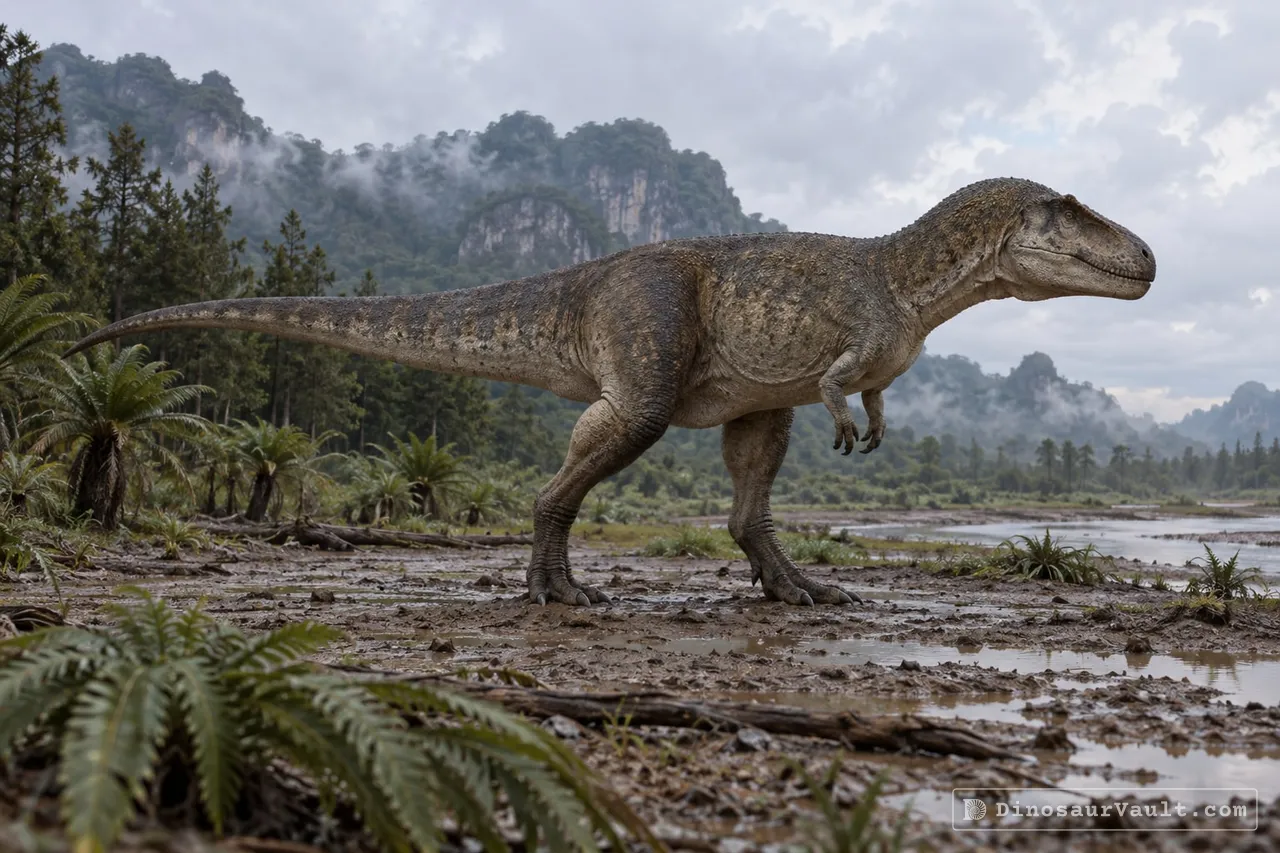
More views of Datanglong
Scenes reconstructed from the available fossil evidence.
Lived alongside
Found in the same rock formations


A rock formation can hold fossils laid down millions of years apart, so not every animal here met Datanglong.
The evidence
The science behind Datanglong
Which parts of the picture come from its own bones, and which come from its relatives.
From its own fossils
- Part of the backbone and hips preserves the rear of the back, the fused hip vertebrae and the beginning of the tail.
- The upper hip bone has large openings leading into internal air spaces.
Borrowed from relatives
- The head, arms and legs in a restoration follow comparisons with other large theropods, such as Allosaurus.
Still unknown
- Its exact place in the theropod family tree.
- The shape of its skull and the length of its arms.
- Its skin covering and color.
Discovery timeline
- 2014Named itMO et al.
- 2015Its worldMO et al.
- 2019Family treeSamathi, Chanthasit & Sander
Key papers
The research behind what we know of Datanglong
Named it
Named a large theropod from hips and backbone, and placed it among the carcharodontosaurs.
A New Carcharodontosauria (Theropoda) from the Early Cretaceous of Guangxi, Southern China. Acta Geologica Sinica - English Edition 88: 1051-1059
Read the paper : A New Carcharodontosauria (Theropoda) from the Early Cretaceous of Guangxi, Southern China (opens in a new tab)Its world
Reviewed the animals from the Xinlong Formation and linked its river deposits to a warm, dry climate.
Early Cretaceous vertebrates from the Xinlong Formation of Guangxi (southern China): a review. Geological Magazine 153: 143-159
Read the paper : Early Cretaceous vertebrates from the Xinlong Formation of Guangxi (southern China): a review (opens in a new tab)Family tree
Compared Datanglong's hip vertebrae with those of newly described theropods from Thailand.
Two new basal coelurosaurian theropod dinosaurs from the Early Cretaceous Sao Khua Formation of Thailand. Acta Palaeontologica Polonica 64
Read the paper : Two new basal coelurosaurian theropod dinosaurs from the Early Cretaceous Sao Khua Formation of Thailand (opens in a new tab)
Close relatives
Other members of Carcharodontosauria


Sources: Wikidata