Leinkupal
"vanishing family"
- Lived
- 139 to 133 million years ago, Early Cretaceous
- Diet
- Herbivore
- Group
- Sauropods, Diplodocidae
- Found in
- Argentina
- Named by
- Gallina et al. 2014
Where its fossils were found
The evidence
Today

135 million years ago
Habitat
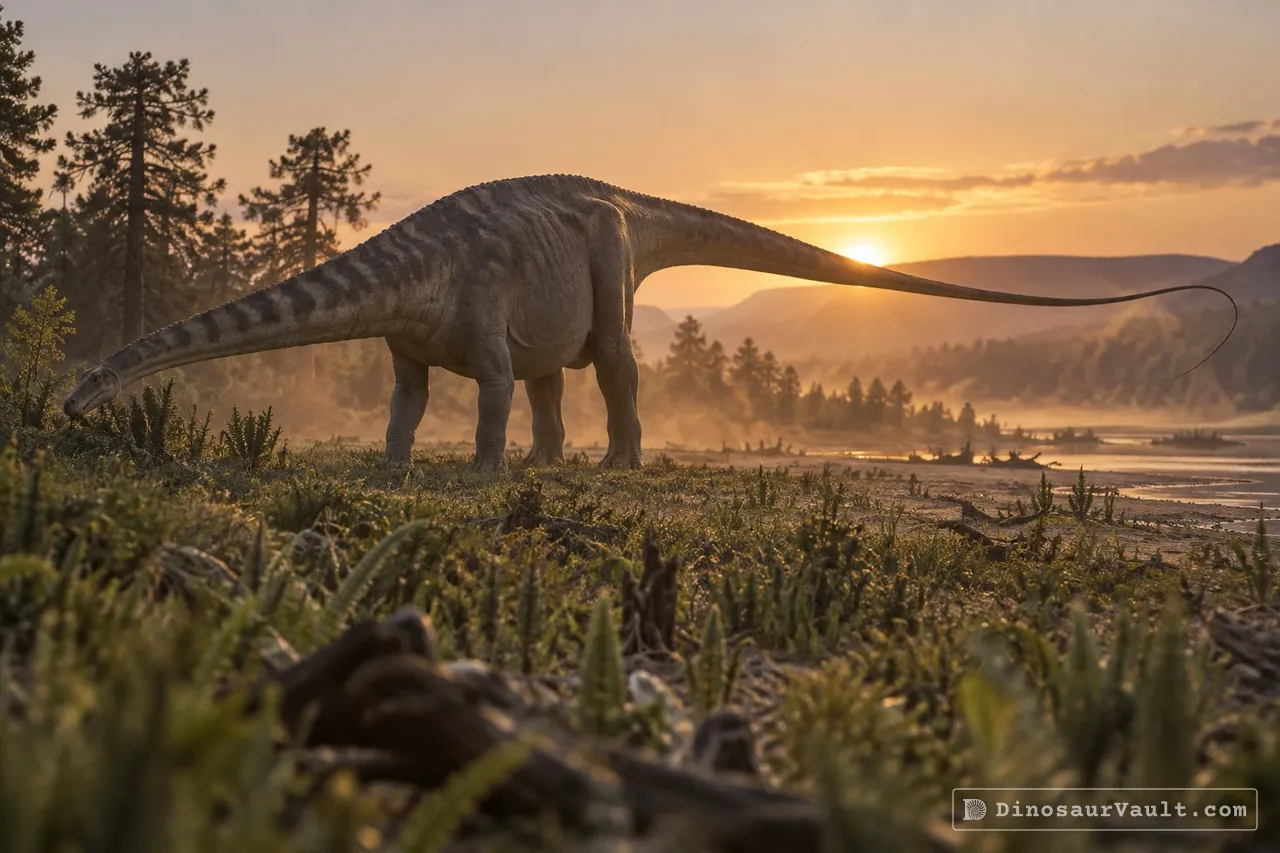
Branching river channels crossed the Bajada Colorada landscape in Argentina. Other sauropods from these rocks include Bajadasaurus and Ninjatitan.
Field notes
About Leinkupal
What it was like
Leinkupal was a diplodocid, a long-necked, whip-tailed sauropod related to Diplodocus. It is securely known from a single tail vertebra. Neck, back and more tail bones from the same mixed quarry have been assigned to it, but their identity is uncertain.
Its world
It lived in the Early Cretaceous, in what is now Argentina. It comes from the Bajada Colorada Formation, where it shared the land with the spiny-necked Bajadasaurus and the early titanosaur Ninjatitan. It was one of the last diplodocids, a family that was disappearing by then.
How it was found
Gallina and colleagues named Leinkupal in 2014.
Field gallery
More views of Leinkupal
Scenes reconstructed from the available fossil evidence.
Lived alongside
Found in the same rock formations


A rock formation can hold fossils laid down millions of years apart, so not every animal here met Leinkupal.
The evidence
The science behind Leinkupal
Which parts of the picture come from its own bones, and which come from its relatives.
From its own fossils
- The type specimen is a single vertebra from the front of the tail. Its sideways projections are greatly extended, a sturdy bony ridge runs to its front joints, and paired hollows beside its rear joints are linked to air sacs.
- Neck, back and more tail vertebrae from the same quarry were also assigned to it, but later studies treat them as uncertain because that quarry also holds bones of dicraeosaurs.
Borrowed from relatives
- Its missing head and neck are restored after Diplodocus.
Still unknown
- Its full body size.
- Its closest relative. The naming paper and one later study placed it next to Tornieria, while another study put it among later diplodocines near Galeamopus.
- Whether a later braincase find, and the neck and back bones from its quarry, belong to Leinkupal.
Discovery timeline
- 2014Named itGallina et al.
- 2015Family treeTschopp, Mateus & Benson
- 2019Same rocksGallina et al.
- 2022SkullGarderes et al.
- 2025Family treeMannion & Moore
Key papers
The research behind what we know of Leinkupal
Named it
Named the first confirmed South American diplodocid, showing that this family survived into the Early Cretaceous.
A Diplodocid Sauropod Survivor from the Early Cretaceous of South America. PLoS ONE 9: e97128
Read the paper : A Diplodocid Sauropod Survivor from the Early Cretaceous of South America (opens in a new tab)Family tree
A specimen-by-specimen study of diplodocids that kept Leinkupal as a separate genus based on its type tail bone alone, placing it among later diplodocines.
A specimen-level phylogenetic analysis and taxonomic revision of Diplodocidae (Dinosauria, Sauropoda). PeerJ 3: e857
Read the paper : A specimen-level phylogenetic analysis and taxonomic revision of Diplodocidae (Dinosauria, Sauropoda) (opens in a new tab)Same rocks
Described Bajadasaurus from the same formation, with long neck spines that pointed forward and may have helped defend it.
A new long-spined dinosaur from Patagonia sheds light on sauropod defense system. Scientific Reports 9
Read the paper : A new long-spined dinosaur from Patagonia sheds light on sauropod defense system (opens in a new tab)Skull
Studied a partial diplodocid braincase tentatively assigned to Leinkupal, comparing its brain and inner ear with those of other diplodocids.
Neuroanatomy of a diplodocid sauropod dinosaur from the Lower Cretaceous of Patagonia, Argentina. Cretaceous Research 129: 105024
Read the paper : Neuroanatomy of a diplodocid sauropod dinosaur from the Lower Cretaceous of Patagonia, Argentina (opens in a new tab)Family tree
A revised family tree of diplodocoids that kept Leinkupal as a distinct genus and, in one analysis, found it closest to Tornieria.
Critical reappraisal of a putative dicraeosaurid sauropod dinosaur from the Middle Jurassic of Gondwana and a revised view of diplodocoid evolutionary relationships and biogeography. Journal of Systematic Palaeontology 23
Read the paper : Critical reappraisal of a putative dicraeosaurid sauropod dinosaur from the Middle Jurassic of Gondwana and a revised view of diplodocoid evolutionary relationships and biogeography (opens in a new tab)
Close relatives
Other members of Diplodocidae


Sources: Wikidata