Kurupi
Type species Kurupi itaata
- Lived
- 72 to 66 million years ago, Late Cretaceous
- Diet
- Carnivore
- Group
- Theropods, Abelisauridae
- Found in
- Brazil
- Named by
- Iori et al. 2021
Where its fossils were found
The evidence
Today

70 million years ago
Habitat
It lived in a semiarid landscape in what is now Brazil, with long dry spells. Aeolosaurus is among the titanosaurs recorded from the same rocks.
Field notes
About Kurupi
What it was like
Kurupi was an abelisaur, a predator with tiny arms. It is known from the hips and part of the tail, which suggest a stiff, strong tail base.
Its world
It lived about 72 to 66 million years ago, near the end of the Cretaceous, in what is now Brazil. It comes from the Marília Formation, where the titanosaur Aeolosaurus also lived.
How it was found
Iori and colleagues named Kurupi in 2021. The type species is Kurupi itaata. Its name comes from a figure of local legend.
Field gallery
More views of Kurupi
Scenes reconstructed from the available fossil evidence.
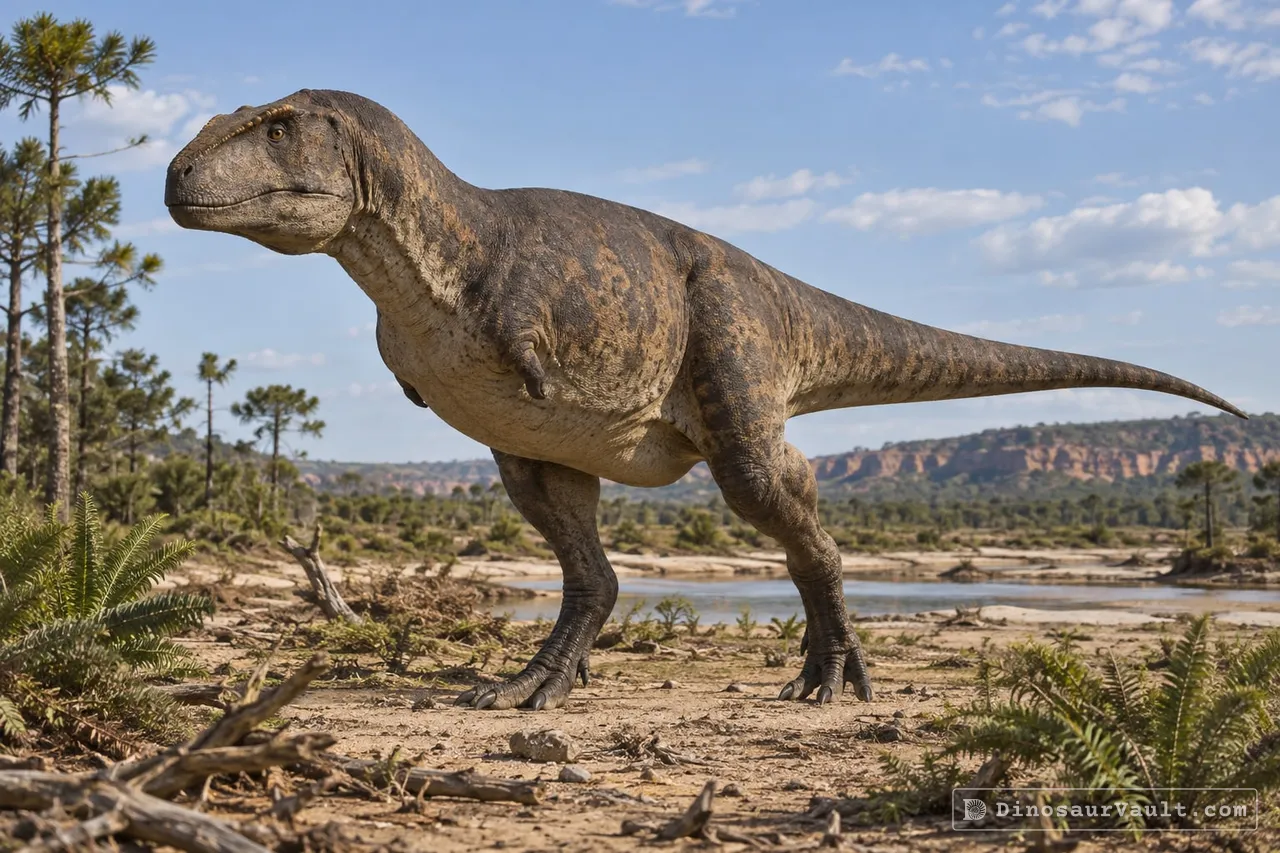
1 of 2
Lived alongside
Found in the same rock formations

A rock formation can hold fossils laid down millions of years apart, so not every animal here met Kurupi.
The evidence
The science behind Kurupi
Which parts of the picture come from its own bones, and which come from its relatives.
From its own fossils
- Part of the pelvis and several tail vertebrae establish Kurupi as an abelisaurid predator.
- Broad projections on the tail vertebrae provided attachment areas for muscles.
- The bones suggest a muscular, relatively stiff tail base.
Borrowed from relatives
- Majungasaurus helps restore the missing short, deep head and most of the body.
- The tiny arms and reduced fingers follow abelisaurid relatives such as Majungasaurus.
Still unknown
- The shape of its skull and whether it had head ornaments.
- Its full body proportions and the exact form of its hands and feet.
- Its skin covering and color.
Often drawn wrong
- The projections on its tail vertebrae belong beneath the muscles and skin, rather than sticking out as fins or spikes.
- The horns of Carnotaurus or the head dome of Majungasaurus should not be copied onto Kurupi.
Discovery timeline
- 2007Close relativeSampson & Witmer
- 2012Close relativeBurch & Carrano
- 2021Named itIori et al.
Key papers
The research behind what we know of Kurupi
Close relative
Described the short, deep skull of Majungasaurus, providing a comparison for the missing head of Kurupi.
CRANIOFACIAL ANATOMY OF MAJUNGASAURUS CRENATISSIMUS (THEROPODA: ABELISAURIDAE) FROM THE LATE CRETACEOUS OF MADAGASCAR. Journal of Vertebrate Paleontology 27: 32-104
Read the paper : CRANIOFACIAL ANATOMY OF MAJUNGASAURUS CRENATISSIMUS (THEROPODA: ABELISAURIDAE) FROM THE LATE CRETACEOUS OF MADAGASCAR (opens in a new tab)Close relative
Described the very short forearms and reduced hands of Majungasaurus, helping restore the missing arms of Kurupi.
An articulated pectoral girdle and forelimb of the abelisaurid theropod Majungasaurus crenatissimus from the Late Cretaceous of Madagascar. Journal of Vertebrate Paleontology 32: 1-16
Read the paper : An articulated pectoral girdle and forelimb of the abelisaurid theropod Majungasaurus crenatissimus from the Late Cretaceous of Madagascar (opens in a new tab)Named it
Named Kurupi from pelvic and tail bones, identifying an abelisaurid with a muscular, relatively stiff tail.
New theropod dinosaur from the Late Cretaceous of Brazil improves abelisaurid diversity. Journal of South American Earth Sciences 112: 103551
Read the paper : New theropod dinosaur from the Late Cretaceous of Brazil improves abelisaurid diversity (opens in a new tab)
Close relatives
Other members of Abelisauridae


Sources: Wikidata