Kangnasaurus
- Lived
- 101 to 66 million years ago, Late Cretaceous
- Diet
- Herbivore
- Group
- Ornithopods
- Found in
- South Africa
- Named by
- Haughton 1915
Where its fossils were found
The evidence
Today

80 million years ago
Habitat
The fossil-bearing sediments filled an ancient crater lake in what is now South Africa.
Field notes
About Kangnasaurus
What it was like
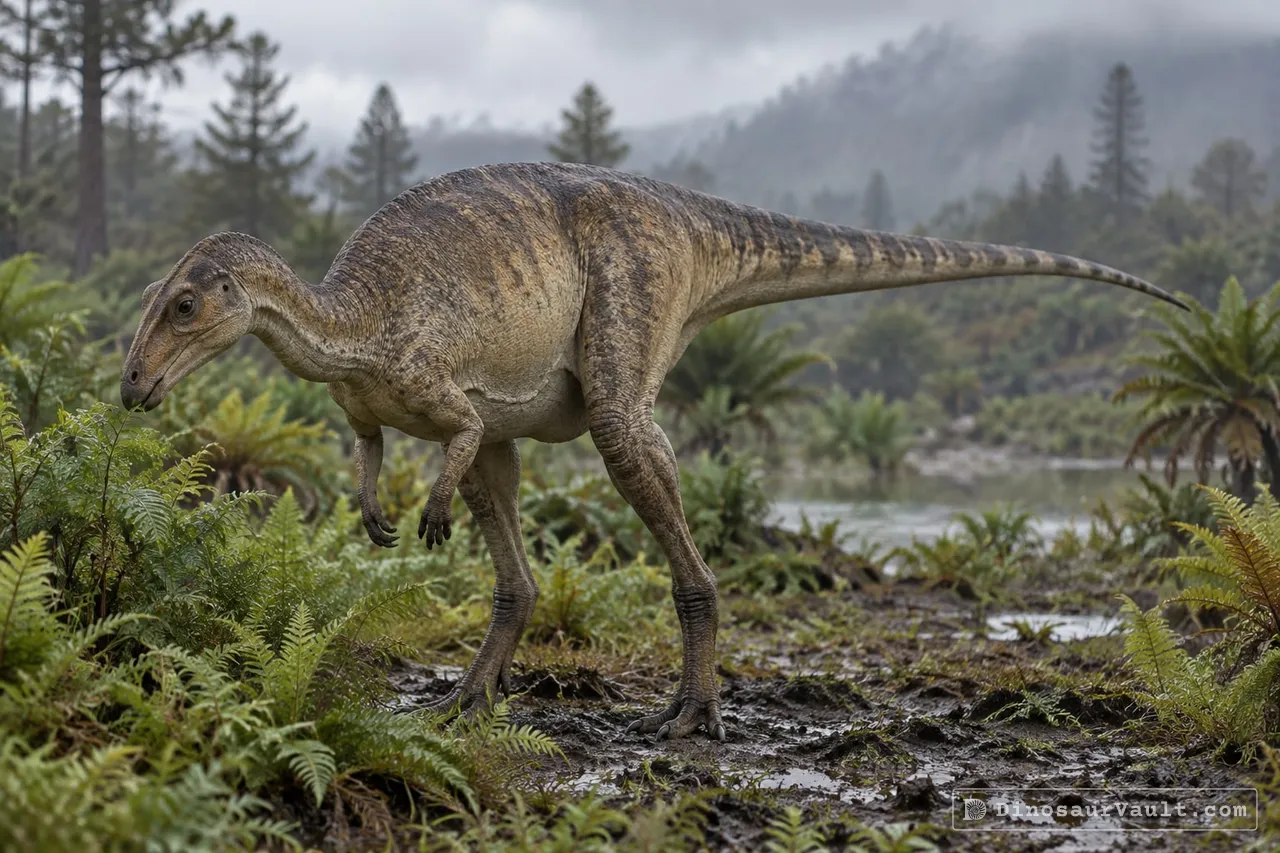
Kangnasaurus was a small plant eater known from a tooth and perhaps some leg bones. It may have been an elasmarian, a group of ornithopods found in the southern continents.
Its world
It lived in the Cretaceous, in what is now South Africa. The fossils were found in a well, so their exact age is uncertain.
How it was found
Haughton named Kangnasaurus in 1915. Its name comes from the farm where it was found.
Field gallery
More views of Kangnasaurus
Scenes reconstructed from the available fossil evidence.
The evidence
The science behind Kangnasaurus
Which parts of the picture come from its own bones, and which come from its relatives.
From its own fossils
- The tooth used to name Kangnasaurus has a prominent ridge down its crown.
- Scattered bones collected with the tooth include parts of the legs and backbone.
Borrowed from relatives
- The missing body is restored by comparison with small ornithopods such as Dryosaurus.
Still unknown
- Which of the scattered bones belong to Kangnasaurus.
- Its exact age and place in the ornithopod family tree.
- Its complete body shape, size and color.
Discovery timeline
- 1915Named itHaughton
- 2014Family treeEscaso et al.
- 2022Fossil sitesForster et al.
Key papers
The research behind what we know of Kangnasaurus
Named it
Named Kangnasaurus from a tooth recovered during well digging in South Africa and described other bones from the area.
ON SOME DINOSAUR REMAINS FROM BUSHMANLAND. Transactions of the Royal Society of South Africa 5: 259-264
Read the paper : ON SOME DINOSAUR REMAINS FROM BUSHMANLAND (opens in a new tab)Family tree
Placed Kangnasaurus near Dryosaurus and Eousdryosaurus in a family tree, offering one interpretation of its relationships.
A new dryosaurid ornithopod (Dinosauria, Ornithischia) from the Late Jurassic of Portugal. Journal of Vertebrate Paleontology 34: 1102-1112
Read the paper : A new dryosaurid ornithopod (Dinosauria, Ornithischia) from the Late Jurassic of Portugal (opens in a new tab)Fossil sites
Reviewed the scattered Kangnasaurus fossils, their disputed classification and geological arguments for a Late Cretaceous age while describing Iyuku.
Iyuku raathi, a new iguanodontian dinosaur from the Early Cretaceous Kirkwood Formation, South Africa. The Anatomical Record 306: 1762-1803
Read the paper : Iyuku raathi, a new iguanodontian dinosaur from the Early Cretaceous Kirkwood Formation, South Africa (opens in a new tab)
Close relatives
Other members of Elasmaria


Sources: Wikidata