Jinyunpelta
"Jinyun shield"
- Lived
- 113 to 101 million years ago, Early Cretaceous
- Diet
- Herbivore
- Group
- Ankylosaurs, Ankylosauridae
- Found in
- China
- Named by
- Zheng et al. 2018
Where its fossils were found
The evidence
Today

105 million years ago
Habitat
It lived around shallow lakes in what is now China. Its fossils come from the Liangtoutang Formation, which also preserves the small plant eater Yueosaurus.
Field notes
About Jinyunpelta
What it was like
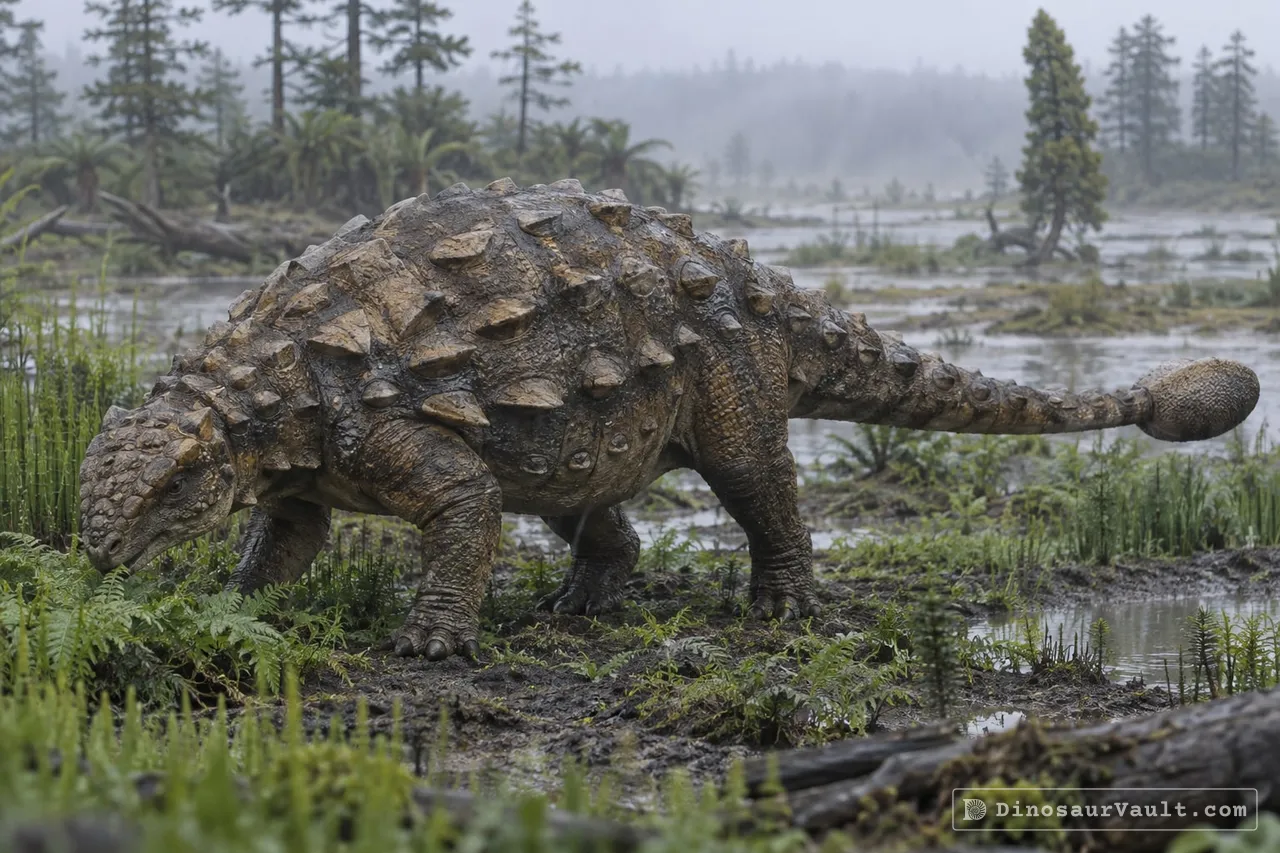
Jinyunpelta was an ankylosaur with a tail club. It is one of the oldest known ankylosaurs with a club, and its skull and club are well preserved.
Its world
It lived in the Cretaceous, in what is now China. It comes from the Liangtoutang Formation, where the small plant eater Yueosaurus also lived.
How it was found
Zheng and colleagues named Jinyunpelta in 2018.
Field gallery
More views of Jinyunpelta
Scenes reconstructed from the available fossil evidence.
1 of 3
Lived alongside
Found in the same rock formations

A rock formation can hold fossils laid down millions of years apart, so not every animal here met Jinyunpelta.
The evidence
The science behind Jinyunpelta
Which parts of the picture come from its own bones, and which come from its relatives.
From its own fossils
- An almost complete skull and partial skeletons preserve its jaws, backbones, limb bones and armor.
- The tail club had a stiff handle of tightly interlocking backbones reinforced by long bony tendons.
- The club's knob was flattened from top to bottom and roughly hexagonal when seen from above.
Borrowed from relatives
- Missing parts of the body and the arrangement of much of the armor are restored from other ankylosaurs, such as Pinacosaurus.
- Its skull resembles those of Gobisaurus and Shamosaurus more than the broad skull of Ankylosaurus.
Still unknown
- The complete arrangement of its body armor.
- Its color.
- How its tail club changed as it grew.
Discovery timeline
- 2012Same rocksZheng et al.
- 2015Family treeArbour & Currie
- 2018Named itZheng et al.
Key papers
The research behind what we know of Jinyunpelta
Same rocks
Named Yueosaurus from a partial skeleton in the same formation, documenting a small plant eater in this dinosaur fauna.
A new ornithischian dinosaur from the Cretaceous Liangtoutang Formation of Tiantai, Zhejiang Province, China. Cretaceous Research 34: 208-219
Read the paper : A new ornithischian dinosaur from the Cretaceous Liangtoutang Formation of Tiantai, Zhejiang Province, China (opens in a new tab)Family tree
Found that ankylosaur tail clubs evolved in stages, with stiffened tail backbones appearing before the enlarged bony knob.
Ankylosaurid dinosaur tail clubs evolved through stepwise acquisition of key features. Journal of Anatomy 227: 514-523
Read the paper : Ankylosaurid dinosaur tail clubs evolved through stepwise acquisition of key features (opens in a new tab)Named it
Described an early ankylosaur with a well-developed tail club, showing that large clubs appeared earlier in the group's history than previously documented.
The most basal ankylosaurine dinosaur from the Albian–Cenomanian of China, with implications for the evolution of the tail club. Scientific Reports 8
Read the paper : The most basal ankylosaurine dinosaur from the Albian–Cenomanian of China, with implications for the evolution of the tail club (opens in a new tab)
Close relatives
Other members of Ankylosauridae


Sources: Wikidata