Jiangxisaurus
"Jiangxi lizard"
- Lived
- 72 to 66 million years ago, Late Cretaceous
- Diet
- Omnivore
- Group
- Theropods, Oviraptoridae
- Found in
- China
- Named by
- Wei et al. 2013
Where its fossils were found
The evidence
Today

70 million years ago
Habitat
It probably lived in river and lake country in southern China. Other oviraptorosaurs from the same rocks include Nankangia, Ganzhousaurus and Banji.
Field notes
About Jiangxisaurus
What it was like
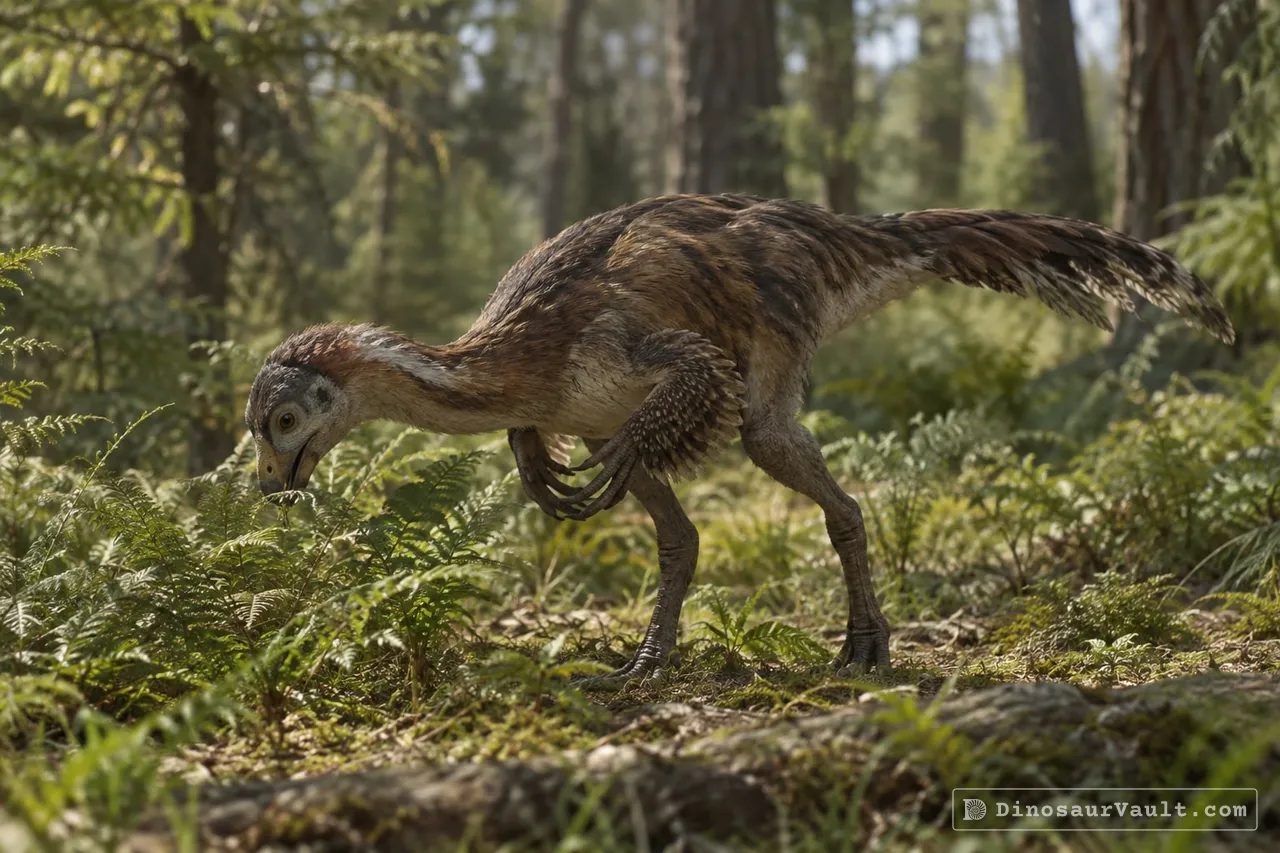
Jiangxisaurus was an oviraptor, a beaked dinosaur with no teeth that probably had feathers. It is known from a partial skull and skeleton, and it had curved claws on its hands.
Its world
It lived about 72 to 66 million years ago, at the end of the Late Cretaceous, in what is now southern China, a region that has produced many kinds of oviraptors.
How it was found
Wei and colleagues named Jiangxisaurus in 2013, from a single find.
Field gallery
More views of Jiangxisaurus
Scenes reconstructed from the available fossil evidence.
The evidence
The science behind Jiangxisaurus
Which parts of the picture come from its own bones, and which come from its relatives.
From its own fossils
- A partial skull and skeleton preserve a toothless mouth and curved hand claws.
- The lower jaw is long and shallow, with a tip that bends only slightly downward.
- The thumb is more robust than the other fingers, and the outermost hand claw is less curved than the others.
Borrowed from relatives
- Its feather covering is inferred from feathered oviraptorosaurs such as Caudipteryx.
Still unknown
- Its feather colors and patterns.
- Exactly which foods it ate.
- Whether it cared for its young.
Discovery timeline
- 2013Named itWei et al.
- 2013How it fedLü et al.
- 2015Family treeLü et al.
- 2016Family treeLü et al.
- 2021Family treeBi et al.
- 2024Family treeFunston
Key papers
The research behind what we know of Jiangxisaurus
Named it
Described a partial skeleton with an unusually long, shallow lower jaw and named Jiangxisaurus.
A new oviraptorid dinosaur (Theropoda: Oviraptorosauria) from the Late Cretaceous of Jiangxi Province, southern China. Acta Geologica Sinica (English Edition) 87: 899-904
No link available
How it fed
Compared the jaws of Nankangia, Ganzhousaurus and Jiangxisaurus, suggesting these neighbors may have eaten different foods.
A New Oviraptorosaur (Dinosauria: Oviraptorosauria) from the Late Cretaceous of Southern China and Its Paleoecological Implications. PLoS ONE 8: e80557
Read the paper : A New Oviraptorosaur (Dinosauria: Oviraptorosauria) from the Late Cretaceous of Southern China and Its Paleoecological Implications (opens in a new tab)Family tree
Compared Jiangxisaurus with Huanansaurus and added new observations of Jiangxisaurus to an analysis of oviraptorid relationships.
A New Oviraptorid Dinosaur (Dinosauria: Oviraptorosauria) from the Late Cretaceous of Southern China and Its Paleobiogeographical Implications. Scientific Reports 5
Read the paper : A New Oviraptorid Dinosaur (Dinosauria: Oviraptorosauria) from the Late Cretaceous of Southern China and Its Paleobiogeographical Implications (opens in a new tab)Family tree
Added Tongtianlong to the local fauna and placed Jiangxisaurus among the more specialized oviraptorids.
A Late Cretaceous diversification of Asian oviraptorid dinosaurs: evidence from a new species preserved in an unusual posture. Scientific Reports 6
Read the paper : A Late Cretaceous diversification of Asian oviraptorid dinosaurs: evidence from a new species preserved in an unusual posture (opens in a new tab)Family tree
Compared hand claws across oviraptorids, noting that the outermost claw of Jiangxisaurus is less curved than its other hand claws.
An oviraptorid preserved atop an embryo-bearing egg clutch sheds light on the reproductive biology of non-avialan theropod dinosaurs. Science Bulletin 66: 947-954
Read the paper : An oviraptorid preserved atop an embryo-bearing egg clutch sheds light on the reproductive biology of non-avialan theropod dinosaurs (opens in a new tab)Family tree
Compared oviraptorid hands, including the robust thumb and more slender outer fingers of Jiangxisaurus.
Osteology of the two-fingered oviraptorid Oksoko avarsan (Theropoda: Oviraptorosauria). Zoological Journal of the Linnean Society 202
Read the paper : Osteology of the two-fingered oviraptorid Oksoko avarsan (Theropoda: Oviraptorosauria) (opens in a new tab)
Close relatives
Other members of Oviraptoridae


Sources: Wikidata