Huehuecanauhtlus
"old duck"
Type species Huehuecanauhtlus tiquichensis
- Lived
- 86 to 84 million years ago, Late Cretaceous
- Diet
- Herbivore
- Group
- Ornithopods
- Found in
- Mexico
- Named by
- Ramírez-Velasco et al. 2012
Where its fossils were found
The evidence
Today

80 million years ago
Habitat
Its bones come from sandstone in Mexico, among layers of volcanic sediment and buried soils. Other plant-eating dinosaurs and meat eaters occur in the same deposits.
Field notes
About Huehuecanauhtlus
What it was like
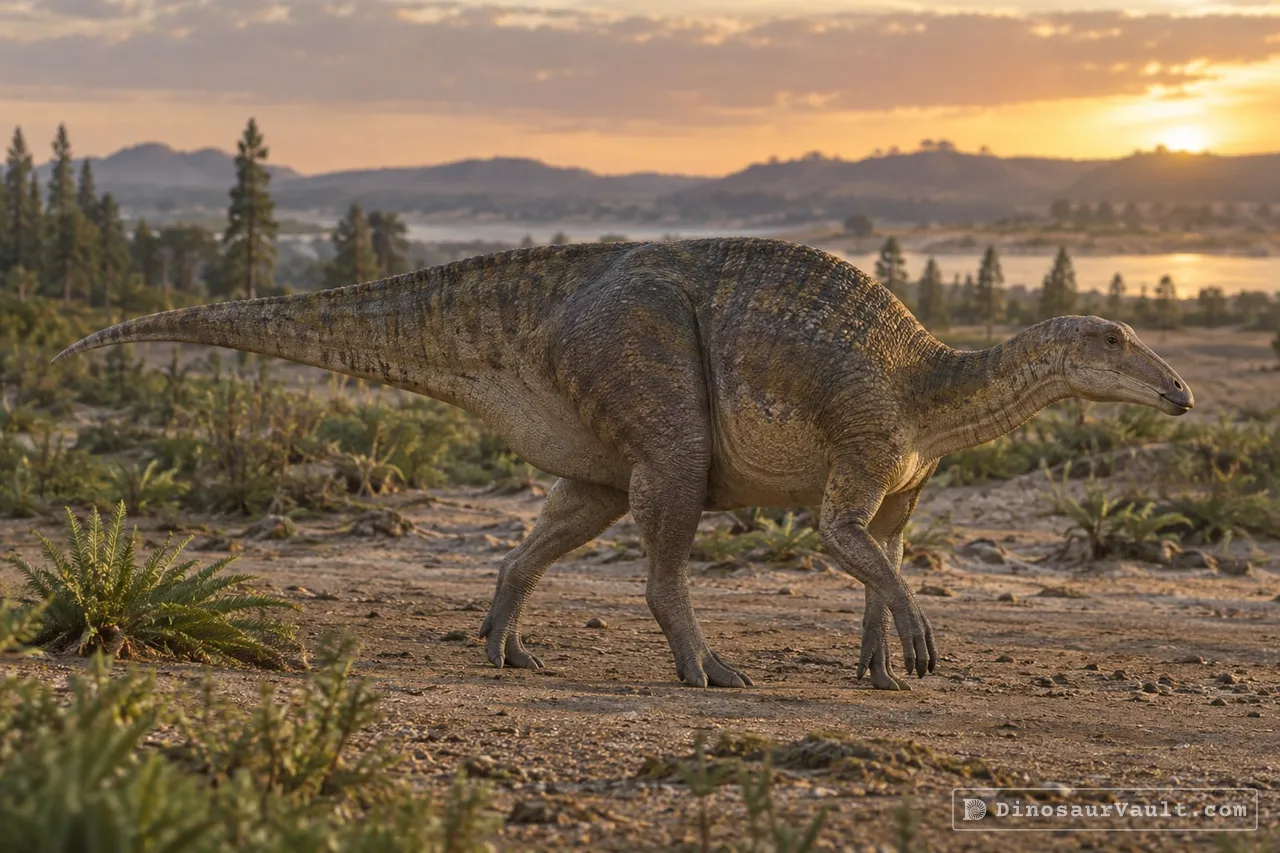
Huehuecanauhtlus was a relative of the duckbills, a plant eater with a broad beak. It is known from part of the skeleton and jaws.
Its world
It lived about 86 to 84 million years ago, in the Late Cretaceous, in what is now Mexico. It comes from the Cutzamala Formation.
How it was found
Ramírez-Velasco and colleagues named Huehuecanauhtlus in 2012. The type species is Huehuecanauhtlus tiquichensis. Its name comes from a native language of Mexico.
Field gallery
More views of Huehuecanauhtlus
Scenes reconstructed from the available fossil evidence.
1 of 2
The evidence
The science behind Huehuecanauhtlus
Which parts of the picture come from its own bones, and which come from its relatives.
From its own fossils
- The type specimen preserves pieces of the upper and lower jaw with their teeth, backbone, ribs and hip bones, including tall bony spines near the hips and tail base.
- The hip bone has a front projection that bends sharply downward.
- Damaged ribs and a back vertebra show abnormal bone growth and fusion.
Borrowed from relatives
- The missing limbs and much of the head are restored by comparison with Eolambia.
Still unknown
- Its full skull shape.
- Its color and skin pattern.
- Which plants it ate.
Discovery timeline
- 2012Named itRamírez-Velasco et al.
- 2012SkullsMcDonald et al.
- 2016Full descriptionRamírez-Velasco et al.
- 2022Family treeRamírez-Velasco
- 2023Family treeAlarcón-Muñoz et al.
Key papers
The research behind what we know of Huehuecanauhtlus
Named it
Described a duckbill relative with distinctive hip bones and teeth, extending the known range of this group southward in North America.
Huehuecanauhtlus tiquichensis, a new hadrosauroid dinosaur (Ornithischia: Ornithopoda) from the Santonian (Late Cretaceous) of Michoacán, Mexico. Canadian Journal of Earth Sciences 49: 379-395
Read the paper : Huehuecanauhtlus tiquichensis, a new hadrosauroid dinosaur (Ornithischia: Ornithopoda) from the Santonian (Late Cretaceous) of Michoacán, Mexico (opens in a new tab)Skulls
Described Eolambia bones, including the skull, hands and feet, providing comparisons for missing parts of Huehuecanauhtlus.
Osteology of the Basal Hadrosauroid Eolambia caroljonesa (Dinosauria: Ornithopoda) from the Cedar Mountain Formation of Utah. PLoS ONE 7: e45712
Read the paper : Osteology of the Basal Hadrosauroid Eolambia caroljonesa (Dinosauria: Ornithopoda) from the Cedar Mountain Formation of Utah (opens in a new tab)Full description
Described damaged ribs and a back vertebra with abnormal bone growth and fusion, probably linked to infection.
Spinal and rib osteopathy in Huehuecanauhtlus tiquichensis (Ornithopoda: Hadrosauroidea) from the Late Cretaceous in Mexico. Historical Biology 29: 208-222
Read the paper : Spinal and rib osteopathy in Huehuecanauhtlus tiquichensis (Ornithopoda: Hadrosauroidea) from the Late Cretaceous in Mexico (opens in a new tab)Family tree
Compared Mexican duckbill relatives and placed Huehuecanauhtlus on an early branch outside the true duckbills.
Phylogenetic and biogeography analysis of Mexican hadrosauroids. Cretaceous Research 138: 105267
Read the paper : Phylogenetic and biogeography analysis of Mexican hadrosauroids (opens in a new tab)Family tree
Compared Huehuecanauhtlus with Gonkoken and included it in analyses of early duckbill relatives, with relationships differing between methods.
Relict duck-billed dinosaurs survived into the last age of the dinosaurs in subantarctic Chile. Science Advances 9
Read the paper : Relict duck-billed dinosaurs survived into the last age of the dinosaurs in subantarctic Chile (opens in a new tab)
Close relatives
Other members of Hadrosauroidea


Sources: Wikidata