Huaxiazhoulong
Type species Huaxiazhoulong shouwen
- Lived
- 84 to 72 million years ago, Late Cretaceous
- Diet
- Herbivore
- Group
- Ankylosaurs, Ankylosauridae
- Found in
- China
- Named by
- Zhu et al. 2024
Where its fossils were found
The evidence
Today

80 million years ago
Habitat
It lived in southern China. Sandstones of the Tangbian Formation record wind-built dunes in a dry landscape.
Field notes
About Huaxiazhoulong
What it was like
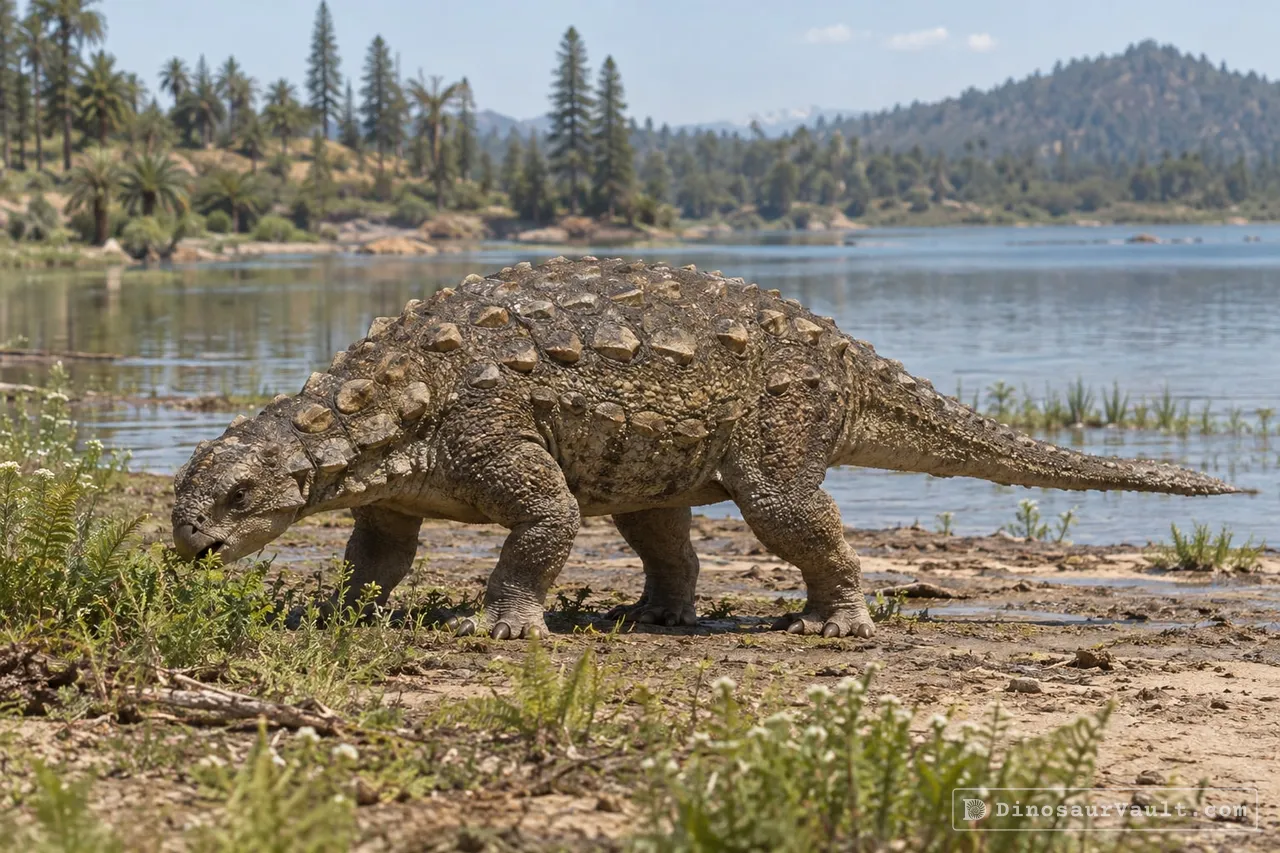
Huaxiazhoulong was an ankylosaur, an armored plant eater with bony plates on its body. It is known from a partial skeleton.
Its world
It lived in the Late Cretaceous in what is now southern China. Its bones come from the Tangbian Formation.
How it was found
Zhu and colleagues named it in 2024. The type species is Huaxiazhoulong shouwen.
Field gallery
More views of Huaxiazhoulong
Scenes reconstructed from the available fossil evidence.
The evidence
The science behind Huaxiazhoulong
Which parts of the picture come from its own bones, and which come from its relatives.
From its own fossils
- The type skeleton preserves sturdy limbs, shoulder and hip bones, and a tail club with a broad knob; isolated armor bones are low and blunt with weak ridges.
- The front tail vertebrae have heart-shaped ends.
- A notch separates the head of the upper arm bone from the ridge where shoulder muscles attached.
Borrowed from relatives
- Its missing head and neck can be restored by comparison with Jinyunpelta.
Still unknown
- The exact shape of its head.
- Its color and the full arrangement of its armor.
- How its body changed as it grew.
Discovery timeline
- 2008Its worldJiang et al.
- 2018Family treeZheng et al.
- 2024Named itZhu et al.
Key papers
The research behind what we know of Huaxiazhoulong
Its world
Identified wind-built dunes in the Tangbian Formation from sandstone textures and layers, revealing a dry setting.
Late Cretaceous aeolian dunes and reconstruction of palaeo-wind belts of the Xinjiang Basin, Jiangxi Province, China. Palaeogeography, Palaeoclimatology, Palaeoecology 257: 58-66
Read the paper : Late Cretaceous aeolian dunes and reconstruction of palaeo-wind belts of the Xinjiang Basin, Jiangxi Province, China (opens in a new tab)Family tree
Described Jinyunpelta with a well-developed tail club, showing that this weapon appeared early in its branch of armored dinosaurs.
The most basal ankylosaurine dinosaur from the Albian–Cenomanian of China, with implications for the evolution of the tail club. Scientific Reports 8
Read the paper : The most basal ankylosaurine dinosaur from the Albian–Cenomanian of China, with implications for the evolution of the tail club (opens in a new tab)Named it
Described a partial armored skeleton with unusual limb and tail bones and placed it near the base of Ankylosauridae.
A new ankylosaurid dinosaur from the Upper Cretaceous of Jiangxi Province, southern China. Historical Biology 37: 2783-2799
Read the paper : A new ankylosaurid dinosaur from the Upper Cretaceous of Jiangxi Province, southern China (opens in a new tab)
Close relatives
Other members of Ankylosauridae


Sources: Wikidata