Hoplitosaurus
"hoplite lizard"
- Lived
- 126 to 121 million years ago, Early Cretaceous
- Diet
- Herbivore
- Group
- Ankylosaurs, Nodosauridae
- Found in
- United States
- Named by
- Lucas 1902
Where its fossils were found
The evidence
Today

125 million years ago
Habitat
Rivers crossed the landscape recorded in the Lakota Formation of South Dakota. Dakotadon and Osmakasaurus were other plant eaters in these rocks.
Field notes
About Hoplitosaurus
What it was like
Hoplitosaurus was an armored plant eater related to Polacanthus and Gastonia. It is known from part of the skeleton and armor, including spikes and plates.
Its world
It lived in the Early Cretaceous, in what is now South Dakota. It comes from the Lakota Formation, where the plant eaters Dakotadon and Osmakasaurus also lived.
How it was found
Lucas named Hoplitosaurus in 1902.
Field gallery
More views of Hoplitosaurus
Scenes reconstructed from the available fossil evidence.
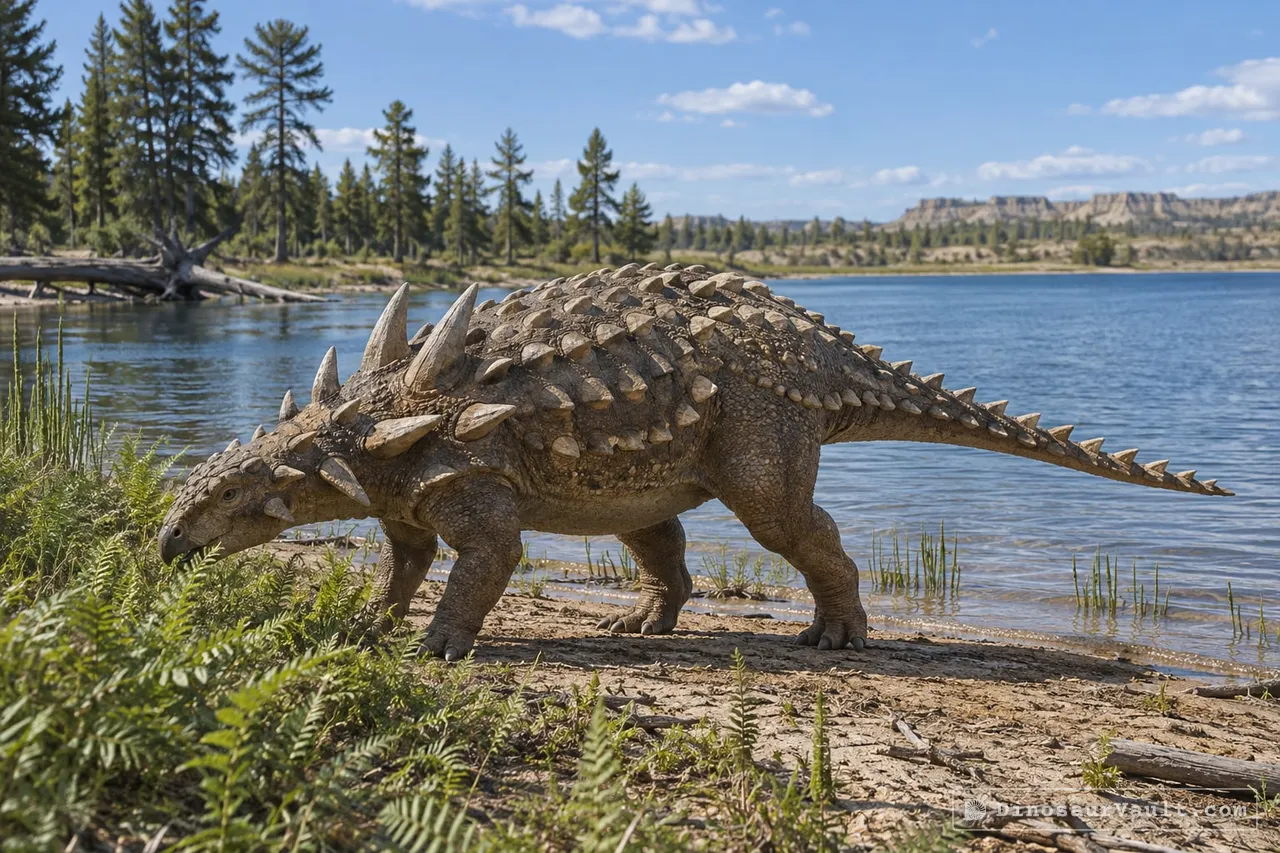
1 of 2
Lived alongside
Found in the same rock formations

A rock formation can hold fossils laid down millions of years apart, so not every animal here met Hoplitosaurus.
The evidence
The science behind Hoplitosaurus
Which parts of the picture come from its own bones, and which come from its relatives.
From its own fossils
- The type specimen includes a thigh bone, parts of the arms and shoulder, ribs and some vertebrae assigned to it.
- The armor pieces found with the skeleton include broad-based spines, keeled plates and smaller rounded pieces.
Borrowed from relatives
- Gargoyleosaurus provides a comparison for the missing skull, and Sauropelta for the missing neck, feet and tail.
Still unknown
- The exact arrangement of its plates and spines, and whether the assigned tail vertebrae belong to it.
- The shape of its skull.
- Its skin color.
Discovery timeline
- 1901Full descriptionLucas
- 1902Named itLucas
- 1914Full descriptionGilmore & United States National Museum
Key papers
The research behind what we know of Hoplitosaurus
Full description
First described the plates, spines and limb bones of the animal later renamed Hoplitosaurus.
A new dinosaur, Stegosaurus marshi, from the Lower Cretaceous of South Dakota. Proceedings of the United States National Museum 23: 591-592
Read the paper : A new dinosaur, Stegosaurus marshi, from the Lower Cretaceous of South Dakota (opens in a new tab)Named it
Moved the armored animal originally called Stegosaurus marshi into its own genus, Hoplitosaurus.
Paleontological Notes. Science 16: 435-435
Read the paper : Paleontological Notes (opens in a new tab)Full description
Described the surviving Hoplitosaurus bones and the mixed armor pieces in detail.
Osteology of the armored Dinosauria in the United States National Museum, with special reference to the genus Stegosaurus.
Read the paper : Osteology of the armored Dinosauria in the United States National Museum, with special reference to the genus Stegosaurus (opens in a new tab)
Close relatives
Other members of Nodosauridae


Sources: Wikidata