Osmakasaurus
"canyon lizard"
- Lived
- 126 to 121 million years ago, Early Cretaceous
- Diet
- Herbivore
- Group
- Ornithopods
- Found in
- United States
- Named by
- McDonald 2011
Where its fossils were found
The evidence
Today

125 million years ago
Habitat
Rivers, floodplains, lakes and swamps formed the landscape recorded by the Lakota Formation. Ferns, cycads and conifers grew there, alongside dinosaurs such as Dakotadon and Hoplitosaurus.
Field notes
About Osmakasaurus
What it was like
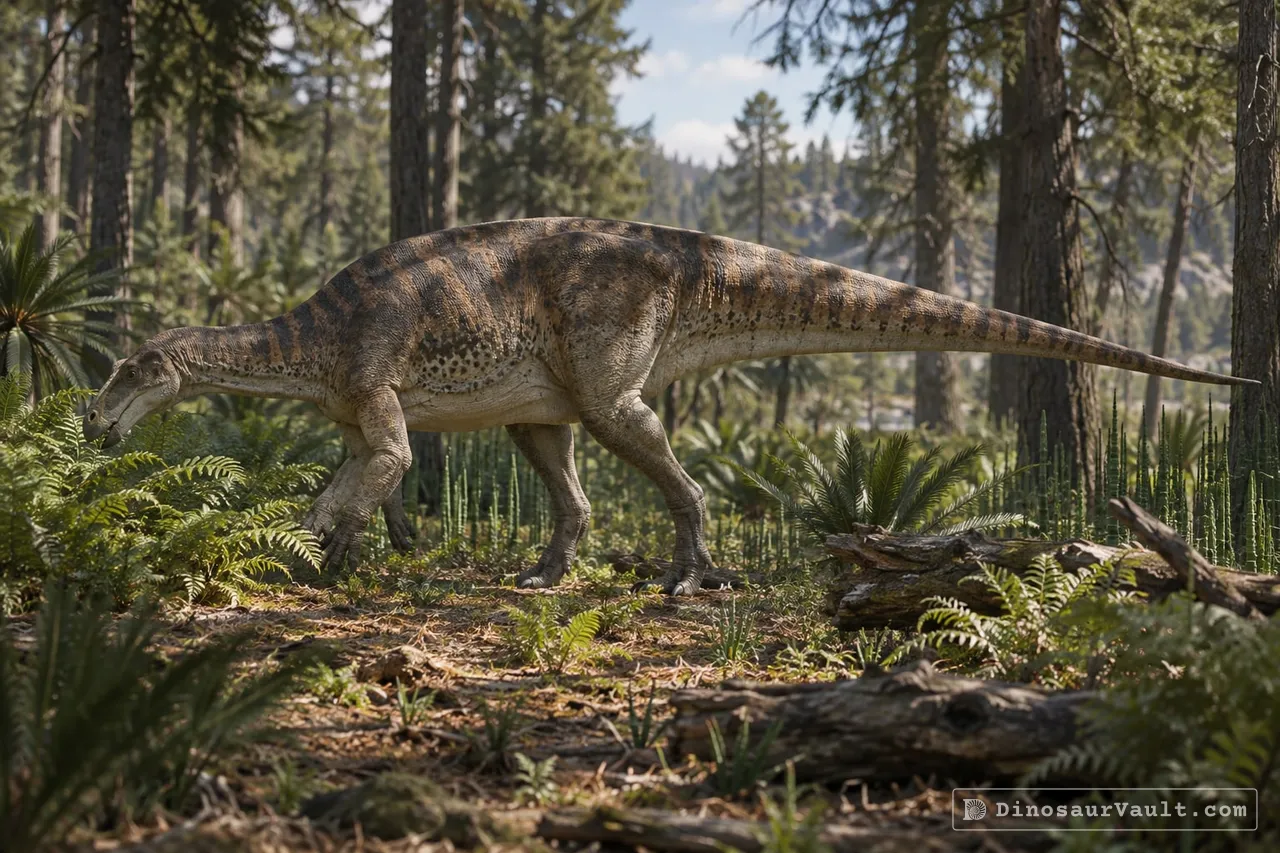
Osmakasaurus was a plant eater related to Iguanodon, known from hip bones and parts of the backbone.
Its world
It lived in the Early Cretaceous in what is now South Dakota. Its bones come from the Lakota Formation, where the plant eater Dakotadon and the armored Hoplitosaurus also lived.
How it was found
Its bones were first described as a species of Camptosaurus. McDonald gave it its own genus in 2011. Its name comes from the Lakota language.
Field gallery
More views of Osmakasaurus
Scenes reconstructed from the available fossil evidence.
Lived alongside
Found in the same rock formations

A rock formation can hold fossils laid down millions of years apart, so not every animal here met Osmakasaurus.
The evidence
The science behind Osmakasaurus
Which parts of the picture come from its own bones, and which come from its relatives.
From its own fossils
- The known skeleton includes hip bones and parts of the backbone.
- The upper hip bone has a straight top edge and a widened front tip.
Borrowed from relatives
- The missing head and limbs are restored by comparison with better-known iguanodonts such as Iguanodon and Camptosaurus.
Still unknown
- The shape of its head and the proportions of its limbs.
- Its skin covering and color.
- Whether the surviving bones are distinctive enough to identify a separate genus.
Discovery timeline
- 2011Named itMCDONALD
- 2012Family treeMcDonald
- 2015Same rocksBoyd & Pagnac
- 2022Family treePoole
Key papers
The research behind what we know of Osmakasaurus
Named it
Separated Osmakasaurus from Camptosaurus and rejected its earlier assignment to Planicoxa.
The taxonomy of species assigned to Camptosaurus (Dinosauria: Ornithopoda). Zootaxa 2783
Read the paper : The taxonomy of species assigned to Camptosaurus (Dinosauria: Ornithopoda) (opens in a new tab)Family tree
Included Osmakasaurus in a broad comparison of iguanodonts and highlighted the difficulty of placing dinosaurs known from fragmentary skeletons.
Phylogeny of Basal Iguanodonts (Dinosauria: Ornithischia): An Update. PLoS ONE 7: e36745
Read the paper : Phylogeny of Basal Iguanodonts (Dinosauria: Ornithischia): An Update (opens in a new tab)Same rocks
Restudied Dakotadon from the Lakota Formation and used its fossil site to refine its geological age.
Insight on the anatomy, systematic relationships, and age of the Early Cretaceous ankylopollexian dinosaur Dakotadon lakotaensis. PeerJ 3: e1263
Read the paper : Insight on the anatomy, systematic relationships, and age of the Early Cretaceous ankylopollexian dinosaur Dakotadon lakotaensis (opens in a new tab)Family tree
Questioned whether Osmakasaurus can be identified as a distinct dinosaur because its proposed identifying hip features also occur in other iguanodonts.
Phylogeny of iguanodontian dinosaurs and the evolution of quadrupedality. Palaeontologia Electronica
Read the paper : Phylogeny of iguanodontian dinosaurs and the evolution of quadrupedality (opens in a new tab)
Close relatives
Other members of Iguanodontia


Sources: Wikidata