Choyrodon
Type species Choyrodon barsboldi
- Lived
- 110 to 101 million years ago, Early Cretaceous
- Diet
- Herbivore
- Group
- Ornithopods
- Found in
- Mongolia
- Named by
- Gates et al. 2018
Where its fossils were found
The evidence
Today

105 million years ago
Habitat
Braided streams and lakes crossed its landscape in what is now Mongolia. Altirhinus, Psittacosaurus and Harpymimus also lived in the Khuren Dukh Formation.
Field notes
About Choyrodon
What it was like
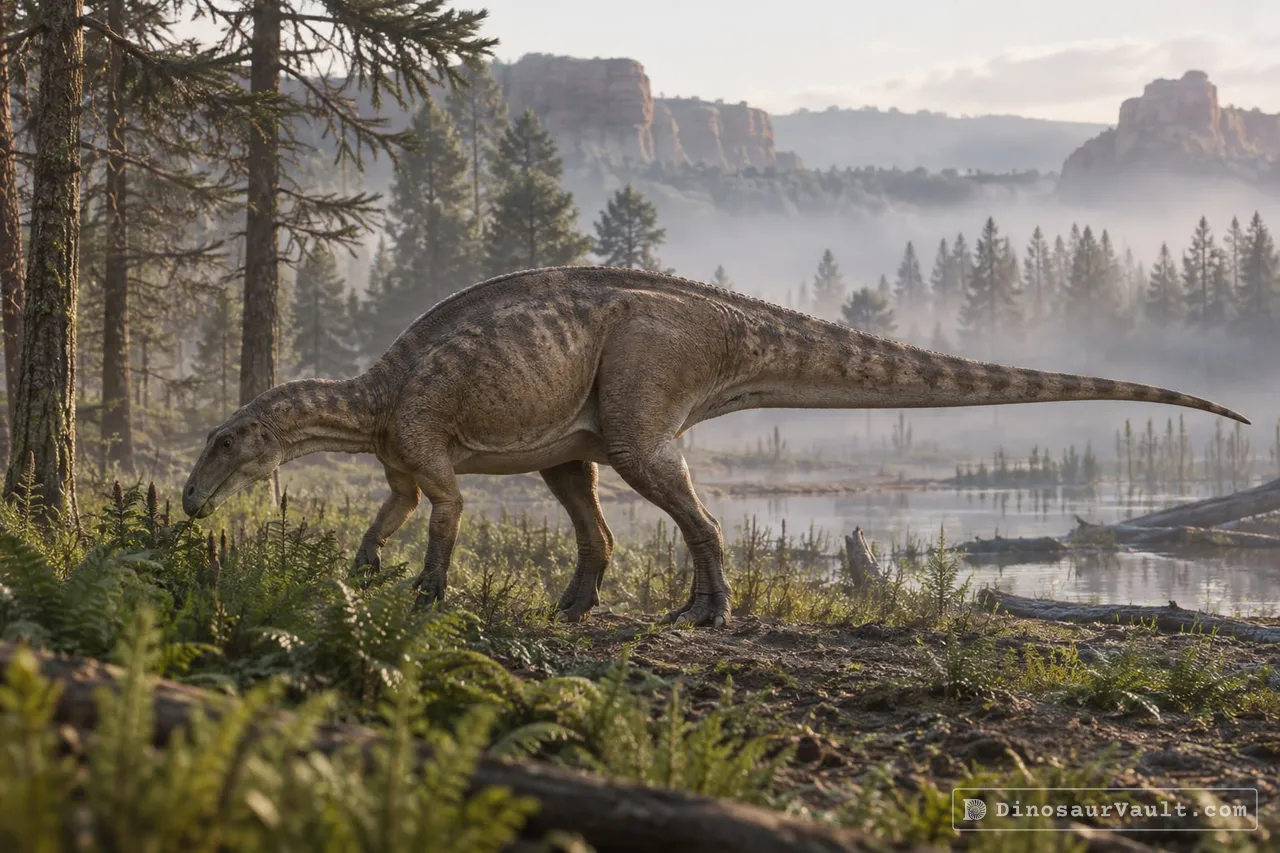
Choyrodon was a plant eater related to the duckbills. Its snout was long, and it had a gap between its beak and teeth.
Its world
It lived in the Early Cretaceous, in what is now Mongolia. It comes from the Khuren Dukh Formation, where it shared the land with the high-nosed Altirhinus, the parrot-beaked Psittacosaurus and the ostrich-like Harpymimus.
How it was found
Gates and colleagues named Choyrodon in 2018. The type species is Choyrodon barsboldi.
Field gallery
More views of Choyrodon
Scenes reconstructed from the available fossil evidence.
1 of 3
Lived alongside
Found in the same rock formations


A rock formation can hold fossils laid down millions of years apart, so not every animal here met Choyrodon.
The evidence
The science behind Choyrodon
Which parts of the picture come from its own bones, and which come from its relatives.
From its own fossils
- Partial skulls and associated body bones preserve a long-snouted plant eater.
- Its skull has an opening in front of the eye, enlarged nostril openings and a downward-curving lower jaw.
- Microscopic study of its bones shows that the known animals were still growing.
Borrowed from relatives
- Missing parts of the body are restored by comparison with early duckbill relatives such as Eolambia.
Still unknown
- Whether the opening in front of the eye closed as it grew.
- The full size and appearance of an adult.
- Its exact relationship to other early duckbill relatives.
Discovery timeline
- 1998Same rocksNORMAN
- 2012Close relativeMcDonald et al.
- 2018Named itGates et al.
Key papers
The research behind what we know of Choyrodon
Same rocks
Named Altirhinus from the Khuren Dukh locality, providing a comparison for distinguishing Choyrodon from another plant eater in the same rocks.
On Asian ornithopods (Dinosauria: Ornithischia). 3. A new species of iguanodontid dinosaur. Zoological Journal of the Linnean Society 122: 291-348
Read the paper : On Asian ornithopods (Dinosauria: Ornithischia). 3. A new species of iguanodontid dinosaur (opens in a new tab)Close relative
Described the skull and skeleton of Eolambia, a useful comparison for the anatomy of Choyrodon.
Osteology of the Basal Hadrosauroid Eolambia caroljonesa (Dinosauria: Ornithopoda) from the Cedar Mountain Formation of Utah. PLoS ONE 7: e45712
Read the paper : Osteology of the Basal Hadrosauroid Eolambia caroljonesa (Dinosauria: Ornithopoda) from the Cedar Mountain Formation of Utah (opens in a new tab)Named it
Described a new plant eater from partial skeletons and used bone structure to show that the known specimens were subadults.
A new iguanodontian (Dinosauria: Ornithopoda) from the Early Cretaceous of Mongolia. PeerJ 6: e5300
Read the paper : A new iguanodontian (Dinosauria: Ornithopoda) from the Early Cretaceous of Mongolia (opens in a new tab)
Close relatives
Other members of Iguanodontia


Sources: Wikidata