Altirhinus
"high nose"
- Lived
- 110 to 101 million years ago, Early Cretaceous
- Diet
- Herbivore
- Group
- Ornithopods
- Found in
- Mongolia
- Named by
- Norman 1998
Where its fossils were found
The evidence
Today

105 million years ago
Habitat
Rivers, lakes and swampy floodplains spread across its part of Mongolia. Other dinosaurs from the Khuren Dukh Formation include Psittacosaurus, Harpymimus and Choyrodon.
Field notes
About Altirhinus
What it was like
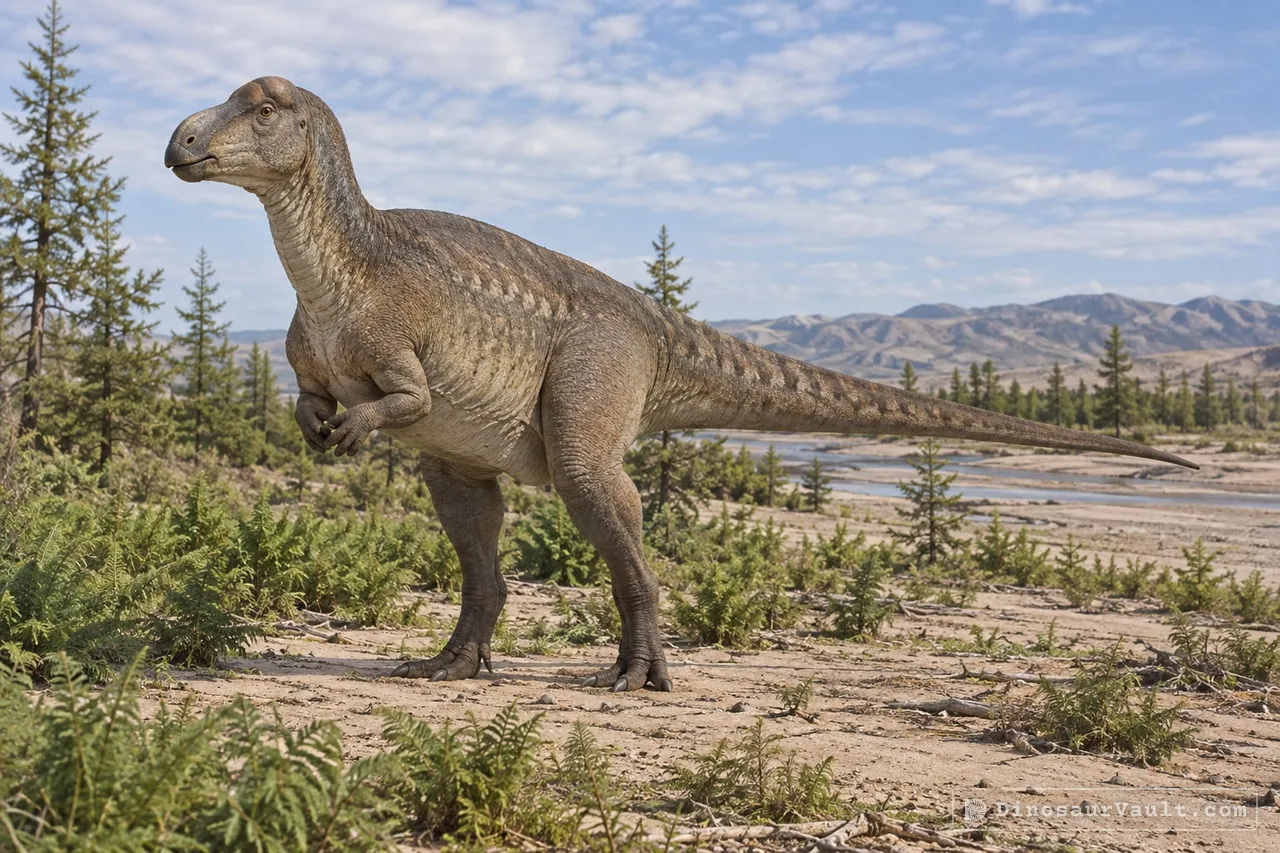
Altirhinus was a large plant eater related to Iguanodon, with a thumb spike and a tall, arched nose. No one knows for sure why its nose was so high: it may have helped with calls, smell or display.
Its world
It lived in the Early Cretaceous, in what is now Mongolia. It shared the land with the small parrot-beaked Psittacosaurus and the ostrich-like Harpymimus.
How it was found
Norman named Altirhinus in 1998, from fossils first placed in Iguanodon.
Field gallery
More views of Altirhinus
Scenes reconstructed from the available fossil evidence.
1 of 3
Lived alongside
Found in the same rock formations


A rock formation can hold fossils laid down millions of years apart, so not every animal here met Altirhinus.
The evidence
The science behind Altirhinus
Which parts of the picture come from its own bones, and which come from its relatives.
From its own fossils
- Skull bones show a tall arch over the nose and large openings for the nostrils.
- Its jaws carried closely packed teeth for cutting plant food.
- Partial skeletons include limb bones from adults and animals that were still growing.
Borrowed from relatives
- The overall body outline follows comparisons with Iguanodon and Ouranosaurus.
Still unknown
- What the tall nose was used for.
- How the nose changed as it grew.
- Its skin color and pattern.
Discovery timeline
- 1998Named itNORMAN
- 2011Close relativePRIETO‐MÁRQUEZ
- 2018Same rocksGates et al.
Key papers
The research behind what we know of Altirhinus
Named it
Separated the high-nosed skull and associated bones from Iguanodon and named Altirhinus.
On Asian ornithopods (Dinosauria: Ornithischia). 3. A new species of iguanodontid dinosaur. Zoological Journal of the Linnean Society 122: 291-348
Read the paper : On Asian ornithopods (Dinosauria: Ornithischia). 3. A new species of iguanodontid dinosaur (opens in a new tab)Close relative
Tracked growth changes in Bactrosaurus and noted fragmentary bones from Altirhinus that had not finished growing.
Cranial and appendicular ontogeny ofBactrosaurus johnsoni, a hadrosauroid dinosaur from the Late Cretaceous of northern China. Palaeontology 54: 773-792
Read the paper : Cranial and appendicular ontogeny ofBactrosaurus johnsoni, a hadrosauroid dinosaur from the Late Cretaceous of northern China (opens in a new tab)Same rocks
Named Choyrodon and found skull differences supporting its separation from Altirhinus, rather than treating it as a young Altirhinus.
A new iguanodontian (Dinosauria: Ornithopoda) from the Early Cretaceous of Mongolia. PeerJ 6: e5300
Read the paper : A new iguanodontian (Dinosauria: Ornithopoda) from the Early Cretaceous of Mongolia (opens in a new tab)
Close relatives
Other members of Neoiguanodontia


Sources: Wikidata