Zavacephale
"origin head"
Type species Zavacephale rinpoche
- Lived
- 120 to 101 million years ago, Early Cretaceous
- Diet
- Herbivore
- Group
- Pachycephalosaurs
- Found in
- Mongolia
- Named by
- Chinzorig et al. 2025
Where its fossils were found
The evidence
Today

110 million years ago
Habitat
Rivers and lakes filled the basin in what is now Mongolia. Psittacosaurus, Altirhinus and Harpymimus come from the same formation.
Field notes
About Zavacephale
What it was like
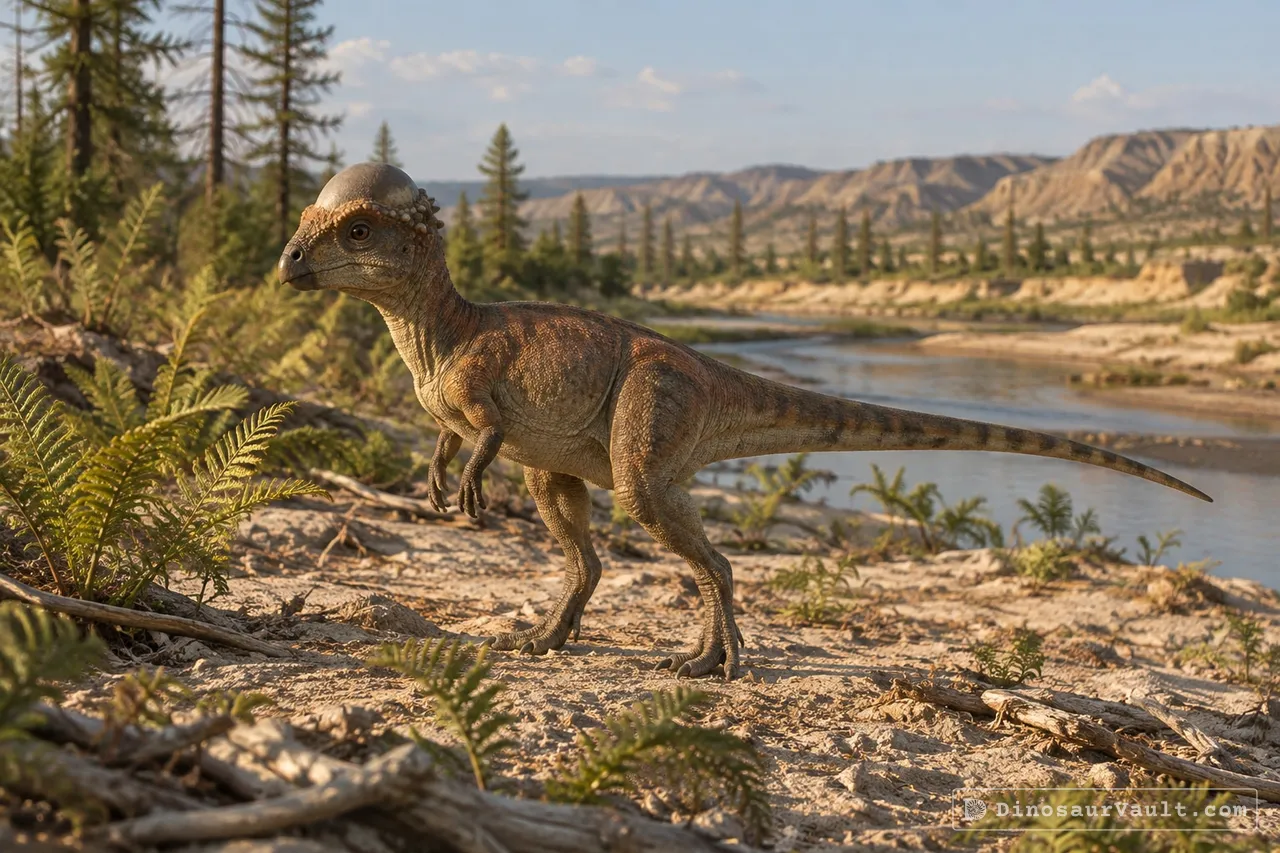
Zavacephale was a small dome-headed dinosaur, a member of the pachycephalosaurs. Its skull already carried a thick, rounded dome, like those of its later and larger relatives.
It is the oldest pachycephalosaur known for certain and also the most complete, with a nearly whole skull and much of the skeleton, which shows how these animals looked early in their history.
Its world
It lived in the Early Cretaceous, between about 120 and 101 million years ago, in what is now Mongolia. Its fossil comes from the Khuren Dukh Formation, which has also produced Psittacosaurus, the iguanodont Altirhinus and the ostrich-like Harpymimus.
How it was found
Chinzorig and colleagues named Zavacephale rinpoche in 2025, from a single skeleton.
Field gallery
More views of Zavacephale
Scenes reconstructed from the available fossil evidence.
1 of 3
Lived alongside
Found in the same rock formations


A rock formation can hold fossils laid down millions of years apart, so not every animal here met Zavacephale.
The evidence
The science behind Zavacephale
Which parts of the picture come from its own bones, and which come from its relatives.
From its own fossils
- A nearly complete skull and much of the skeleton make it the most complete known dome-headed dinosaur.
- The skull carries a well-developed bony dome.
- The skeleton preserves hand bones and swallowed stones.
Borrowed from relatives
- Much of the body is known from its own skeleton; comparisons with Stegoceras help explore how the dome grew and worked.
Still unknown
- Its adult size and appearance.
- Its color.
- Whether it used its dome in fights.
Discovery timeline
- 2011Close relativeSchott et al.
- 2011Close relativeSnively & Theodor
- 2025Named itChinzorig et al.
Key papers
The research behind what we know of Zavacephale
Close relative
Tracked dome growth in Stegoceras, providing a comparison for the early dome development seen in Zavacephale.
Cranial Ontogeny in Stegoceras validum (Dinosauria: Pachycephalosauria): A Quantitative Model of Pachycephalosaur Dome Growth and Variation. PLoS ONE 6: e21092
Read the paper : Cranial Ontogeny in Stegoceras validum (Dinosauria: Pachycephalosauria): A Quantitative Model of Pachycephalosaur Dome Growth and Variation (opens in a new tab)Close relative
Compared Stegoceras skulls with those of head-butting mammals and found features suited to absorbing impacts.
Common Functional Correlates of Head-Strike Behavior in the Pachycephalosaur Stegoceras validum (Ornithischia, Dinosauria) and Combative Artiodactyls. PLoS ONE 6: e21422
Read the paper : Common Functional Correlates of Head-Strike Behavior in the Pachycephalosaur Stegoceras validum (Ornithischia, Dinosauria) and Combative Artiodactyls (opens in a new tab)Named it
Described the oldest definite dome-headed dinosaur and showed that its dome developed before its body finished growing.
A domed pachycephalosaur from the early Cretaceous of Mongolia. Nature 646: 1138-1145
Read the paper : A domed pachycephalosaur from the early Cretaceous of Mongolia (opens in a new tab)
Close relatives
Other members of Pachycephalosauria


Sources: Wikidata