Guemesia
Type species Guemesia ochoai
- Lived
- 84 to 66 million years ago, Late Cretaceous
- Diet
- Carnivore
- Group
- Theropods, Abelisauridae
- Found in
- Argentina
- Named by
- Agnolín et al. 2021
Where its fossils were found
The evidence
Today

75 million years ago
Habitat
Rivers carried sand and pebbles through its landscape in Argentina. Unquillosaurus is also known from the Los Blanquitos Formation.
Field notes
About Guemesia
What it was like
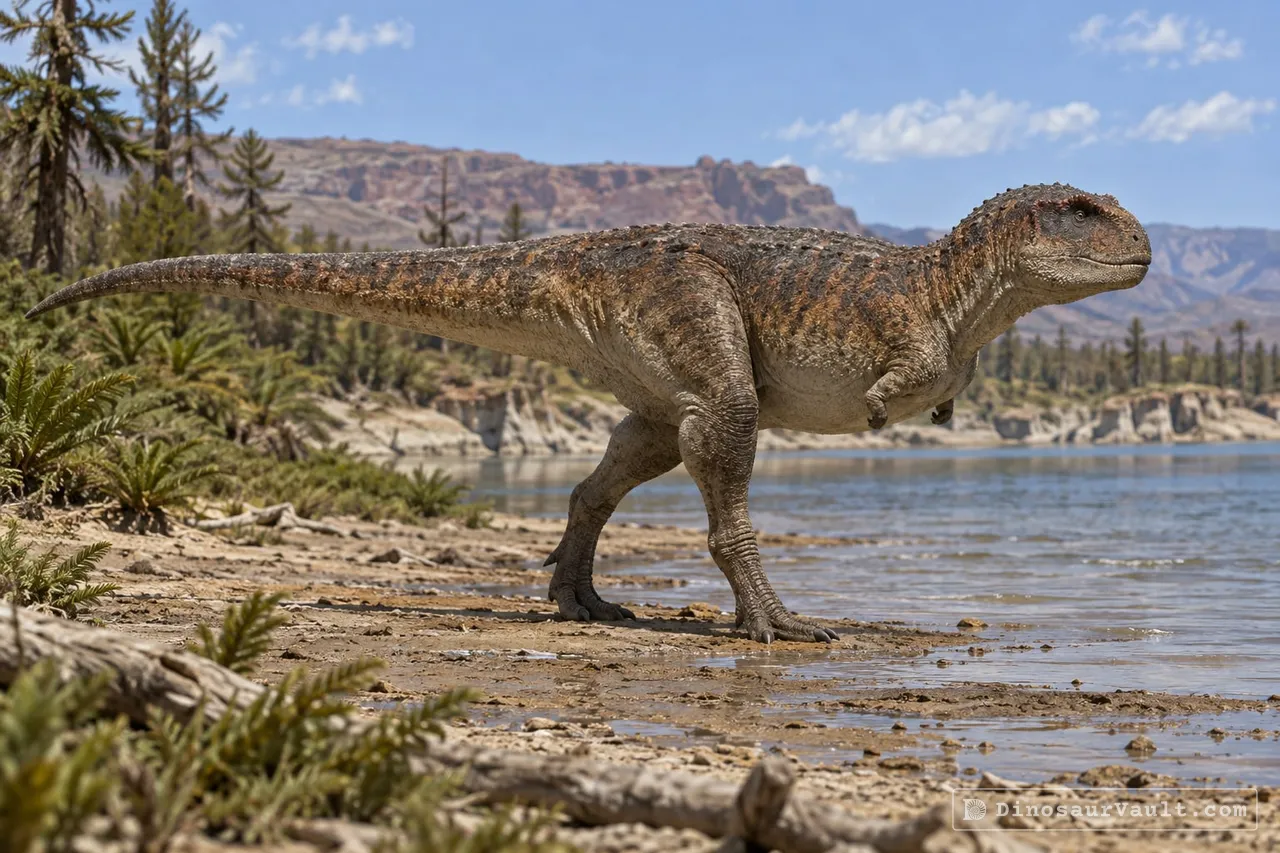
Guemesia was an abelisaur, a predator with a short skull and tiny arms. It is known from a braincase. Its skull roof had many small openings, and it had no horns.
Its world
It lived in the Late Cretaceous, in what is now Argentina. It comes from the Los Blanquitos Formation.
How it was found
Agnolín and colleagues named Guemesia in 2021. The type species is Guemesia ochoai. The name honors an Argentine national hero.
Field gallery
More views of Guemesia
Scenes reconstructed from the available fossil evidence.
1 of 2
Lived alongside
Found in the same rock formations

A rock formation can hold fossils laid down millions of years apart, so not every animal here met Guemesia.
The evidence
The science behind Guemesia
Which parts of the picture come from its own bones, and which come from its relatives.
From its own fossils
- A nearly complete braincase preserves the bony housing around the brain and parts of the skull roof.
- The skull roof is low and nearly flat, with pits along its midline and no horns. A later study found it less heavily sculptured than the thick roofs of Niebla and Llukalkan.
- Scans reveal the shapes of the brain cavity and inner ear.
Borrowed from relatives
- The missing face, jaws, body and legs are restored from Majungasaurus, a more complete abelisaurid. Its low skull roof rules out the thick bony dome of Majungasaurus.
- The very short forearms and greatly reduced four-fingered hands follow Majungasaurus.
Still unknown
- Whether the known individual was fully grown.
- Its jaws, teeth, body size and the rest of its skeleton.
- Exactly where it sits in the abelisaurid family tree. The naming study left this unresolved.
Discovery timeline
- 2011Close relativePAULINA CARABAJAL
- 2017Close relativeBurch
- 2021Named itAgnolín et al.
Key papers
The research behind what we know of Guemesia
Close relative
Compared the braincases of Abelisaurus and Aucasaurus, providing a framework for recognizing shared and distinctive abelisaurid skull features.
Braincases of abelisaurid theropods from the Upper Cretaceous of north Patagonia. Palaeontology 54: 793-806
Read the paper : Braincases of abelisaurid theropods from the Upper Cretaceous of north Patagonia (opens in a new tab)Close relative
Reconstructed the arm muscles of Majungasaurus and showed how its forelimb changed with extreme shortening, leaving a short forearm and a greatly reduced four-fingered hand.
Myology of the forelimb of Majungasaurus crenatissimus (Theropoda, Abelisauridae) and the morphological consequences of extreme limb reduction. Journal of Anatomy 231: 515-531
Read the paper : Myology of the forelimb of Majungasaurus crenatissimus (Theropoda, Abelisauridae) and the morphological consequences of extreme limb reduction (opens in a new tab)Named it
Described a small abelisaurid braincase with a flat, hornless skull roof and reconstructed its internal cavities using scans.
First definitive abelisaurid theropod from the Late Cretaceous of Northwestern Argentina. Journal of Vertebrate Paleontology 41
Read the paper : First definitive abelisaurid theropod from the Late Cretaceous of Northwestern Argentina (opens in a new tab)
Close relatives
Other members of Abelisauridae


Sources: Wikidata