Unquillosaurus
Type species Unquillosaurus ceibalii
- Lived
- 84 to 72 million years ago, Late Cretaceous
- Diet
- Carnivore
- Group
- Theropods, Carcharodontosauridae
- Found in
- Argentina
- Named by
- Powell 1979
Where its fossils were found
The evidence
Today

80 million years ago
Habitat
It lived in what is now Argentina, in the landscape preserved by the Los Blanquitos Formation. The meat eater Guemesia also comes from these rocks.
Field notes
About Unquillosaurus
What it was like
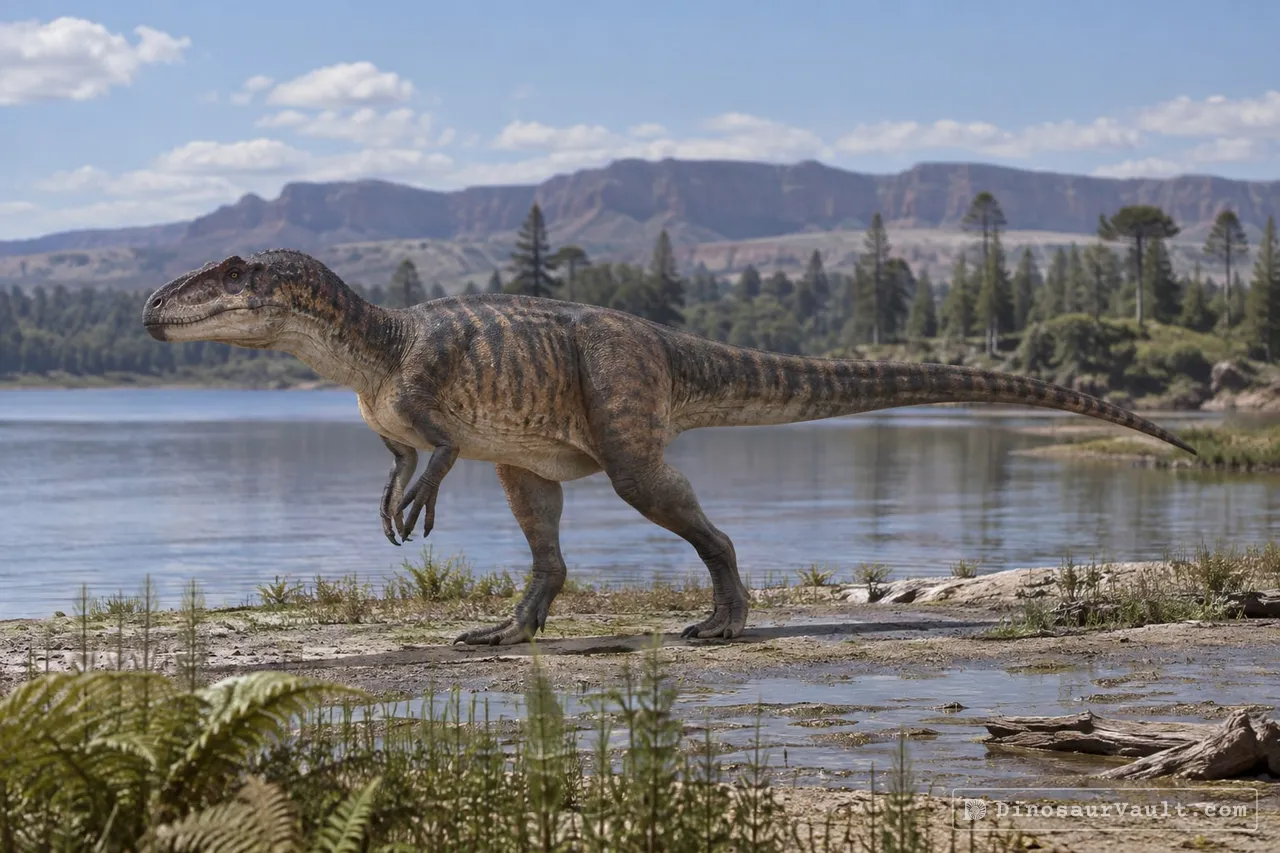
Unquillosaurus was a large theropod known only from a hip bone. It has been linked to several groups, from carcharodontosaurs to relatives of birds, and its place is still uncertain.
Its world
It lived in the Late Cretaceous, in what is now Argentina. It comes from the Los Blanquitos Formation, where the abelisaur Guemesia has also been found.
How it was found
Powell named Unquillosaurus in 1979. The type species is Unquillosaurus ceibalii.
Field gallery
More views of Unquillosaurus
Scenes reconstructed from the available fossil evidence.
1 of 3
Lived alongside
Found in the same rock formations

A rock formation can hold fossils laid down millions of years apart, so not every animal here met Unquillosaurus.
The evidence
The science behind Unquillosaurus
Which parts of the picture come from its own bones, and which come from its relatives.
From its own fossils
- It is known from a single pubis, a long bone from the underside of the hip, with a displaced piece of the upper hip bone stuck to it.
- Its redescribers reinterpreted a groove once listed as a distinctive feature as the edge of that attached piece.
- Its redescribers read it as a left pubis that pointed backward, with a short expansion at its lower end.
Borrowed from relatives
- Everything but the hip has to be restored from relatives. If it was one of the bird-like unenlagiines, its head, neck, shoulders and upper arms would be modeled on Buitreraptor.
Still unknown
- What kind of theropod it was. One study reads the bone as a right pubis with a worn, broken lower end and likens it to Giganotosaurus, while its redescribers argue for a bird-like theropod.
- Its complete body shape and size.
- Whether it had feathers.
Discovery timeline
- 1979Named itPowell
- 2004RedescriptionNovas & Agnolin
- 2021Same rocksAgnolín et al.
- 2024Family treePorfiri et al.
Key papers
The research behind what we know of Unquillosaurus
Named it
Named Unquillosaurus from a large hip bone found in Argentina.
Sobre una asociacion de Dinosaurios y otras evidencias de vertebrados del Crétacico Superior de la region de La Candelaria, Prov. de Salta, Argentina. Ameghiniana 16: 191-204
No link available
Redescription
Reinterpreted the hip bone as backward-pointing and proposed that Unquillosaurus belonged among bird-like theropods rather than traditional large carnosaurs.
Unquillosaurus ceibali Powell, a giant maniraptoran (Dinosauria, Theropoda) from the Late Cretaceous of Argentina. Revista del Museo Argentino de Ciencias Naturales: 61-66
Read the paper : Unquillosaurus ceibali Powell, a giant maniraptoran (Dinosauria, Theropoda) from the Late Cretaceous of Argentina (opens in a new tab)Same rocks
Described the braincase of Guemesia from the Los Blanquitos Formation, adding an abelisaurid to the region's known dinosaur fauna.
First definitive abelisaurid theropod from the Late Cretaceous of Northwestern Argentina. Journal of Vertebrate Paleontology 41
Read the paper : First definitive abelisaurid theropod from the Late Cretaceous of Northwestern Argentina (opens in a new tab)Family tree
Named the unenlagiine Diuqin and listed Unquillosaurus among the possible members of that bird-like group.
Diuqin lechiguanae gen. et sp. nov., a new unenlagiine (Theropoda: Paraves) from the Bajo de la Carpa Formation (Neuquén Group, Upper Cretaceous) of Neuquén Province, Patagonia, Argentina. BMC Ecology and Evolution 24
Read the paper : Diuqin lechiguanae gen. et sp. nov., a new unenlagiine (Theropoda: Paraves) from the Bajo de la Carpa Formation (Neuquén Group, Upper Cretaceous) of Neuquén Province, Patagonia, Argentina (opens in a new tab)
Close relatives
Other members of Carcharodontosauridae


Sources: Wikidata