Sanpasaurus
Type species Sanpasaurus yaoi
- Lived
- 184 to 175 million years ago, Early Jurassic
- Diet
- Herbivore
- Group
- Sauropods
- Found in
- China
- Named by
- Young 1944
Where its fossils were found
The evidence
Today

180 million years ago
Habitat
It lived in an inland basin in Early Jurassic China. The Ziliujing Formation also contains Gongxianosaurus, Archaeocursor and Qianlong.
Field notes
About Sanpasaurus
What it was like
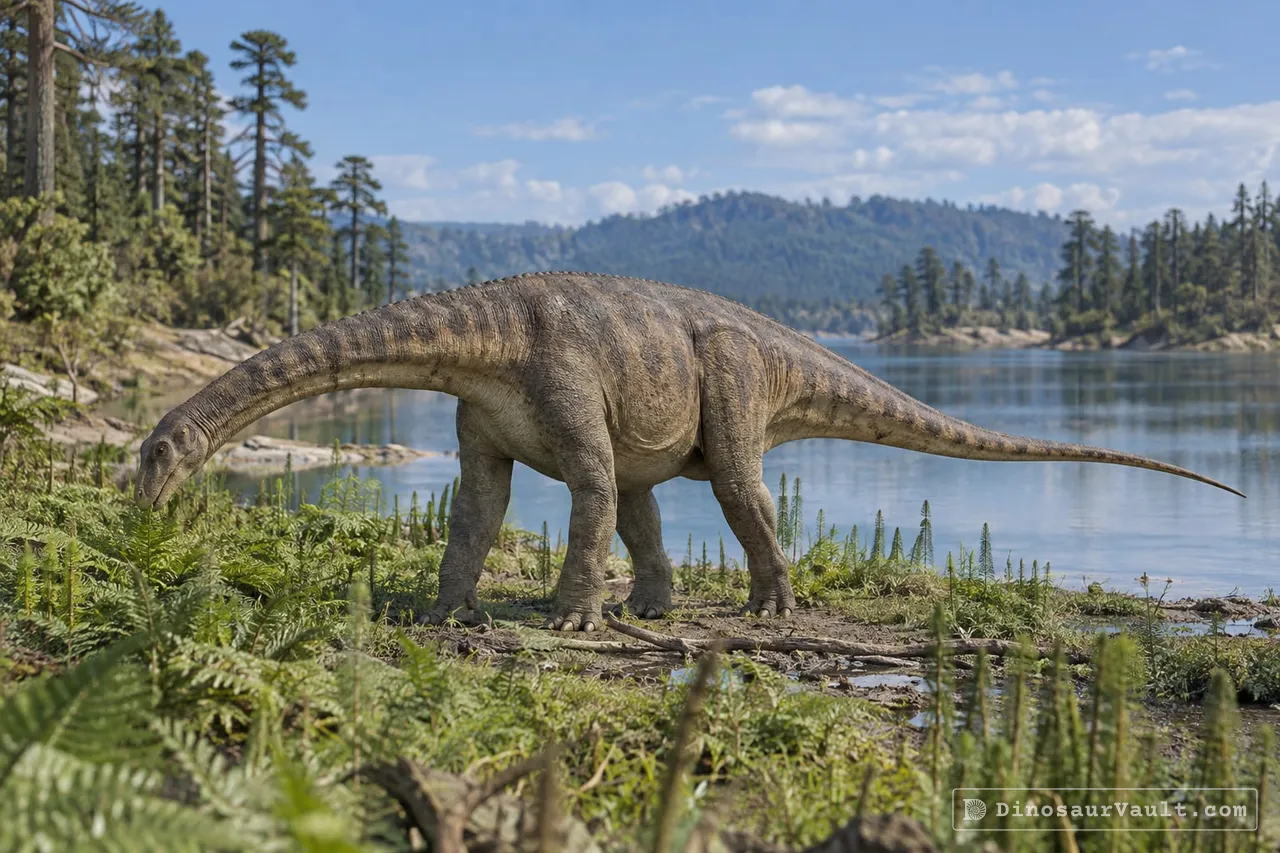
Sanpasaurus was an early sauropod, a long-necked plant eater. It is known from parts of the skeleton, and it was once mixed up with bones of an ornithopod.
Its world
It lived in the Early Jurassic, in what is now China. It comes from the Ziliujing Formation, where the sauropod Gongxianosaurus also lived.
How it was found
Young named Sanpasaurus in 1944. The type species is Sanpasaurus yaoi.
Field gallery
More views of Sanpasaurus
Scenes reconstructed from the available fossil evidence.
1 of 3
Lived alongside
Found in the same rock formations


A rock formation can hold fossils laid down millions of years apart, so not every animal here met Sanpasaurus.
The evidence
The science behind Sanpasaurus
Which parts of the picture come from its own bones, and which come from its relatives.
From its own fossils
- The bones that define Sanpasaurus are back vertebrae with thin, upright ridges on their sides.
- The original collection also contains shoulder, arm, tail and leg bones from several animals.
- An arm bone in the collection has a deep groove that helped hold the forearm bones together.
Borrowed from relatives
- Its missing skull and neck are restored from early sauropods such as Vulcanodon and Tazoudasaurus.
Still unknown
- Which of the other bones in the original collection belong to Sanpasaurus.
- Its adult size and the shape of its head.
- Its skin covering and color.
Discovery timeline
- 1944Named itYoung
- 2016RedescriptionMcPhee et al.
- 2020Family treePol et al.
Key papers
The research behind what we know of Sanpasaurus
Named it
Named Sanpasaurus from a collection of bones and originally interpreted it as an ornithopod.
On the Reptilian Remains from Weiyuan, Szechuan, China*. Bulletin of the Geological Society of China 24: 187-209
Read the paper : On the Reptilian Remains from Weiyuan, Szechuan, China* (opens in a new tab)Redescription
Identified Sanpasaurus as an early sauropod and restricted its defining specimen to diagnostic back vertebrae from a collection containing several animals.
A revision of Sanpasaurus yaoi Young, 1944 from the Early Jurassic of China, and its relevance to the early evolution of Sauropoda (Dinosauria). PeerJ 4: e2578
Read the paper : A revision of Sanpasaurus yaoi Young, 1944 from the Early Jurassic of China, and its relevance to the early evolution of Sauropoda (Dinosauria) (opens in a new tab)Family tree
Compared early sauropodomorph relationships and linked the spread of later sauropods to warming and changes in vegetation.
Extinction of herbivorous dinosaurs linked to Early Jurassic global warming event. Proceedings of the Royal Society B: Biological Sciences 287: 20202310
Read the paper : Extinction of herbivorous dinosaurs linked to Early Jurassic global warming event (opens in a new tab)
Close relatives
Other members of Sauropoda


Sources: Wikidata