Chakisaurus
"elder guanaco lizard"
Type species Chakisaurus nekul
- Lived
- Early Cretaceous
- Diet
- Herbivore
- Group
- Ornithopods
- Found in
- Argentina
- Named by
- Nogueira et al. 2024
Where its fossils were found
The evidence
Today

Habitat
It lived on land in Argentina, where flowering plants grew in the Huincul Formation landscape. Neighbors included Taurovenator, Ilokelesia and Huinculsaurus.
Field notes
About Chakisaurus
What it was like
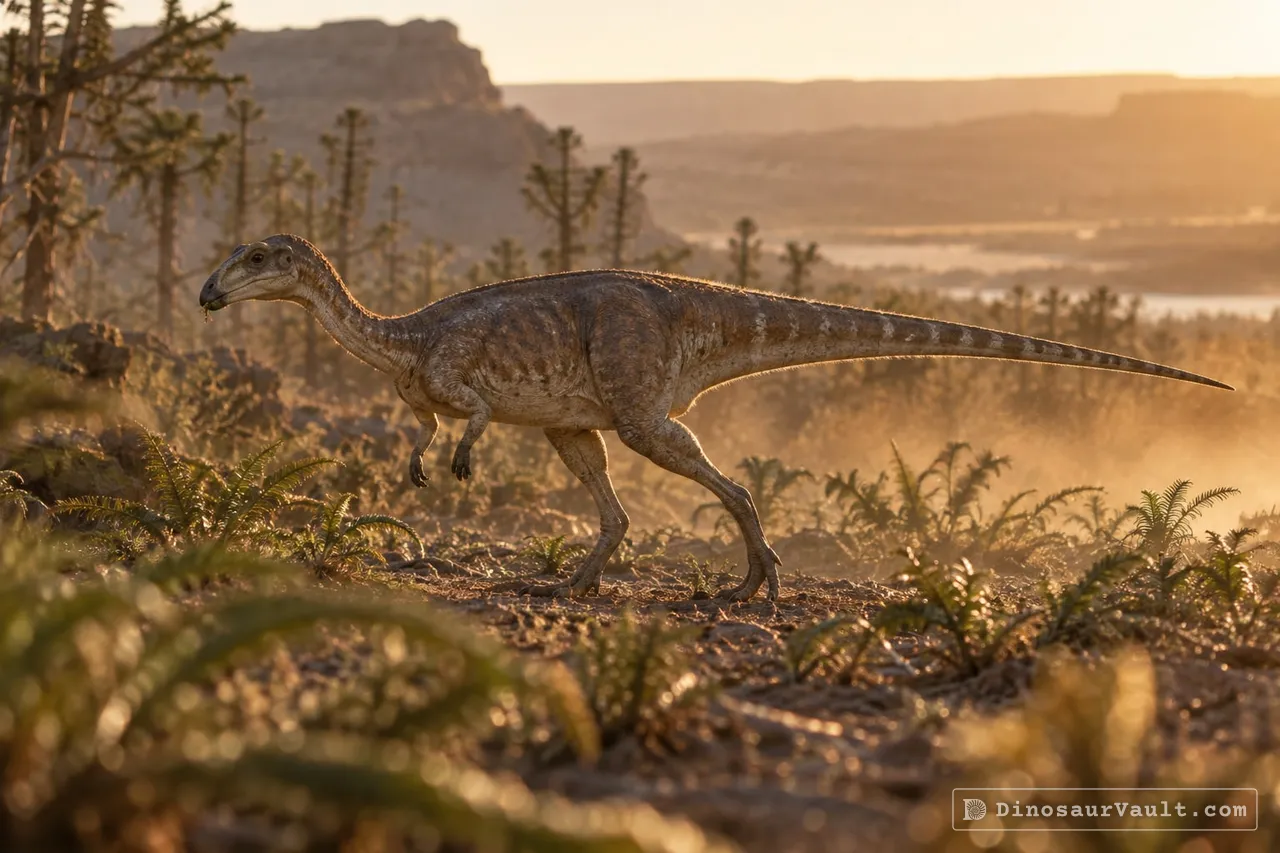
Chakisaurus was a small, two-legged plant eater, known from several partial skeletons of animals of different ages. It belonged to the elasmarians, a group of small plant eaters from the southern continents.
Its world
It lived in the Cretaceous in what is now Argentina. Its bones come from the Huincul Formation, where it shared the land with the giant Argentinosaurus and the hunters Mapusaurus, Meraxes and Skorpiovenator.
How it was found
Nogueira and colleagues named Chakisaurus in 2024. It was the first plant eater of its kind named from this formation.
Field gallery
More views of Chakisaurus
Scenes reconstructed from the available fossil evidence.
The evidence
The science behind Chakisaurus
Which parts of the picture come from its own bones, and which come from its relatives.
From its own fossils
- Partial skeletons include adults and young animals, with bones from the backbone and limbs.
- Its upper arm bone resembles those of small elasmarians such as Anabisetia and Notohypsilophodon.
- The tail bones suggest that the base of its tail curved downward and supported strong running muscles.
Borrowed from relatives
- The missing head can be restored by comparison with small plant eaters such as Gasparinisaura and Anabisetia.
- Talenkauen provides a comparison for the long neck found in other elasmarians.
Still unknown
- The shape of its skull and jaws.
- Its skin covering and color.
- Whether it lived in herds.
Discovery timeline
- 2001Its worldVallati
- 2019Close relativeRozadilla, Agnolín & Novas
- 2024Named itNogueira et al.
Key papers
The research behind what we know of Chakisaurus
Its world
Found that flowering plant pollen dominated a sample from the Huincul Formation, adding a view of its vegetation.
Middle cretaceous microflora from the huincul formation ("dinosaurian beds") in the neuquén basin, Patagonia, Argentina. Palynology 25: 179-197
Read the paper : Middle cretaceous microflora from the huincul formation ("dinosaurian beds") in the neuquén basin, Patagonia, Argentina (opens in a new tab)Close relative
Described Talenkauen in detail and found neck features shared by elasmarians, useful comparisons for restoring Chakisaurus.
Osteology of the Patagonian ornithopod Talenkauen santacrucensis (Dinosauria, Ornithischia). Journal of Systematic Palaeontology 17: 2043-2089
Read the paper : Osteology of the Patagonian ornithopod Talenkauen santacrucensis (Dinosauria, Ornithischia) (opens in a new tab)Named it
Described adult and juvenile skeletons and linked the unusual tail bones to a downward curve at the tail base and strong running muscles.
A new ornithopod from the Upper Cretaceous (Huincul Formation) of northwestern Patagonia, Argentina: Implications on elasmarian postcranial anatomy. Cretaceous Research 159: 105874
Read the paper : A new ornithopod from the Upper Cretaceous (Huincul Formation) of northwestern Patagonia, Argentina: Implications on elasmarian postcranial anatomy (opens in a new tab)
Close relatives
Other members of Elasmaria


Sources: Wikidata