Calamosaurus
"reed lizard"
Type species Calamosaurus foxi
- Lived
- 126 to 120 million years ago, Early Cretaceous
- Diet
- Carnivore
- Group
- Theropods
- Found in
- United Kingdom
- Named by
- Lydekker 1891
Where its fossils were found
The evidence
Today

125 million years ago
Habitat
It lived on a low plain crossed by rivers and dotted with lakes in what is now England. Plant eaters in these landscapes included Hypsilophodon and Iguanodon.
Field notes
About Calamosaurus
What it was like
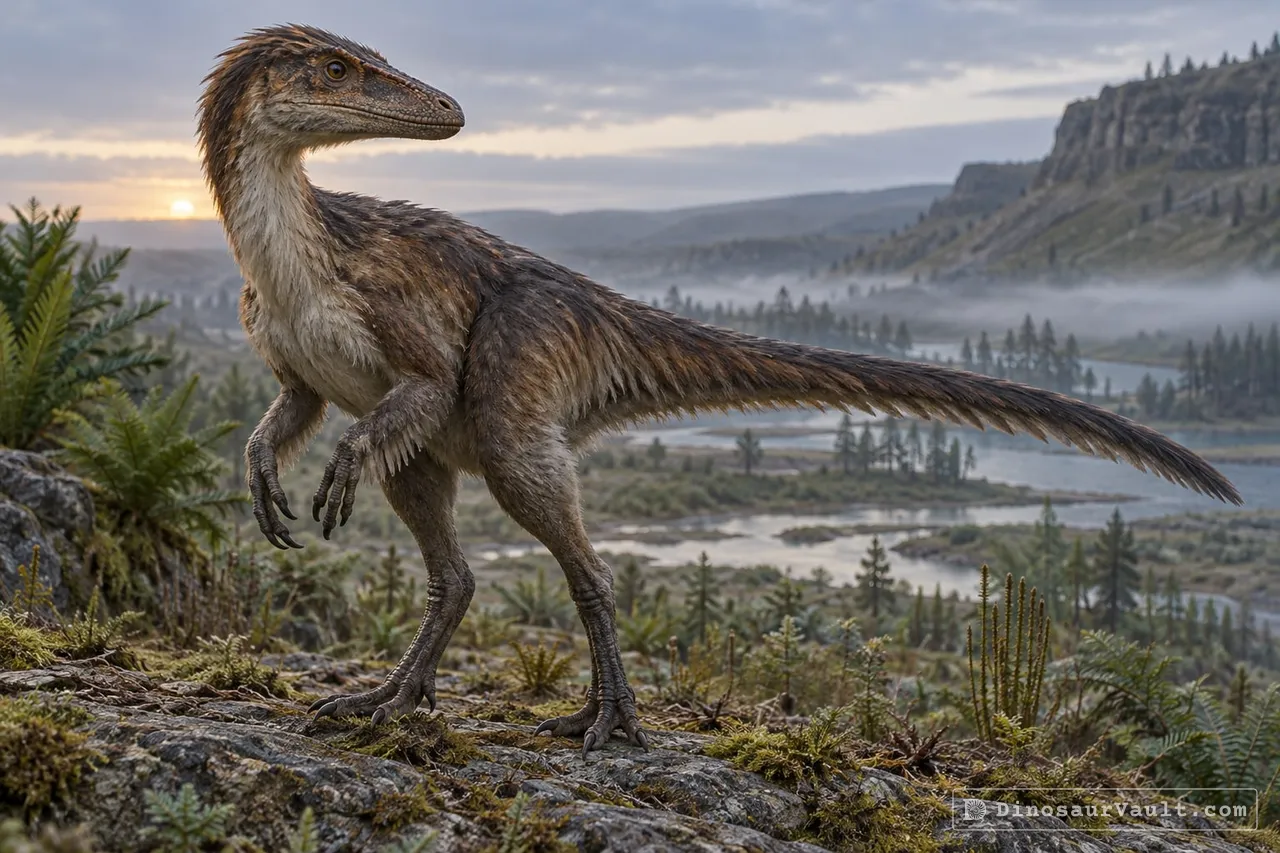
Calamosaurus was a small two-legged predator known only from two neck bones. They were light and slender, but they reveal little else about the animal.
Its world
It lived in the Early Cretaceous in what is now England.
How it was found
Lydekker named it in 1891. The type species is Calamosaurus foxi, which honors the collector who found the bones.
Field gallery
More views of Calamosaurus
Scenes reconstructed from the available fossil evidence.
The evidence
The science behind Calamosaurus
Which parts of the picture come from its own bones, and which come from its relatives.
From its own fossils
- Calamosaurus is securely known from two small neck vertebrae.
- The neck bones have openings for air sacs.
- The neck vertebrae have convex front ends and concave rear ends.
Borrowed from relatives
- Its missing skull, arms and legs are restored after Alnashetri, an early alvarezsauroid.
Still unknown
- The shape of its skull, arms and feet. Historic leg bones from the region are not assigned to it.
- Its exact place among the small theropods; a later study proposed alvarezsauroid relationships but found its position unstable.
- Its skin covering and color.
Discovery timeline
- 1889Full descriptionLydekker
- 1891Named itLydekker
- 1994Its worldINSOLE & HUTT
- 2022Same rocksNaish & Cau
- 2026Family treeMakovicky et al.
Key papers
The research behind what we know of Calamosaurus
Full description
Described the neck bones under the original genus name and compared the small dinosaur with Coelurus.
VIII.—On a Cœluroid Dinosaur from the Wealden. Geological Magazine 6: 119-121
Read the paper : VIII.—On a Cœluroid Dinosaur from the Wealden (opens in a new tab)Named it
Replaced an already used genus name with Calamosaurus for the small theropod represented by neck bones.
On certain Ornithosaurian and Dinosaurian Remains. Quarterly Journal of the Geological Society of London 47: 41-44
Read the paper : On certain Ornithosaurian and Dinosaurian Remains (opens in a new tab)Its world
Reconstructed a landscape of rivers, floodplains and lakes with seasonal water supplies and abundant plant-eating dinosaurs.
The palaeoecology of the dinosaurs of the Wessex Formation (Wealden Group, Early Cretaceous), Isle of Wight, Southern England. Zoological Journal of the Linnean Society 112: 197-215
Read the paper : The palaeoecology of the dinosaurs of the Wessex Formation (Wealden Group, Early Cretaceous), Isle of Wight, Southern England (opens in a new tab)Same rocks
Distinguished the neck bones of Calamosaurus from Eotyrannus and left historical leg bones from the region unassigned.
The osteology and affinities of Eotyrannus lengi , a tyrannosauroid theropod from the Wealden Supergroup of southern England. PeerJ 10: e12727
Read the paper : The osteology and affinities of Eotyrannus lengi , a tyrannosauroid theropod from the Wealden Supergroup of southern England (opens in a new tab)Family tree
Redescribed the neck bones as resembling those of alvarezsauroids, while its place in the family tree stays unstable.
Argentine fossil rewrites evolutionary history of a baffling dinosaur clade. Nature 652: 1240-1244
Read the paper : Argentine fossil rewrites evolutionary history of a baffling dinosaur clade (opens in a new tab)
Close relatives
Other members of Tyrannosauroidea


Sources: Wikidata