Banji
"striped crest"
- Lived
- 72 to 66 million years ago, Late Cretaceous
- Diet
- Omnivore
- Group
- Theropods, Oviraptoridae
- Found in
- China
- Named by
- Xu and Han 2010
Where its fossils were found
The evidence
Today

70 million years ago
Habitat
It lived in southern China, in a landscape where sand and mud accumulated. Other dinosaurs from the region include Huanansaurus, Gannansaurus and Qianzhousaurus.
Field notes
About Banji
What it was like
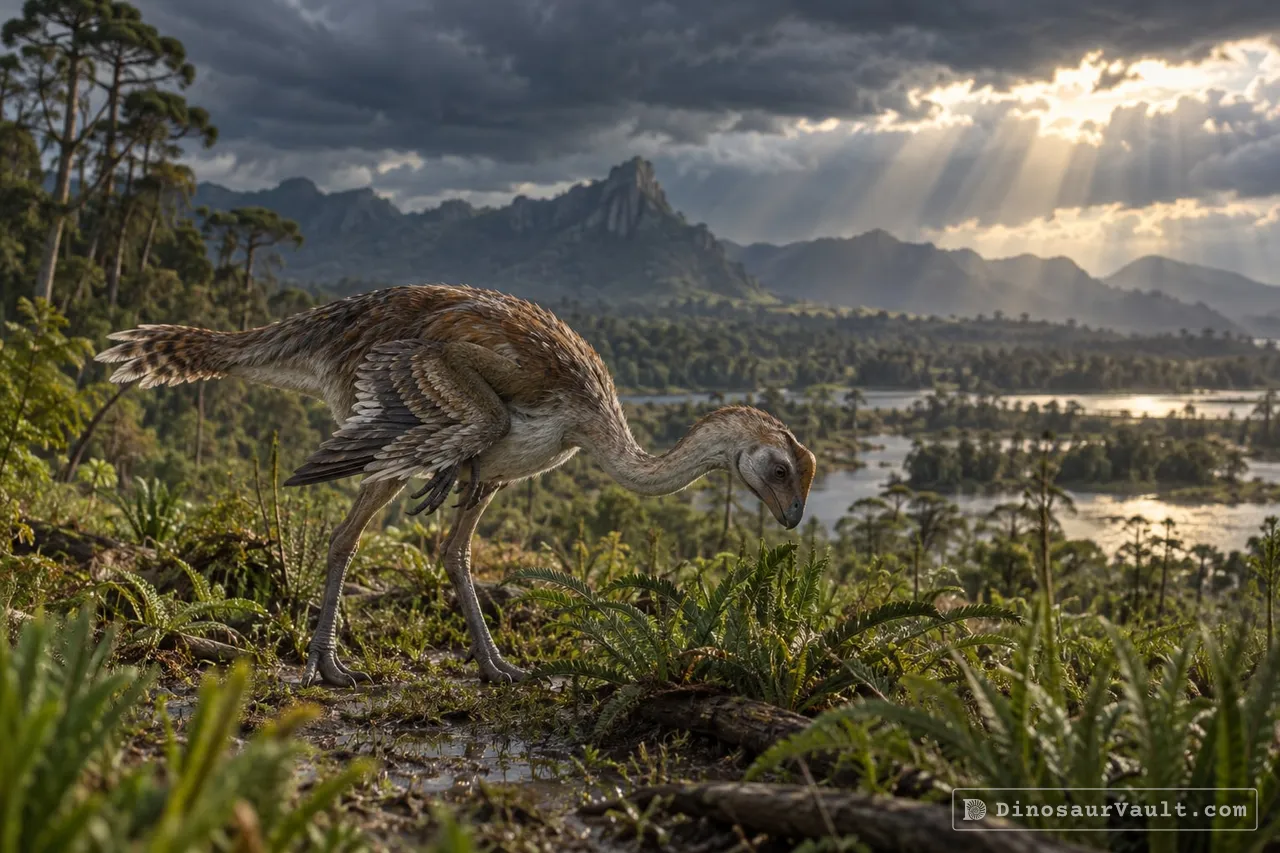
Banji was a small oviraptorid, a toothless, feathered theropod. It is known from a skull of a young animal, with a crest marked by grooves.
Its world
It lived about 72 to 66 million years ago, at the end of the Late Cretaceous, in what is now southern China.
How it was found
Xu and Han named Banji in 2010.
Field gallery
More views of Banji
Scenes reconstructed from the available fossil evidence.
1 of 3
The evidence
The science behind Banji
Which parts of the picture come from its own bones, and which come from its relatives.
From its own fossils
- A nearly complete skull and lower jaw preserve a short snout and strong, toothless jaws.
- The bony crest carries grooves and slanting ridges along its sides.
- The long nasal opening extends back close to the eye socket.
Borrowed from relatives
- Its neck, limbs and tail are restored from better-preserved oviraptorids such as Corythoraptor.
Still unknown
- Its adult size and crest shape.
- Its color and exact diet.
- Whether Banji and Corythoraptor are young and adult forms of the same dinosaur.
Discovery timeline
- 2010Named itXu & Han
- 2015Same rocksLü et al.
- 2017Close relativeLü et al.
Key papers
The research behind what we know of Banji
Named it
Described the grooved crest and long nasal opening of a young oviraptorid, naming it Banji.
A new oviraptorid dinosaur (Theropoda: Oviraptorosauria) from the Upper Cretaceous of China. Vertebrata PalAsiatica 48: 11-18
No link available
Same rocks
Named Huanansaurus and compared its skull with Banji and other oviraptorids, showing the variety of these dinosaurs in southern China.
A New Oviraptorid Dinosaur (Dinosauria: Oviraptorosauria) from the Late Cretaceous of Southern China and Its Paleobiogeographical Implications. Scientific Reports 5
Read the paper : A New Oviraptorid Dinosaur (Dinosauria: Oviraptorosauria) from the Late Cretaceous of Southern China and Its Paleobiogeographical Implications (opens in a new tab)Close relative
Described Corythoraptor, an oviraptorid with a tall crest and a well-preserved body, and studied its growth from bone tissue.
High diversity of the Ganzhou Oviraptorid Fauna increased by a new “cassowary-like” crested species. Scientific Reports 7
Read the paper : High diversity of the Ganzhou Oviraptorid Fauna increased by a new “cassowary-like” crested species (opens in a new tab)
Close relatives
Other members of Oviraptoridae


Sources: Wikidata